Media faculty, students present research at 2024 International Communication Association conference


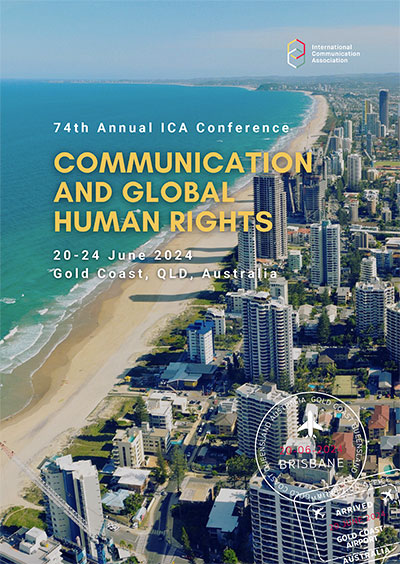
Faculty, graduate students, and recent alumni from the College of Media co-presented 16 topics of research at the 74th annual International Communication Association Conference—the largest academic conference for communication scholars—on June 20-24, 2024, in Gold Coast, Queensland, Australia. The ICA aims to advance the scholarly study of human communication by encouraging and facilitating excellence in academic research worldwide. 

ICA Conference Cover

This year’s conference theme addressed “Communication and Global Human Rights.” Media presenters included faculty in the Institute of Communications Research, the Charles H. Sandage Department of Advertising, and the Department of Journalism; graduate students in the MS Advertising program; and doctoral students in the Institute of Communications Research PhD program. 

Media research presenters and presentations are listed below. (Note: Presenters/authors from other units or institutions are not included. Please see the ICA conference program for full author listings.)

Theme: Environmental Risk and Science Communication
“Satire and Perceived Trustworthiness in Communicating About Renewable Energy”

  • Leona Yi-Fan Su, Assistant Professor, Advertising and ICR
  • Jennifer Shiyue Zhang, ICR student

Theme: Crisis Communication
“Public Engagement in an Era of Misinformation: Examining Corporate Responsible and Ethical Communication on Twitter”

Yanbo Li, ICR student

Theme: Continuing Effects and Practice of Stereotypes in Intercultural Communication
“Effects of Chinese Female Images in Controversial Advertisements on Audience Attitudes and Purchase Intention”

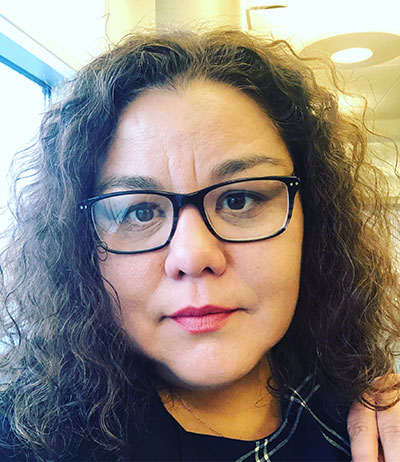
  • Ruiheng (Rachel) Sun, MS Advertising student (pictured below)
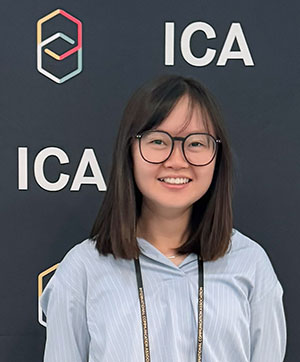
Rachel Sun
Rachel Sun

Theme: Hello Chatbot! Can We Talk?
“How Conversational-Agent Modality Affects Charitable Behavioral Intentions: The Roles of Communication Style and Anthropomorphism”

Theme: Stigma, Infodemic, and Social Media
“Unmasking the COVID-19 Infodemic: An In-Depth Examination of Information Dissemination and Misinformation Propagation on Twitter During the COVID-19 Pandemic”

Theme: Information Systems and Health Communication
“Combating Optimistic Bias: Evaluating the Role of Self-Focused Augmented Reality in Enhancing E-Cigarette Risk Perception Among Users”

  • Lizi Ma, MS Advertising alum (December ’23)

Theme: Information Systems and Health Communication
“Understanding (Counter-) Persuasive Effects of Personalized Health Messages Through Psychological Reactance Theory: Privacy Intrusion as a Freedom Threat”

Theme: Journalistic Acts on Social Media
“The Journalists’ Exodus: Navigating the Transition From Twitter to Other Alternative Platforms”

Theme: Navigating New Visibility That’s Feline Perplexing: Examining Emerging Dynamics around Data and Disclosure
“A Picture Is Worth a Thousand Doubts: The Counterintuitive Impact of Chat Log Screenshots”

Theme: Information Systems and Persuasive Effects
“Recall or Perception? Social Media Engagement Metrics, Perceived Social Endorsement, and Perceptions of Message Credibility”

Theme: Global Communication: Marco and Micro Perspectives
“Relational Surveillance Through Alipay Within the Localized Chinese Context”

  • Ran Ju, ICR alum (PhD ’23)

Theme: Information Systems and AI
“Playing Hide and Seek With Algorithms: Investigating Digital Media Users’ Algorithm Refinement Behavior”

  • Ewa Maslowska, Associate Professor, Advertising and ICR
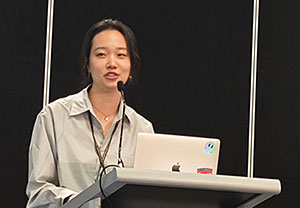
  • Jiwon Oh, ICR student
  • Jiyeon Chang, ICR student

Theme: Algorithms, Social Media and Online Engagement
“Analyzing the Political Leanings of YouTube Recommendations in Brazil: A Network-Based Approach Using YouTube Audience on Twitter”

Theme: Information Systems and Methodological Considerations, Science, and Climate
“Extending Message Framing to Virtual Space: An Experimental Study on the Impact of Self-Focused vs. Non-Self-Focused AR Embodiments on Vaping Risk Perceptions”

  • Mike Yao, Professor and Director of ICR, Advertising and ICR

Theme: Information Systems at Work
“Targeting Against Disinformation: The Effect of Microtargeted Corrections on the Impact of Fake News”

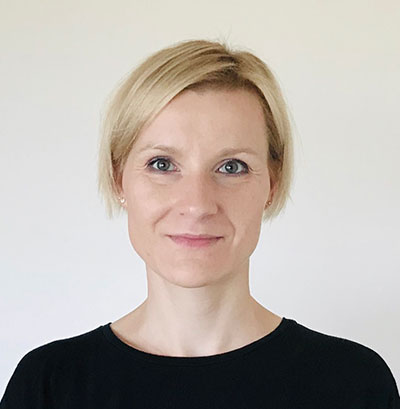
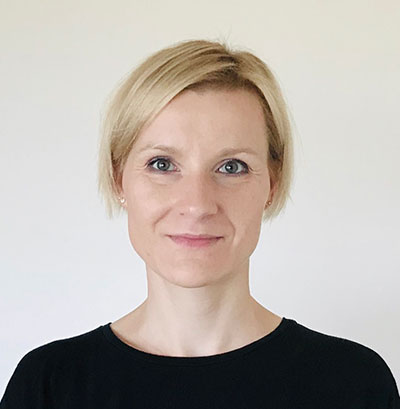
Melodie Zhao
Melodie Zhao

Theme: Information Systems in the Social Context
“Unraveling the Impact of User-Generated Content and Producer-Generated Content on K-Pop Fan Identity and Motivations”

  • Zixuan (Melodie) Zhao, ICR student (pictured at right)

Share on social
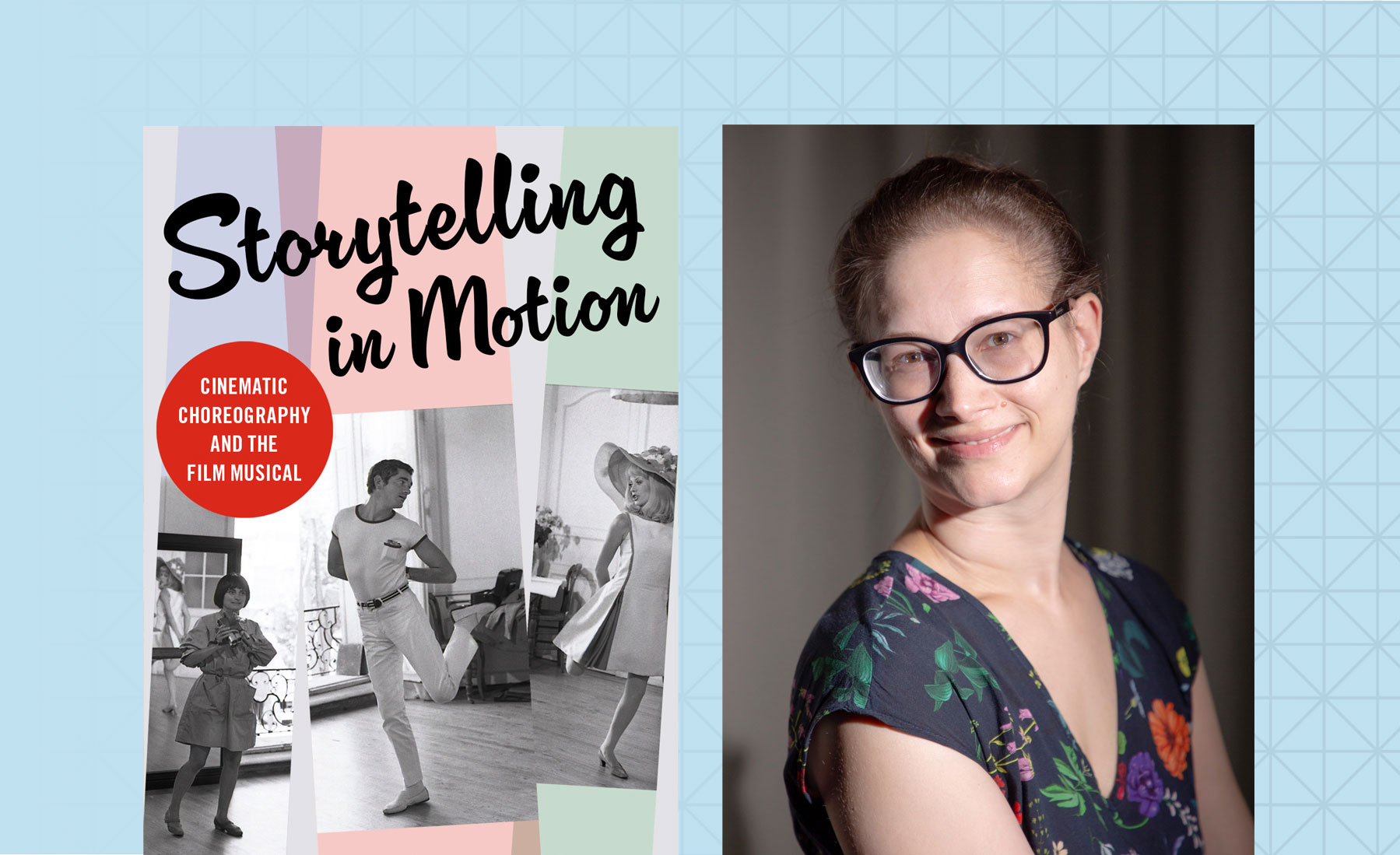
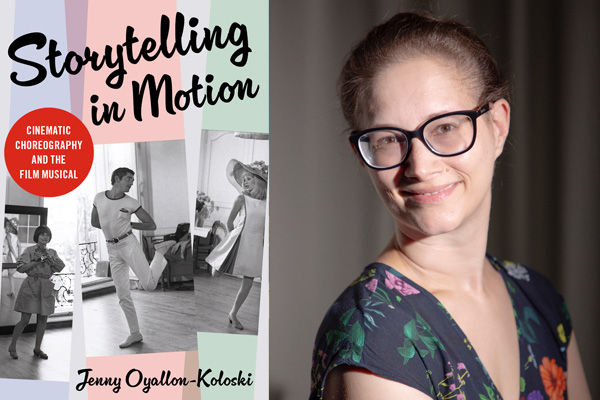
Jenny Oyallon-Koloski considers the power of movement in film in her first book: ‘Storytelling in Motion’


Three vertical mirrors hang on the wall in the office of Jenny Oyallon-Koloski, assistant professor of media and cinema studies, where she keeps an open area that allows her the space to move. 

Jenny Oyallon-Koloski and new book

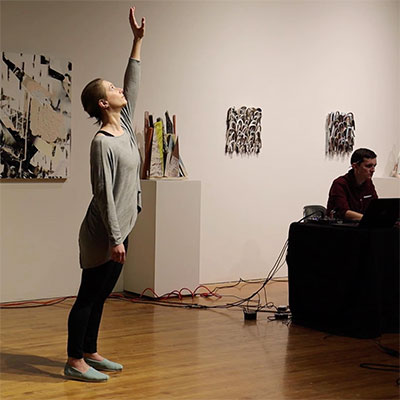
As a certified movement analyst and director of the movement visualization (mv) lab, she wants the space to serve as a research environment where she can use motion-capturing technology to study the manifestations of human movement in cinematic space.

Her extensive research on how figure movement and dance create meaning in musical cinema is the subject of her first book, Storytelling in Motion: Cinematic Choreography and the Film Musical (Oxford University Press), which will be available May 17. 

Oyallon-Koloski’s idea for the book came out of her dissertation project, which tied her interest in dance and movement into her core work in film and film history. 

While her dissertation focused mainly on French filmmaker Jacques Demy, using his films as case studies, her book discusses broader ideas of how people can understand the significance of dance in film. 

“That’s one of the core questions [in the book]—how do filmmakers use movement to tell stories, and specifically in the musical genre,” she said.

Her book also compares French and American film production histories and considers the impact of time, money, and rehearsal space available to filmmakers. 

“What I found was really interesting between French and American musicals is Hollywood had a symbiotic relationship with Broadway, and those industries or artistic sectors kind of grew together. So there was all this culture around dance and musicals, at least in the Hollywood system. But in France, those artistic sectors were really separate,” she said.

That’s one of the core questions [in the book]—how do filmmakers use movement to tell stories, and specifically in the musical genre?

Oyallon-Koloski discovered an interest in dance and movement in college. While doing her dissertation research, she became a certified movement analyst at the Laban/Bartenieff Institute of Movement Studies in New York, an educational and research center that trains people in the language of movement. 

Oyallon-Koloski movement lab

“I was taking dance classes, but I wasn’t getting a specific degree in dance and I really wanted to be able to have credibility with the dance community,” she said. 

Oyallon-Koloski spent two years studying the Laban system—a method and language describing, visualizing, interpreting, and documenting human movement invented by Rudolf von Laban in the 1920s—alongside a wide range of students with interests in dance, therapy, academic research, and more. 

Using never-before-published interviews with filmmakers and choreographers, she applies the principles from the Laban/Bartenieff Movement Studies to analyze the impact of figure movement in cinema. 

Oyallon-Koloski also created three video essays to accompany her written chapters: Seeing Movement in Cinema: An Introduction to Laban Movement Analysis; Endless Conversations: Reflexive Musical Clusters; and Diegetic Flutters: Views from the bridge, which was accepted to the international Marienbad Film Festival to be held in the Czech Republic this June. 

Movement visualizations
Visualizations of movement traceforms from the mv lab.

Making video essays is one of Oyallon-Koloski’s course specialties, as well as digital media production, contemporary movies, and cinema theory. 

Although she doesn’t consider videographic criticism a substitute for writing, Oyallon-Koloski does believe audiovisual context is a way to help generate interest in films, particularly those people have rarely seen.

Oyallon-Koloski, a dual American-French citizen who speaks fluent French and lived in France her senior year of high school, says her familiarity with the culture enabled her to write a book about dance in French cinema, which some might consider a fringe topic.

After completing Storytelling in Motion, Oyallon-Koloski says she realized she still has more to say on the subject of French cinema.

“I think my next project will probably be about [Jacques] Demy and his filmography. He made about 13 films, so [the book would be] less focused on dance and movement and more film history and style,” she said. “I like working with archival collections … and I like the interplay between French cinema and international cinema.” 

Share on social
Media students present at 2024 Undergraduate Research Symposium


Undergraduate Research Symposium

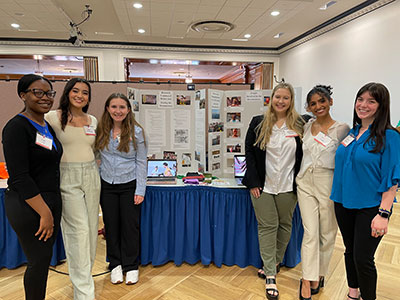
Update June 4, 2024: Congratulations to the students who presented “Exploring Period Poverty in Sierra Leone” (pictured below) for receiving an award for Outstanding Exhibit at the Undergraduate Research Symposium from the Office of Undergraduate Research! Learn more about their trip to Sierra Leone.


Students from the College of Media are participating in the annual University of Illinois Undergraduate Research Week, held April 21-27. The Undergraduate Research Symposium, the signature event held on April 24 at the Illini Union, features presentations, posters, and performances from students across campus. 

Media student presentations include:

Sierra Leone group presentation

On Exhibit: Robots & Medical Technology
“Exploring Period Poverty in Sierra Leone” 

  • Faith Lee, junior in journalism
  • Piper Pascarella, sophomore in journalism
  • Maggie Knutte, junior in journalism
  • Stephanie Wayda, senior in journalism
  • Nour Longi, junior, journalism
  • Elena Cleary, junior in agricultural communications (College of ACES)
  • Research Mentors: Alison Davis and Charles “Stretch” Ledford, Department of Journalism
     
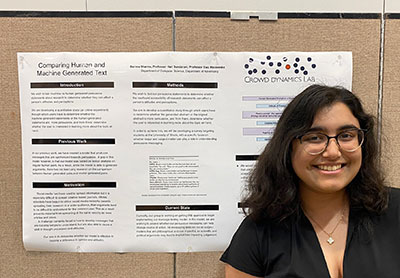
Garima Sharma

CS Student Ambassadors/Research Scholars
Illinois Scholars Undergraduate Research Program Research Expo
“Comparing Human Generated Text with Machine Generated Text”
Garima Sharma, senior in CS + advertising
 

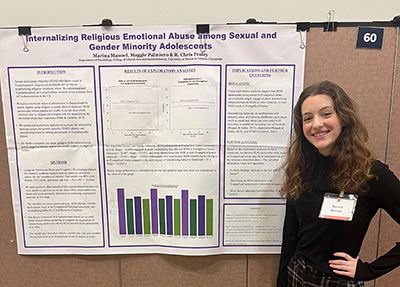
Marina Manuel

Poster Presentation: Social Science & Human Behavior 
“Mental Health and Wellbeing Outcomes among Gender and Sexuality Diverse Individuals Raised in Fundamentalist Religious Environments: Exploratory Analyses and Study Design”
Marina Manuel, senior in media and cinema studies
Research Mentor(s): Chris Fraley and Maggie Palmiero, Department of Psychology (College of LAS)

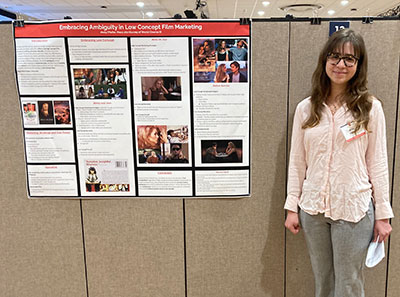
Pfeifer

Jenny Oyallon-Koloski, assistant professor of media and cinema studies, was the research mentor for Molly Pfeifer, senior in psychology (College of LAS) and cinema studies minor, who is presenting “Embracing Ambiguity in Low Concept Film Marketing” as part of the Humanities, Arts & Social Sciences poster presentations. 

View the Undergraduate Research Week program.

Advertising and ICR faculty and graduate students recognized at 2024 AAA conference


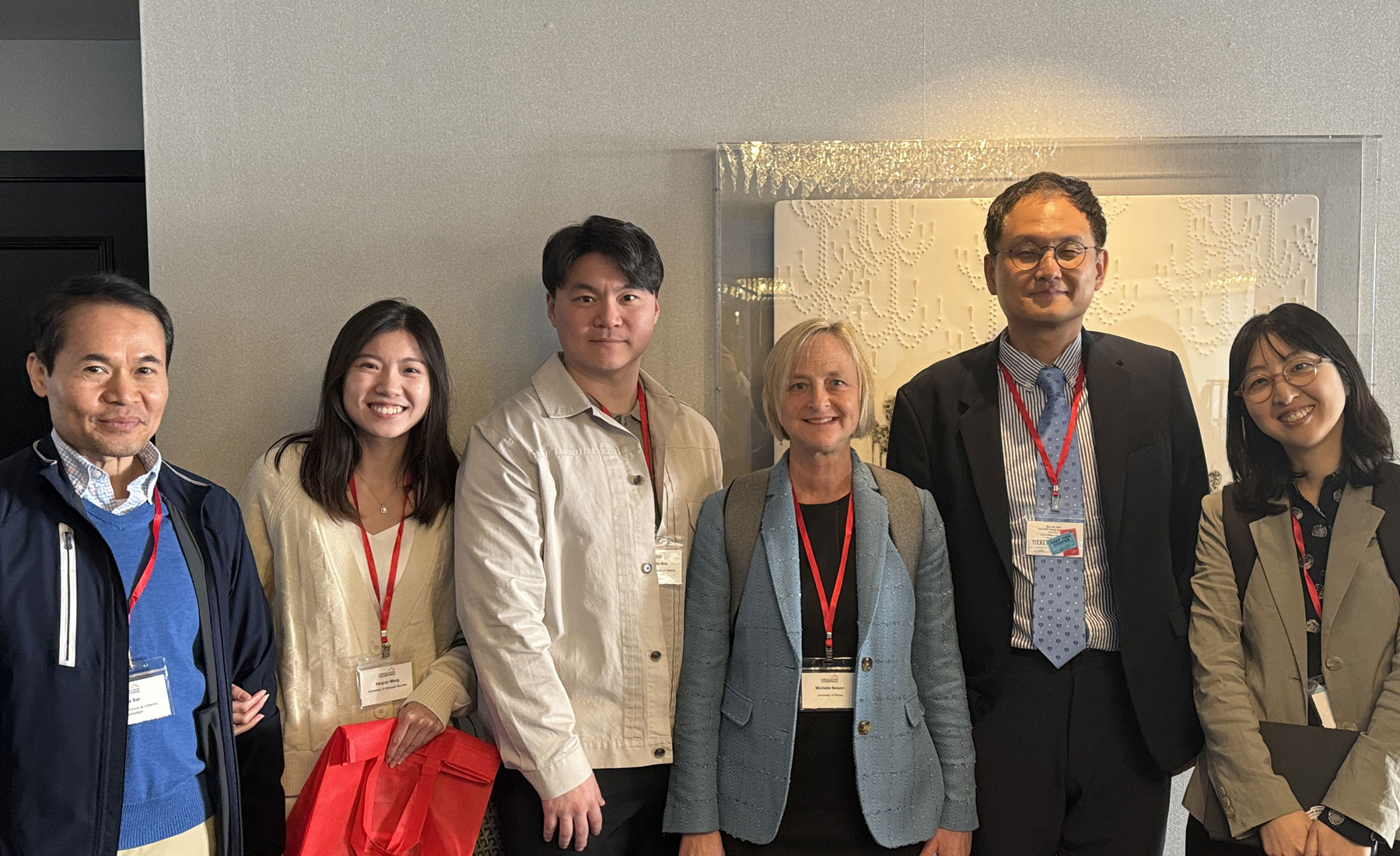
AAA group of faculty and students

Faculty and graduate students in the Charles H. Sandage Department of Advertising and Institute of Communications Research were honored with awards and presented research at the annual conference of the American Academy of Advertising, held March 14-17, 2024, in Portland, Oregon. 

Nelson AAA award

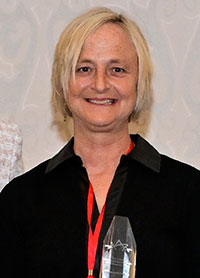
Professor Michelle Nelson, head of the Charles H. Sandage Department of Advertising, won AAA’s Career Award, the Ivan L. Preston Outstanding Contribution to Research on Advertising Award. As AAA’s top research award, this is designed to honor an individual who has made an outstanding contribution to the discipline of advertising through a systematic and sustained program of published research. The award carries a $1,000 prize. This award is given only to active AAA members for exemplary research on advertising across 20 years or more. 

Chang-Dae Ham, associate professor of advertising and associate head of graduate studies, was elected vice president of AAA and began his term on the executive committee.

Kevin Wise, professor of advertising, was appointed head of AAA’s graduate student committee. 

ICR student WooJin Kim (Advisor: Chang-Dae Ham) won a doctoral dissertation competition award for “When Humans Anthropomorphize Nonhumans: Examining the Role of AI Interactivity and Human Motivations.” Floria Yujin Lee, a graduate student in advertising, won a travel fellowship award. 

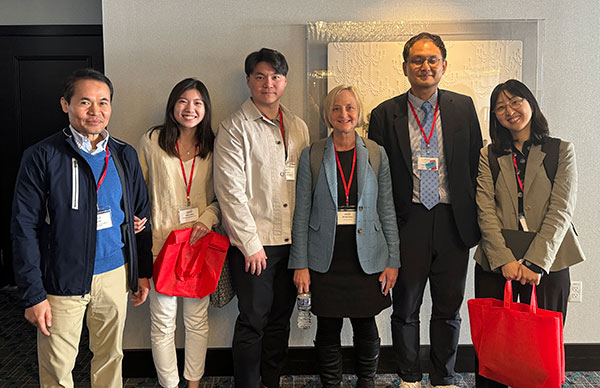
(Pictured at top: Professors Sela Sar at left, Michelle Nelson in center, and Chang-Dae Ham at right at the conference with graduate students.)

Presentations

Pre-Conference Panel Session: “How to Develop a Successful Journal Submission: Advice from Editors and Leading Experts” – with presentation “Best practices for experimental studies” by Sela Sar, professor of advertising

Special Session: “Stepping out of the Ivory Tower: Engaged Research & Teaching in Advertising” led by Professor Michelle Nelson

Research paper presentations: 

AAA students present
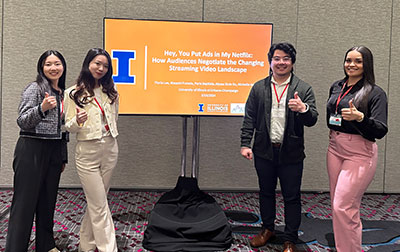
“Hey, You Put Ads in My Netflix: How Audiences Negotiate the Changing Streaming Video Landscape”
Floria Yujin Lee (MS Advertising), Masashi Fukada (MS Advertising), Paris Baptiste (MS Advertising), Xinle Du (MS Advertising); Professor Michelle Nelson 

“Exploring Motivation to Follow Virtual Influencers (VIs): The Role of Emotional Attachment as a Mechanism for Generating Positive Effects in VI-Endorsed Advertising”
Professor Chang-Dae Ham and Seo Jeong Heo (ICR) 

“When Lonely Hearts Meet Talkative Artificial Intelligence (AI) Chatbot: Exploring the Role of AI Interactivity in Sociality Motivation in the Context of AI-Powered Advertising”
WooJin Kim (ICR), Professor Chang-Dae Ham, Dongchan Lee (Northwestern University), Se Il Park (ICR), Seo Jeong Heo (ICR), Floria Yujin Lee (MS Advertising) 

Michelle and Regina with alpaca and llama

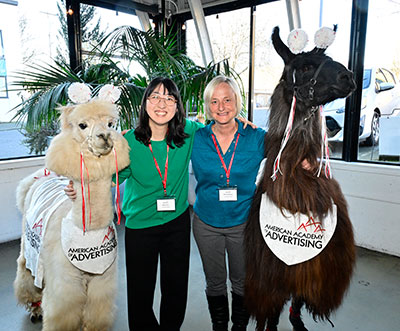
(Pictured above: Alumna Regina Ahn (MS ’14, advertising; PhD ’19, ICR) and Professor Michelle Nelson met a llama and alpaca during the AAA conference.)

See more photos from the conference.


Derek Long takes on history of Hollywood film distribution in his first book, ‘Playing the Percentages’


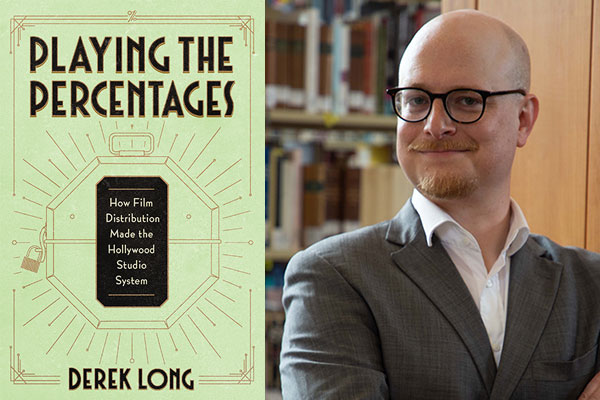
Derek Long, assistant professor of media and cinema studies, sheds light on a rarely covered piece of Hollywood history in his first book, Playing the Percentages: How Film Distribution Made the Hollywood Studio System.

Derek Long publishes book

Praised as “invaluable to media industry scholars of the past and present,” the book is a comprehensive history of film distribution in the United States during the silent era that illustrates the importance of power struggles between distributors and exhibitors over booking, pricing, and playing time (i.e., how long it stays in theaters).

“When people think about Hollywood as an industry, maybe they think about the more glamorous aspects of it like stars, producers, or figures in Hollywood,” Long said. “But I was interested in how Hollywood came to be an industrial institution and the history of that, particularly in the silent era.”

Playing the Percentages, set for release on April 16, considers the economic history of the industry’s film distribution process from 1910 through 1930, including booking, circuiting, and packaging marketing practices.

While many Hollywood histories focus on linear narratives such as industry growth and improvements in technology, Long said there was a “hole in the scholarship” regarding the various ways films were distributed, sold, or marketed. 

“That was a story nobody had really told, at least in an American context, and so I wanted to fill that gap,” he said. 

Long didn’t begin writing Playing the Percentages until 2017, but the project developed out of his dissertation over a decade ago. 

Previous histories basically think about distribution as a mechanism or industrially organized system of shipping films out when there’s a lot more to it than that.

In addition to using digital libraries, Long conducted extensive archival research across the country, visiting the Margaret Herrick Library in California, which is the archives and repository of the Academy of Motion Picture Arts and Sciences; the Warner Brothers Archives at University of Southern California; the Library of Congress in Washington, D.C.; the New York Public Library; the Shubert Archives in New York; and the Harry Ransom Center at the University of Texas.

After months of research, Long said it became apparent that developing the system of film distribution was not a straight line and his book highlights those crucial changes in the system brought about by live theater, the rise of longer feature-length films, and the transition to sound. 

“Previous histories basically think about distribution as a mechanism or industrially organized system of shipping films out when there’s a lot more to it than that,” Long said. “Actually, the history of building that system is part and parcel of the history of Hollywood as an industry, and how it came to be so powerful, particularly in the 1930s and ’40s.” 

Long, whose course specialties include film history, media distribution, and digital tools and historiography, has incorporated his research discoveries into his lectures on classical Hollywood and how distribution works. 

In addition to teaching and writing, Long is also the creator and developer of Early Cinema History Online, a filmographic database of credits for over 35,000 early American films. The searchable archive, which serves as a reference tool for scholars, features credits for titles released in the United States from 1908 through 1920. 

He also organizes the annual MACS Student Showcase, screening student work that has been produced in MACS classes throughout the academic year. This year’s showcase will be held on Saturday, May 4, at the Spurlock Museum.

Long is already thinking about a sequel to his first book, which would look at film distribution relationships in the 1930s and ’40s, including how race was a factor.  

“I want to look at alternative systems of distribution, particularly for race cinemas, films specifically for African American audiences,” Long said. “That was essentially a completely segregated and different form of distribution.”

In the meantime, Long is enjoying the feeling of accomplishment after completing his first book.

“It’s very exciting to see your book in print for the first time,” Long said. “Especially when you’ve been working on it for so long.”

Long’s book, Playing the Percentages, will be available on April 16; use code UTXM25 for a discounted price.

Share on social
How will generative artificial intelligence affect political advertising in 2024?


Michelle Nelson
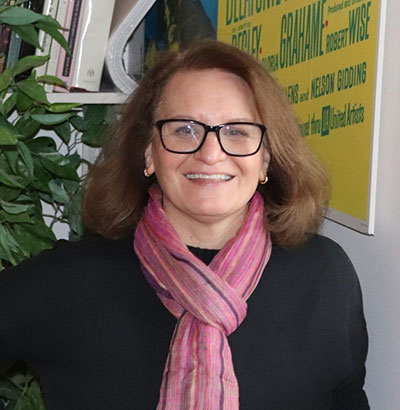
Michelle Nelson, professor and head of the Charles H. Sandage Department of Advertising, says voters should expect to see a lot more generative AI in political ads during the 2024 election cycle, warning that it might be difficult-to-impossible to tell what’s real and what’s fake. (Photo by L. Brian Stauffer.)

It’s estimated that $12 billion will be spent on political ads this election cycle—30% more than in 2020. The sheer volume of ads is remarkable, and there is vast potential to use this political information to contribute to democracy: to reach more potential voters and provide accurate information. There’s also more potential than ever for generative artificial intelligence to misrepresent candidates and policies, leading to confusion in the voting booth. News Bureau editor Lois Yoksoulian spoke with advertising professor and department head Michelle Nelson about the topic.

How is AI used in political ads, and what are some recent examples of AI-generated political ads?

After President Joe Biden announced his re-election bid, the Republican National Committee released an AI-generated political advertisement that depicted a dystopian world should Biden be re-elected. The video ad features a number of “what if” questions (e.g., What if crime worsens?) with AI-generated images. This is a classic fear appeal-negative attack ad. Emotional ads reach us, and we remember them—like the famous Daisy political ad used during the 1964 election cycle or the Willie Horton ad used in 1988. But they may also get some backlash for being too negative, too manipulative, especially because they are using AI.

Some say the Joe Biden RNC ad is the first AI-generated ad, but it’s hard to prove. However, in the top left corner of the ad, you see a disclosure in a small font: “Built entirely with AI imagery.” The video description on the GOP’s YouTube page says, “An AI-generated look into the country’s possible future if Joe Biden is re-elected in 2024.” So they are not hiding the use of AI. There’s also a spoof ad that ran on The Daily Show, which uses an AI-generated voiceover for Biden. It’s pretty easy these days to use AI tools to create content and make it look pretty real.

Are the entities behind these types of ads required to disclose that AI has been used?

The Federal Election Commission, the governmental body that regulates political communication, including advertising in the U.S., sought public comments on amending a regulation related to the use of deliberately deceptive AI in campaign ads at their meeting titled 2023: REG 2023-02 Artificial Intelligence in Campaign Ads. They have not yet made a ruling here. However, states such as California, Texas, Michigan, Washington, and Minnesota have enacted new state laws where any deepfake AI images, video, or audio need to be labeled in. A similar law is being discussed here in Illinois. It’s not clear how these state laws relate to the Constitution.

Some tech companies have started requiring disclosures. For example, Google indicated that all AI-generated political ads shown on YouTube or other Google platforms “that alter people or events” must have a prominent disclosure. There is also a verification process for political ads in some regions.

Microsoft has started their “Content Credentials as a Service” which is like a watermarking tool—it lets users digitally sign and authenticate the media—whether it’s an image or video through their Coalition for Content Provenance and Authenticity. The idea is that the watermark serves as metadata so users can see the history of the content. For example, “how, when, and by whom the content was created or edited,” whether by a person or AI. This information stays with the content so anyone can see the origin.

To what extent AI-generated political content is now being watermarked or disclosed I have no idea. It seems difficult to police all of these images at this moment in time.

What is the potential harm of using AI in political ads? 

The concerns for harm relate to possibilities for deepfakes and disinformation. Others can re-create something using AI voice or images without authorization to create stories and content that are absolutely untrue.

We’ve had tools and technology in the past, like Photoshop to manipulate existing images. Do you remember the 2004 ads featuring altered photos depicting John Kerry, the Democratic nominee for president, and Jane Fonda at an anti-Vietnam War rally? Ads are regularly embellished or altered: The colors or lighting are changed to make people look ominous or more youthful. But this is different. This is a whole new level. Anyone can make AI messages using free tools such as Open AI’s ChatGPT or Google’s Bard. This may be good when used responsibly, or it may be harmful.

Our research shows that many people don’t know that the First Amendment protects political advertising in the U.S. Political advertising is not held up to the same standards as commercial advertising, say for a cheeseburger. The Truth-in-Advertising laws by the Federal Trade Commission do not apply to political ads. That means political ads can legally be deceptive or lie. Of course, there are libel laws, but they are rarely used in this arena.

Beyond this regulatory difference in commercial and political advertising, the idea is that we want free-flowing political information to contribute to a dialogue that can enhance our democracy. Too much regulation can have a chilling effect on political speech. Yet the potential today with AI to lie and deceive and to deploy these messages in a personalized manner and at a grand scale offers a challenge perhaps to our thinking about regulation and political advertising.

Do you have any advice on how consumers can spot the use of generative AI in political ads?

They can’t. You can look for irregularities like the number of legs on the cat. But it is getting harder and harder to tell if AI makes an image or video. Whether it’s Taylor Swift, an image of Trump in jail, or a funny meme, we can’t always tell, especially as we scroll through our social media feeds. The best we can do is hope that the tech industry develops systems able to trace the origin of the content so we can see who made the image and when and how. If this tech is built in, it’s harder to fool people. We could also encourage disclosure mandates among tech companies.

But in the age of this kind of media and in an election year, we need to focus on the basics of media literacy—looking for reliable sources of information, watching the political debates and trying to form our own informed opinions.

Editor’s note: To reach Michelle Nelson, call 217-344-5068; email nelsonmr@illinois.edu

View original press release.

Angela Aguayo selected as 2024-25 Humanities Research Institute Faculty Fellow


Angela Aguayo

Angela Aguayo, associate professor of media and cinema studies and acting director of the Roger Ebert Center for Film Studies, has been selected as a 2024-25 Humanities Research Institute Faculty Fellow.

As an HRI Faculty Fellow, Aguayo will be provided with research funds and one semester of release time to work on a new book, titled Collective Matters: Documentary Film Practice and Public Engagement in the US, 1970-Present.

Her book will address the micro-practices of public engagement with documentary production that have led to sustained media culture. When the larger culture is deeply divided, the traditions and strategies of community-centered documentary storytelling build connections between people.

“There is a long tradition of communities representing themselves, acquiring equipment, pinning a sheet to a wall, and projecting images made by the community for the community,” Aguayo said. “These early films addressed social problems, local needs, and aspired to compel hearts rather than turn profits. This tradition had evolved over the years, shaped by technological innovation and years of connecting media-making with communities who need validation, visibility, and representation.”

Drawing upon research in media, communication, and cultural studies, and informed by interviews with media workers, filmmakers, and activists, the book will consider how community-centered documentary storytelling provides frameworks for larger civic-sector conversations.

“These are the types of media that start and sustain conversations in the world, beyond the screening room, about what could and should be done to activate the conditions for a more equitable and just world,” Aguayo added.

Aguayo will join six other faculty members and seven graduate students who will meet at the Humanities Research Institute throughout the year to address how they are rethinking research paradigms. She will take leave from teaching for the Fall 2024 semester.

The upcoming project will be Aguayo’s third book. Her first book was a reader on theories of public argumentation. Her second book, Documentary Resistance, addressed the possibilities for documentary and social change.

HRI grants fellowships to Illinois faculty and graduate students, who spend the year engaged in research and writing. All HRI Fellows participate in HRI activities, including the yearlong Fellows Seminar.

HRI’s 2024-25 theme, “Think Again…,” is an invitation to revisit well-known texts, to upend dominant narratives, to historicize what appears self-evident in the present, and/or to ask what happens when we juxtapose x with y in ways never been done before. “Think Again” underscores the opportunity to think across diverse interdisciplinary formations, and to identify when, how, and under what conditions new ones may be happening.

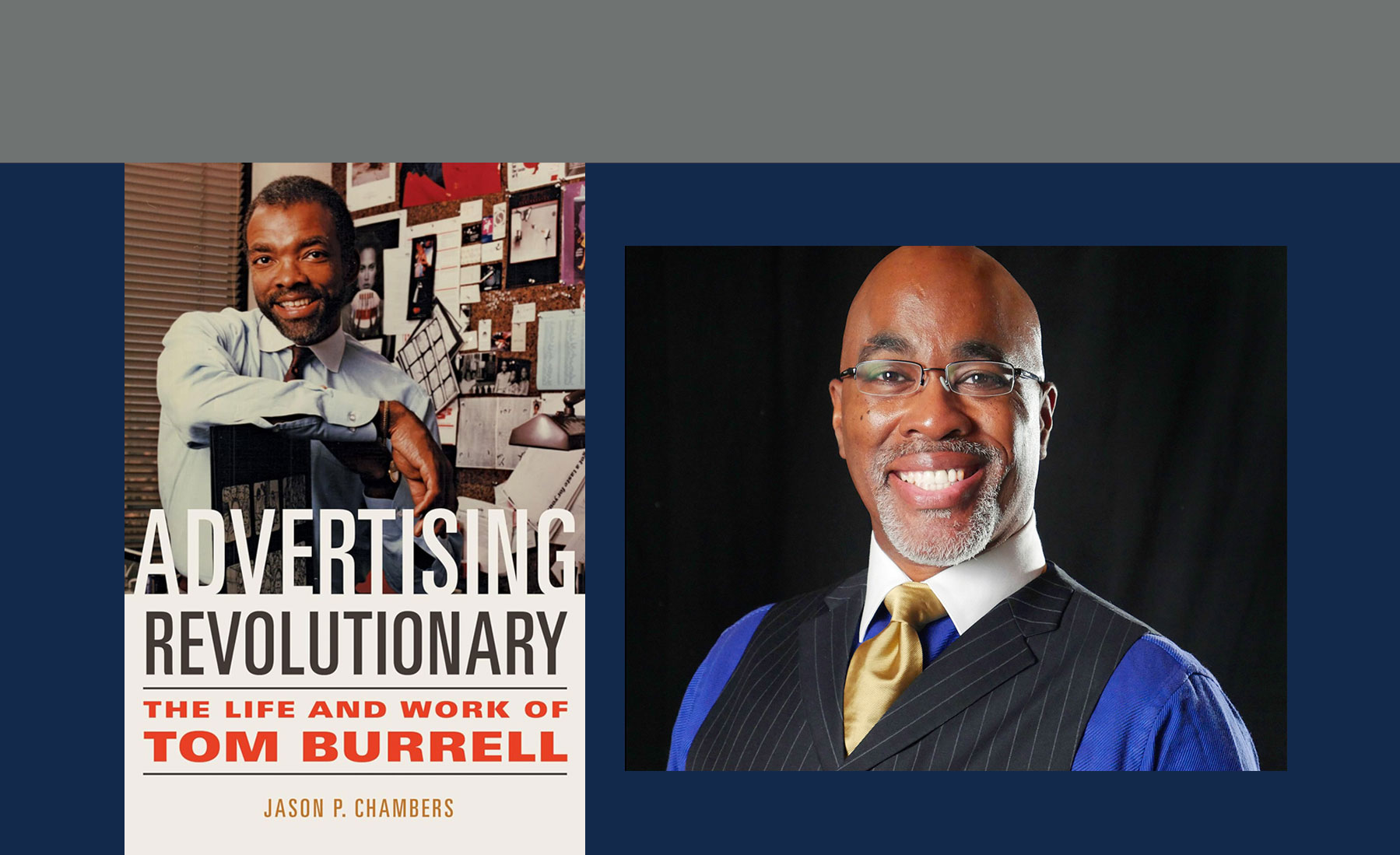
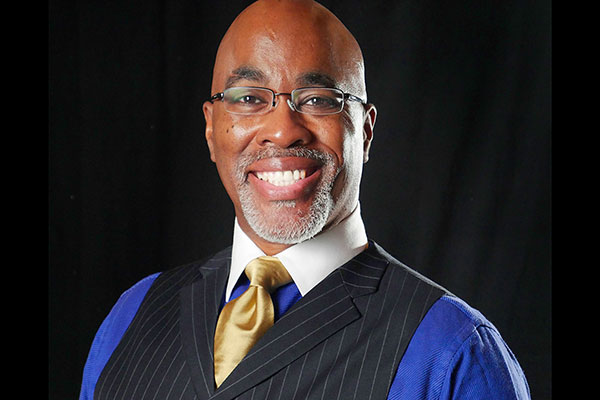
Jason P. Chambers’s new book ‘Advertising Revolutionary: The Life and Work of Tom Burrell’ details ad exec’s influence on industry’s approach to African Americans


Jason P. Chambers

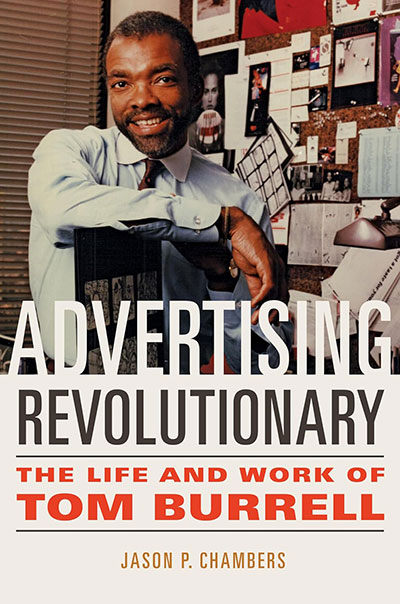
Advertising Professor Jason P. Chambers’s new biography about Tom Burrell, a renowned Black visionary who changed the face of the ad industry for African Americans, will be published on February 6. 

While Advertising Revolutionary: The Life and Work of Tom Burrell (University of Illinois Press) will appeal to those interested in advertising and its history, Chambers said it’s written for a broad audience to enjoy.

“If you have an interest in biographies, Chicago, Chicago stories, Chicago entrepreneurs, African American entrepreneurs, what goes into the creation of an advertising campaign, and client relationships, I think you’d be interested in this story,” Chambers said. 

Chambers, who is also the associate dean for diversity, equity, and inclusion at the College of Media, describes Burrell as his “favorite person in the history of the [advertising] industry.”

“He started in advertising at a time in which the number of African Americans operating in a professional capacity could have been measured in the dozens,” Chambers said, adding that Burrell was the first Black copywriter at a mainstream agency in Chicago. “He is one of the people who is singularly responsible for helping to get African Americans on TV.”

Burrell not only created a place for African Americans within the advertising industry, but he also changed their representation in advertisements. His concept, known as “Positive Realism,” was relatively simple—present realistic and positive images of African Americans using products and brands—yet it was considered revolutionary at the time. 

"Advertising Revolutionary: The Life and Work of Tom Burrell"

Chambers said if you saw a television ad for McDonald’s or Coca-Cola in the 1980s or 1990s that depicted African Americans, Burrell’s agency probably created it.

Thanks to Burrell’s early pioneering efforts, there’s a greater breadth of representation in advertising today, Chambers said. More Hispanic Americans, Asian Americans, LGBTQ community members, and people with different physical abilities are included in current brand messaging than ever before. 

Despite a more inclusive environment, Chambers still questions how much of advertising today is culturally sensitive and how much is culturally representative.

“It’s one of those things that can have two steps forward and a step back,” he said. “It’s not linear progress, but it’s nonetheless, progress.”

Chambers, who also co-edited Building the Black Metropolis: African American Entrepreneurship in Chicago in 2017, said the catalyst for his second book occurred while doing research for his first book, Madison Avenue and the Color Line: African Americans in the Advertising Industry, published in 2009. 

Chambers had the opportunity to interview Burrell on several occasions during that time. He also spent two weeks at Burrell’s ad agency in Chicago through the Advertising Education Foundation Visiting Professor Program, which Chambers says, “deepened my admiration for him.”

The AEF Visiting Professor Program allows professors to visit advertising agencies to enhance their understanding of current developments and practices in advertising and marketing to inform their teaching and research. 

Spending one-on-one time with the industry legend before he retired, coupled with a desire to write a biography, is what led Chambers to call Burrell one day in 2011. Chambers recalls standing in his kitchen, calling Burrell’s office, and thinking “it was a long shot because I was fairly certain that he would try to write his own book.” 

After some consideration, Burrell opted not to write his autobiography, opening the door for Chambers to write the book. 

Chambers spent the next few years interviewing Burrell, mostly at his home in Chicago, along with several other sources who knew him well. 

Challenges did arise throughout the process as Chambers soon realized writing a biography, which relies heavily on oral interviews alongside extensive archival research, can prove difficult. There was even a point when Chambers stepped away from writing the book, having concerns about not being able to interview some key figures in Burrell’s life, such as his original business partner who had passed away before Chambers could interview him.

But Chambers found a renewed motivation after an encounter with two of his professional academic heroes at an event in Chicago. 

Christopher Robert Reed, professor emeritus at Roosevelt University, and Darlene Clark Hine, professor emerita at Michigan State University, both African American historians, gave him the push he needed to get back to writing the book.

“After I told them about the struggles that I was having in terms of deciding to move on from the book, they both said the same thing,” Chambers said. “They said write it anyway. Just tell the readers what happened and write it anyway.”

His experience has taught him a few lessons about courage and writing that he shares with his students. 

“I think the thing that students have to be reminded of is a lack of confidence in work that you’re going to publish is just part of it, and you have to give yourself a license to have those feelings,” he said. “But ultimately the difference between a writer and somebody who writes is that a writer has to make their work public. They have to try and publish.”

Julie Turnock awarded National Endowment for the Humanities Fellowship


Turnock

Julie Turnock, professor of media and cinema studies, was awarded a National Endowment for the Humanities Fellowship for a book project titled Beyond King Kong: Special Effects in the Hollywood Studio Era, 1915–1965. 

She will receive $60,000 in funding to research and write a book about the technical, labor, industrial, and aesthetic history of the special effects industry during the Hollywood studio era.

Turnock’s book project is a history of the labor performed by unsung “below-the-line” effects workers of the era. Through archival historical research, oral history accounts, interviews, theoretical discourse, and formal visual analyses, this project presents a polemic for considering the “specialness” of effects work not from the point of view of the film but from the position of the specially contracted labor. As a labor history, it centers the workers of the Hollywood studio era who are rarely considered in cinema histories, training attention onto those whose skills make much of “movie magic” possible.  

Turnock served as the inaugural director of the Roger Ebert Center for Film Studies and is on sabbatical this academic year. 

The NEH awarded $33.8 million in grants for 260 humanities projects across the country, including 82 fellowships. The fellowship program supports advanced research in the humanities, and recipients produce articles, books, digital materials or other scholarly resources. NEH Fellowships are competitive awards granted to individual scholars pursuing projects that embody exceptional research, rigorous analysis, and clear writing.

The NEH has received an average of 1,120 applications per year for fellowships in the last five rounds of competition, according to its website. During that time, it awarded an average of 79 fellowships per year for a funding rate of 7%, making the fellowships among the most competitive humanities awards in the country.

The NEH is an independent federal agency and one of the largest funders of humanities programs in the U.S. It supports research and learning in history, literature, philosophy and other areas of the humanities by funding selected peer-reviewed proposals from around the nation.

See University of Illinois News Bureau press release.

Maslowska selected as Center for Advanced Study Associate for 2024-25 academic year


Ewa Maslowska

Ewa Maslowska, associate professor of advertising, was selected as a Center for Advanced Study Associate for the 2024-25 academic year, pending Board of Trustees approval. 

As a CAS Associate, Maslowska will take time off from teaching in Fall 2024 to focus on her research of fake online reviews.

Consumer reviews on many e-commerce and travel websites, social media platforms, and entertainment pages have been shown to play a crucial role in consumers’ purchase decisions. As a result, companies started motivating consumers to write reviews by providing various incentives. However, there’s been little research on the process of review generation or review perception, depending on the different levels of review incentives. 

Maslowska said her project “aims to investigate how incentives affect reviewers’ motivations and their reviews.” She also plans “to identify textual markers of incentivized and fake reviews and investigate whether it’s possible to train consumers to recognize such reviews, or at least make them more skeptical about them.” 

Maslowska, who also serves as faculty lead of the computer science + advertising degree program in the Charles H. Sandage Department of Advertising, was appointed a CAS Associate in the Spring 2024 semester upon the recommendation of CAS professors and with concurrence of campus and university administrations.

CAS Associates are tenured Illinois faculty members whose project proposals are selected in an annual competition. They are granted one semester of teaching release to pursue an individual scholarly or creative project. 

The Center for Advanced Study works with every department on campus to identify and support the most productive, high-achieving, and innovative faculty at Illinois, providing them with connections and funding to pursue their work. Members of this accomplished community are invited to participate in CAS activities throughout the year and given opportunities to present their work to the CAS community. See CAS’s upcoming events.

DEV College of Media
119 Gregory Hall
810 S. Wright St.
Urbana, IL 61801
217-333-2350