News is vital to an informed democracy and newspapers in India remain the most credible news providers. Reinstating a national readership survey is essential—not just for the publishing industry but for the health of India’s public discourse.
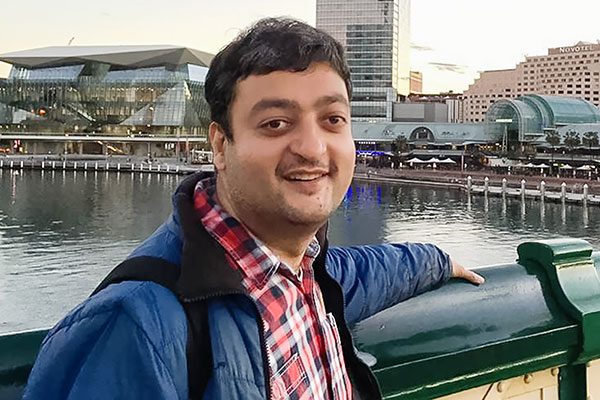
Harsh Taneja, Associate Professor of New and Emerging Media in the Charles H. Sandage Department of Advertising
As a part of an ongoing research project, Harsh Taneja, associate professor of new and emerging media in the Charles H. Sandage Department of Advertising, recently published an opinion piece in the India news outlet Scroll-in. He focuses on the implications of not counting newspaper readership on advertising markets and the impact on democracy if the most credible providers of news disappear.
The Indian Readership Survey, suspended since 2020, is a crucial measure of public discourse, media habits, and socio-economic trends. “For the print media industry in India and their advertisers, this survey provides crucial insights into readership patterns,” Taneja wrote. “Newspapers need advertisers to stay afloat, and advertisers need readership numbers to justify their spending. Readership surveys make that possible.
“Newspapers play an integral role in civic culture,” Taneja continued. “Being informed empowers people to make more responsible individual and collective decisions. At a time when social media is rife with misinformation, and almost half of India’s internet users use WhatsApp for news, credible sources of information such as newspapers are more important than ever.”
For his outstanding career accomplishments and generous monetary support of advertising students, Murray Kalis (BS ’61) was recognized by the College of Media with the 2025 Distinguished Alumni Award.
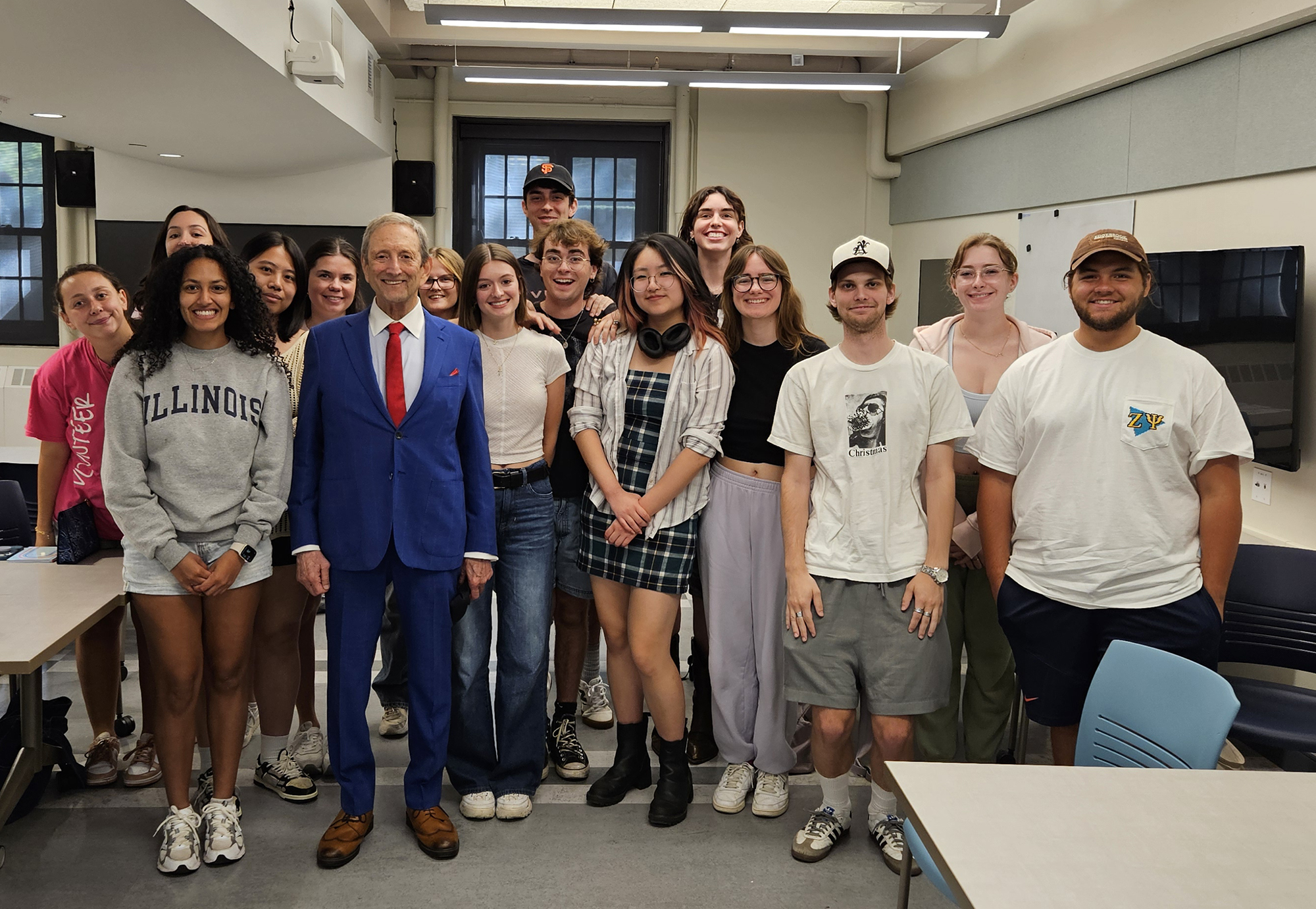
Murray Kalis with advertising students during one of his visits to the College of Media.
Kalis, whose work has taken him across the world and back, heading his own agency, and serving as chair of the largest global network of independent agencies, has experienced some remarkable moments throughout his 50 years (and counting) in advertising.
He’s helped numerous companies build their brands, including United Airlines, Nestle, KFC, Wetzel’s Pretzels, Hormel Foods, and Starbucks Coffee. Most recently, a former client brought him in as a strategic investor for Dave’s Hot Chicken, where he is creating TV and social media advertising that has helped it grow to over 300 restaurants, and just begun international expansion.
In 2020, he established the Murray Kalis Award for Creativity in Advertising to provide monetary gifts to advertising students judged for creative excellence. Students who demonstrate smart positioning, outstanding creative concepts, strong execution, and a “wow” factor receive awards for Best Single Ad, Best Campaign, and Best Portfolio.
“The response to the Award for Creativity in Advertising has been beyond what I anticipated,” Kalis said. “The students are thrilled to express creative ideas. And the questions I get when I teach are insightful, mature, and often surprising.”
“Murray Kalis has charted an exciting career in advertising and shares his wealth of experience, advice, and encouragement with our students,” said Dean Tracy Sulkin. “The College of Media appreciates the time he devotes to our classes—as well as his advocacy of creativity through the award that he established—and we are proud to honor him with the 2025 Distinguished Alumni Award.”
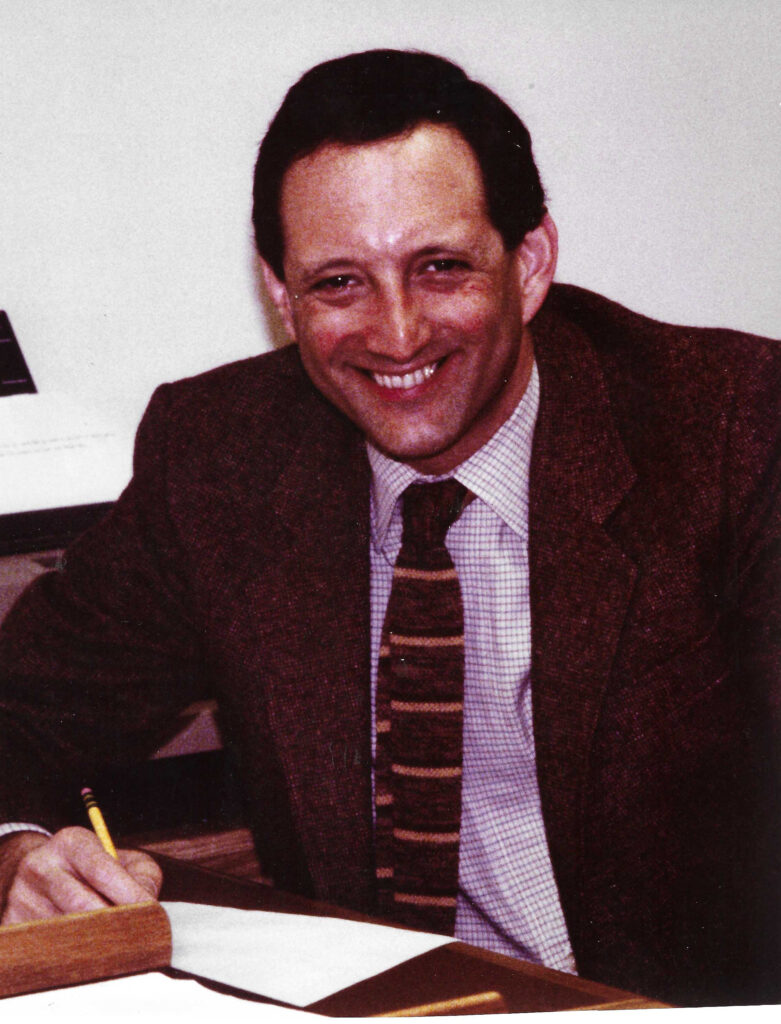
Murray Kalis early in his advertising career.
As a student at the University of Illinois, Kalis felt fortunate to be taught by the legendary “Father of Advertising Education” Professor Charles H. Sandage.
“I can picture him to this day. He made an impression on me that still guides my work,” Kalis said. “He discovered advertising could impart its own magic: That a great ad can do more than sell, it can add value to the product itself.”
Kalis said Sandage always approached advertising from a highly philosophical and intellectual way and encouraged critical thinking. “He used a kind of Socratic method [of teaching].”
If students gave an incorrect answer, Sandage had a way of guiding them to the right one.
“He would start asking you questions, and he would lead you to understand, to try to defend your position, and suddenly you realize, ‘Oh, that doesn’t make any sense,’” Kalis said.
After receiving his bachelor’s degree—and thanks to the University of Illinois Reserve Officers’ Training Corps program—Kalis was commissioned as a lieutenant in the United States Army where he put his civilian education in advertising to work in psychological operations.
“I had two years of active duty basically running an ad agency,” he said. “We found illustrators and writers among the draftees, and we would create leaflets to be dropped out of planes.”
Following his military service, a master’s degree in fine arts, and a college teaching position in Iowa, Murray joined ad agency Leo Burnett in Chicago.
There, he quickly rose up from junior copywriter to creative director in an era when the ad industry resembled the glossy, high-profile lifestyles portrayed in the television series Mad Men.
As a member of the Academy of Television Arts and Sciences and Emmys judge, Kalis met Mad Men star Jon Hamm at a reception for the cast and producers.
Kalis said they discussed the similarities of the TV show and his real-life experience in advertising, which included “making those pitches, dealing with clients, and having to work your way through three-martini lunches.”
Kalis’s creative career also introduced him to actor Tom Hanks. To prepare for a role as a Chicago advertising executive in the 1986 film Nothing in Common, Hanks followed Kalis around the office to get a feel for his daily routine.
At this point in his career, Kalis says he is mainly working in social media, which is a lot different than when he first started in the business. Then, there were just three television channels that offered an opportunity to advertise.
While media delivery options have changed over the years, Kalis said the purpose of advertising—finding solutions to consumer problems—has remained the same.
“The media changes,” he said, “but people don’t. It’s Maslow’s Hierarchy of Needs, just like when I was entering Greg Hall for the first time.”
After all these years, Kalis is still full of energy and enthusiasm for the advertising industry.
“I love the biz. I love doing this stuff,” Kalis said. “I love looking at a product and figuring out how to match it with a consumer.”
Above: Murray Kalis was creative director for this Dave’s Hot Chicken ad.
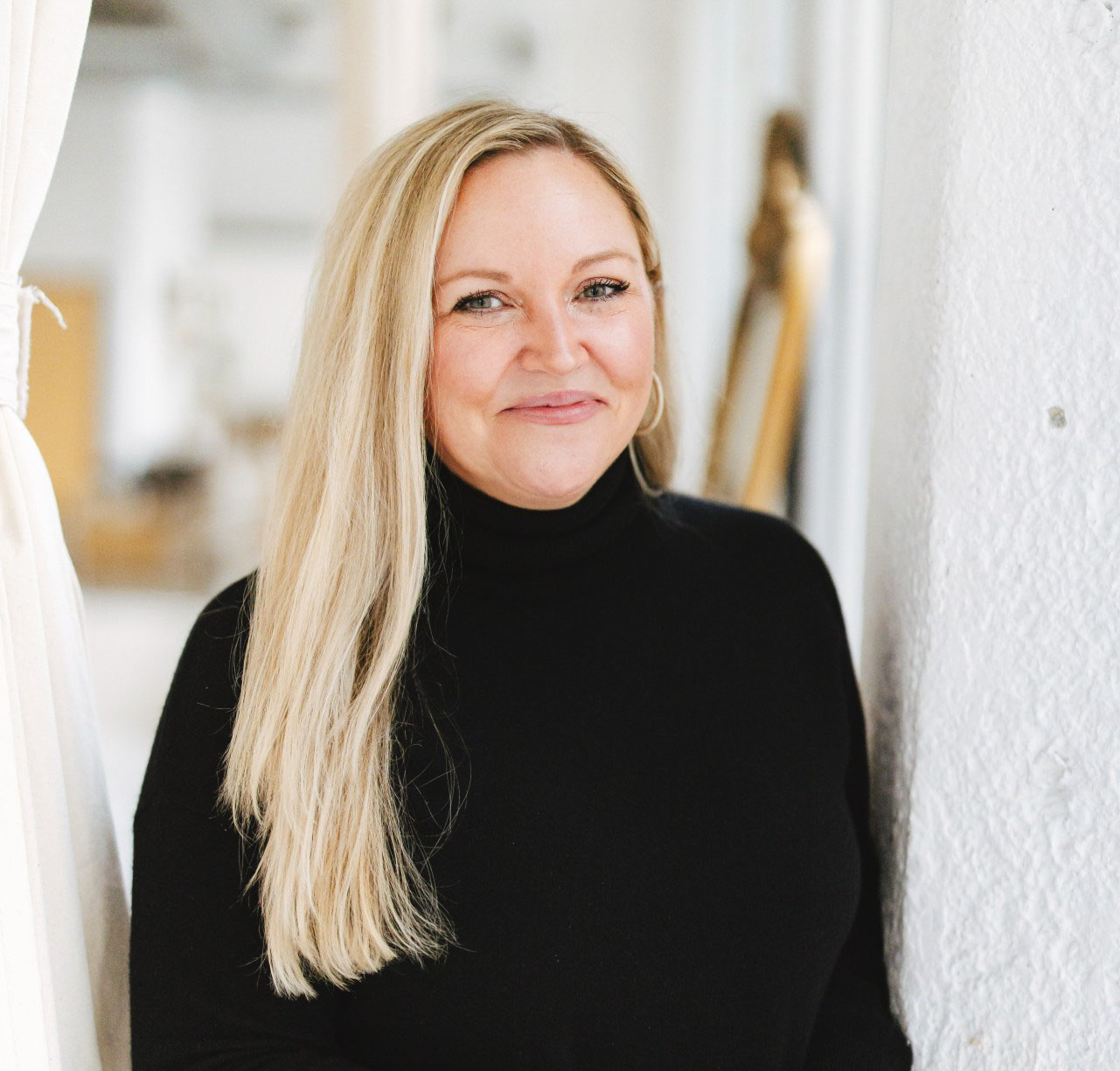
Stephanie Lulay’s (BS ’08, journalism) start-up venture, Block Club Chicago—whose mission is to deliver reliable, nonpartisan, and essential coverage of Chicago’s diverse neighborhoods—has become a news staple for readers throughout the city since its founding in 2018.
Lulay serves as executive editor and co-founder of the award-winning newsroom, which has 18,000 paid subscribers, more than 130,000 newsletter subscribers, and an average of 2.3 million pageviews a month. Over seven years, the newsroom has grown from a staff of eight reporters and editors to a staff of 39. Lulay credits her journalism education at Illinois as a key to her success.
“The [University of Illinois] gave me the problem-solving skills and the confidence I needed to succeed in this industry,” she said.
In honor of her career accomplishments and her continued engagement as an alum, Lulay was chosen as the winner of the 2025 College of Media Emerging Leader Award.
“The College of Media is pleased to award Stephanie Lulay as our 2025 Emerging Leader for her innovative and entrepreneurial path in the journalism industry, along with her enthusiasm for sharing her experiences with our students and alumni,” said Dean Tracy Sulkin. “Stephanie is an alum who exemplifies, in an ever-changing media landscape, how to enhance the lives of people in our state.”
Lulay calls Block Club Chicago a “freemium site”—very few articles are paywalled and most stories are accessible for free, including breaking news, health, election coverage, and news from underserved South Side and West Side neighborhoods. They also produce twice-weekly Block Club Chicago podcasts, hosted by fellow Illinois journalism alum Jon Hansen (BS ’06).
The [University of Illinois] gave me the problem-solving skills and the confidence I needed to succeed in this industry.
Stephanie Lulay
Executive Editor and Co-Founder of Block Club Chicago
Their reporter model is different from traditional newspapers, too. Rather than having beats, reporters are assigned to neighborhoods, tasked with covering whatever news is most important that day.
Lulay says their “big bet” is when they put reporters on the ground every day, it will lead to a more accurate portrayal of the neighborhoods in Chicago and build reader trust.
“That’s what makes me so excited about working for a local newsroom in this time. I When you know who is serving you, and you see them all the time — at your kid’s school, at a community meeting —that is key to rebuilding trust between media and people,” Lulay said.
Lulay says she took what she learned at college with her into the workforce—including the hands-on experience she gained from writing and editing for The Daily Illini and the confidence she built from working closely with Brant Houston, Knight Chair Professor in Investigative and Enterprise Reporting in the Department of Journalism.
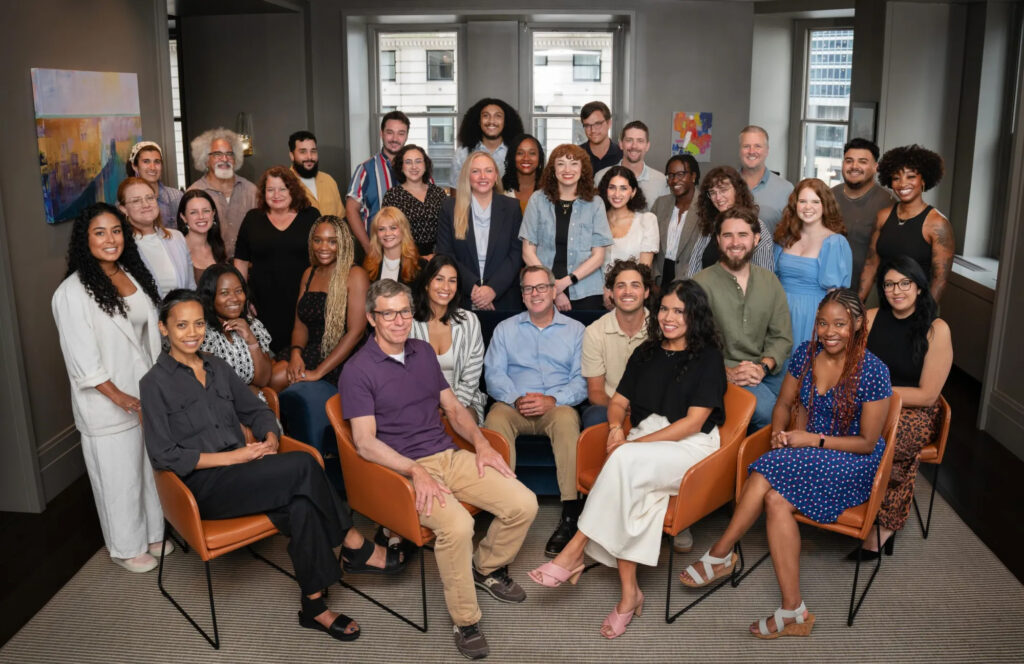
The staff of Block Club Chicago.
“Brant really encouraged me to dig into some big investigative stories and to not think of myself just as a student, but as an investigative journalist,” she said. “Because of that, I was able to get real-life professional experience.”
When Lulay and 115 reporters across the country lost their jobs after DNAinfo sites shuttered in November 2017, one of the first calls she made was to Houston.
Lulay describes Houston as “a godfather in the nonprofit news movement,” and said he gave her the right connections and insight to think through their plan at the start of Block Club Chicago.
Lulay has stayed engaged with College of Media students through educational webinars and classroom visits.
She hopes Block Club Chicago’s success might inspire others to start up similar newsrooms across the country, especially recent College of Media graduates.
“I would love to see some Illini students graduate, pop up in a news desert, and start a newsroom there,” Lulay said. “It’s hard work, but there is so much opportunity right now in nonprofit news and I’d love to see some students capitalizing on that.”
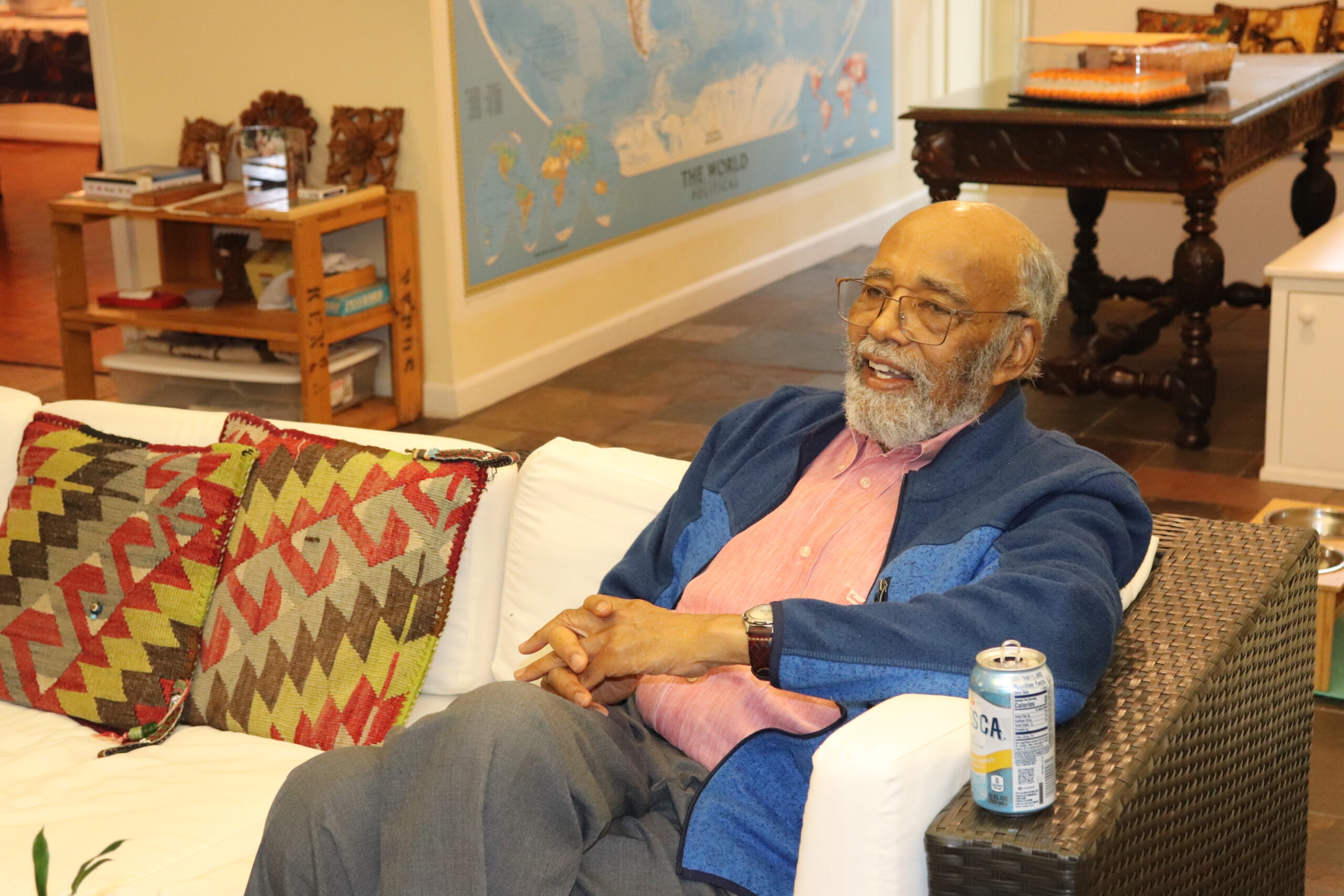
Leon Dash, winner of a Pulitzer Prize and Swanlund Chair Professor of Journalism, sat in his office chair on the third floor of Gregory Hall, appearing calm and collected on his last day of teaching at the College of Media.
Leon Dash at his retirement celebration on May 13, 2025. (Photo by Kelly Youngblood.)
With 27 years of classroom instruction soon to be behind him, and a 30-plus-year career as an investigative news reporter for The Washington Post in his rearview mirror, Dash was looking forward to his next step—retirement.
Dash has always tended to look ahead to the next step, the next chapter, the next story.
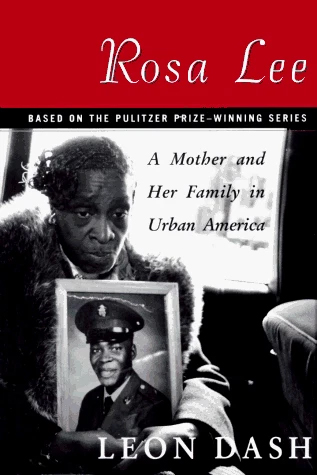
This inclination may have contributed to him becoming a Pulitzer Prize finalist in 1987 for a six-part series on teenage pregnancy, and eventually winning the Pulitzer Prize in Explanatory Journalism in 1995 for an eight-part series, “Rosa Lee’s Story,” that shed light on an impoverished, urban family trapped in intergenerational cycles of crime and addiction.
Dash followed Rosa Lee Cunningham, her children, and her grandchildren for four years, chronicling their struggles and occasional victories for TheWashington Post series, which also won the Robert F. Kennedy Journalism Award for setting “the standard for reporting about poverty.”
The piece was also named to the “Top 100 Works of Journalism of the Century” by the Arthur L. Carter Journalism Institute at New York University.
A year after winning the Pulitzer, Dash published a book based on the series, Rosa Lee: A Mother and Her Family in Urban America. Dash didn’t know it yet but that book, along with another one he wrote about teen pregnancy—When Children Want Children: The Urban Crisis of Teenage Childbearing—would become required reading for his journalism students one day.
Dash’s trailblazing efforts in immersion journalism opened many doors for him, including an opportunity to join the faculty at the College of Media. In Fall 1998, he stood in front of his first class of college students and began the next half of his journalism career—this time as an instructor.
Dash said he was intimidated at first but quickly found his footing thanks to his “self-appointed” faculty mentor and fellow professor of journalism, the late Bob Reid. With Reid’s guidance, Dash said his transition from the newsroom to classroom went very smoothly.
Throughout his extraordinary career, Dash has seen the journalism landscape undergo several changes. The most notable for him is a decline in assertive news reporting.
“So many of the publications are weak when it comes to standing up to power. That used to not be the case,” he said.
At the Post, Dash said he was expected to confront people in power, if necessary, to get answers to the tough questions.
But now more than ever, media outlets are fearful of economic and legal repercussions, he said.
“That was a big disappointment to me. It was painful to watch,” he said. “That kind of interference was unheard of in the past.”
Dash also believes social media has blurred the lines between what is considered news and what is considered opinion, which creates confusion; and people tend to look to a variety of political figures and social influencers for their news today, rather than trained journalists, which Dash views as “very dangerous.”
About 10 years ago, he ran into a former newspaper colleague who told him her job required her to produce two to three different ledes a day for the same story. Using the same facts, the reporter told Dash she had to create a new enticing hook to reel in more readers.
For Dash, who was accustomed to spending months on stories, the idea of churning out multiple ledes a day sounded like “a nightmare.”
Dash says he has no solutions for the many issues plaguing the journalism industry today but does encourage others to think for themselves.
He knows social media is here to stay and engages on a few platforms, sometimes connecting with former students.
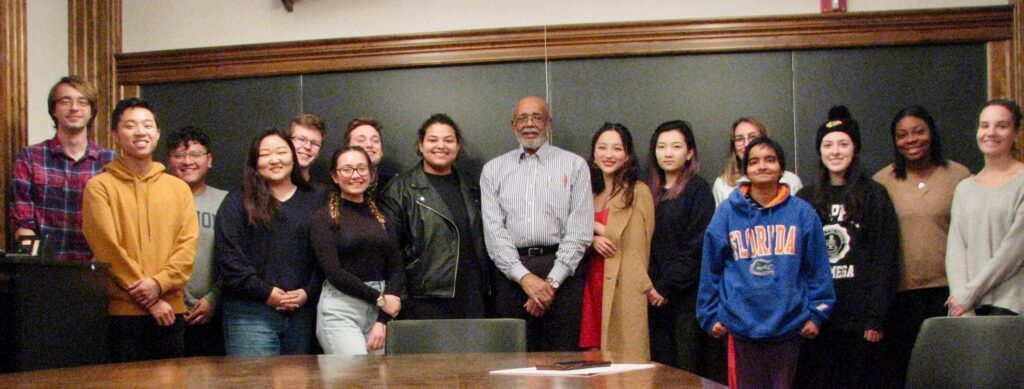
Leon Dash with students in his Great Books of Journalism course in Fall 2019.
He even joined a Facebook Group, which is now inactive, called “Dash Survivors,” created by former students to playfully discuss Dash’s more rigorous coursework.
Dash’s current news diet includes online subscriptions to The New York Times, The Washington Post, and The News-Gazette. He never thought he’d make the transition from reading print news to digital news but now he says it’s more convenient.
“I no longer have ink stains on my fingers from reading the newspaper,” he said.
Dash will miss a lot about teaching, especially working with students who have the ability and genuine interest to become a successful journalist one day.
“Those kinds of revelations are always pleasant, and I’ll miss that,” he said.
But Dash is already looking ahead to his next piece of work. Namely, he said: “A book I need to write.”
He said his forthcoming book “entails lengthy interviews with Black and white Americans focusing on what, when, and under what circumstances did they have a defining ethnic experience on the American landscape.”
Stories of the past might be whitewashed, rewritten, or replaced in official spaces, but people’s consciousness of the past can’t be stripped away.
Melita Garza, Associate Professor and Tom and June Netzel Sleeman Scholar in Business Journalism
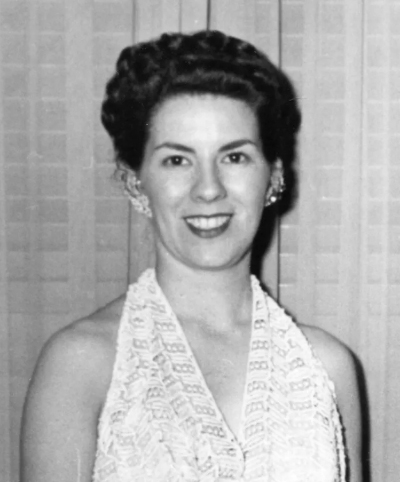
Melita Garza’s mother, Linda Rosa Caballero Hinojosa de Garza, circa 1940s.
In this Newsweek opinion piece, Melita Garza, associate professor and Tom and June Netzel Sleeman Scholar in Business Journalism, combines a Mother’s Day remembrance with a call to use oral history to preserve the lived experiences of events that some want to see removed from museums, books, and other official histories.
“In drawing on these personal recollections, I hope to make the case that listening to our mothers and recording their stories is a way to honor them that will endure long after the flowers have wilted, the perfume faded, and the chocolate box recycled. I say this not just as a daughter, but also as a media historian who spent more than 20 years as a reporter telling the stories of others in the Milwaukee Journal, the Los Angeles Times, the Chicago Tribune, and Bloomberg News,” Garza said.
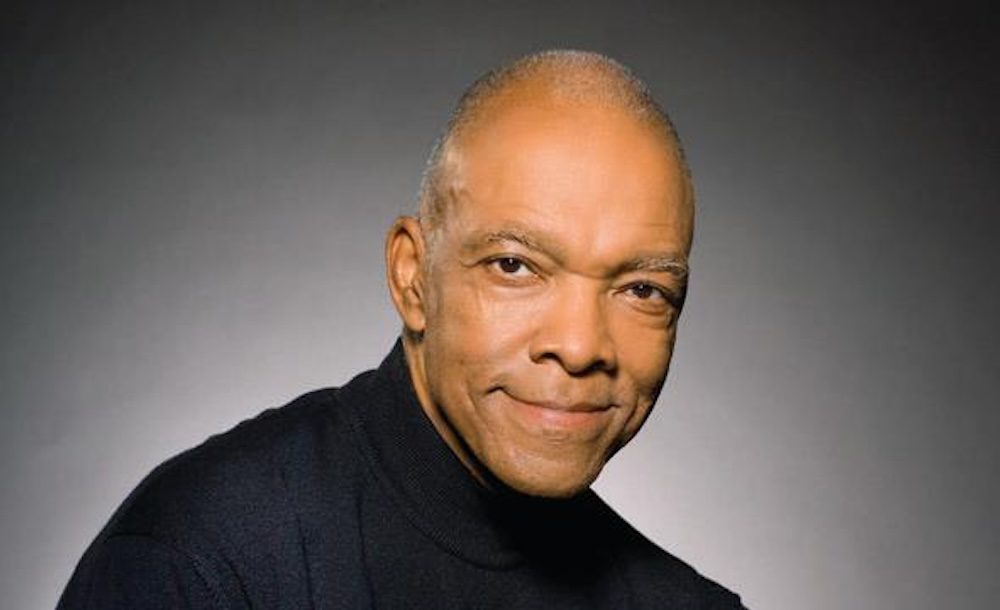
The honorary degree award recognizes individuals who have shown exemplary, extraordinary, and distinguished contributions to knowledge and creativity in a specific field, or sustained activity of uncommon merit.
The Charles H. Sandage Department of Advertising was the key sponsor of Burrell’s honorary degree, with three additional departments supporting his nomination, including the Department of African American Studies, the Marketing Group in the Department of Business Administration, and the Department of Communication.
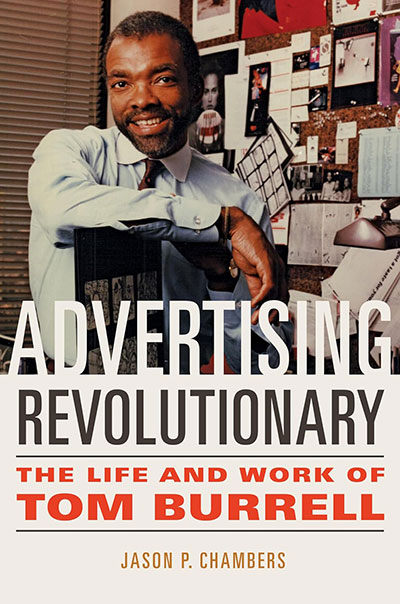
Jason P. Chambers, professor of advertising and associate dean for access and engagement at the College of Media, describes Burrell as his “favorite person in the history of the [advertising] industry.”
Tom Burrell is unquestionably a pioneer in the field of advertising. He helped to normalize the image of African Americans in advertising.
Jason P. Chambers
Advertising Professor and Author of Advertising Revolutionary: The Life and Work of Tom Burrell
“He started in advertising at a time in which the number of African Americans operating in a professional capacity could have been measured in the dozens,” Chambers said. “He is one of the people who is singularly responsible for helping to get African Americans on TV.”
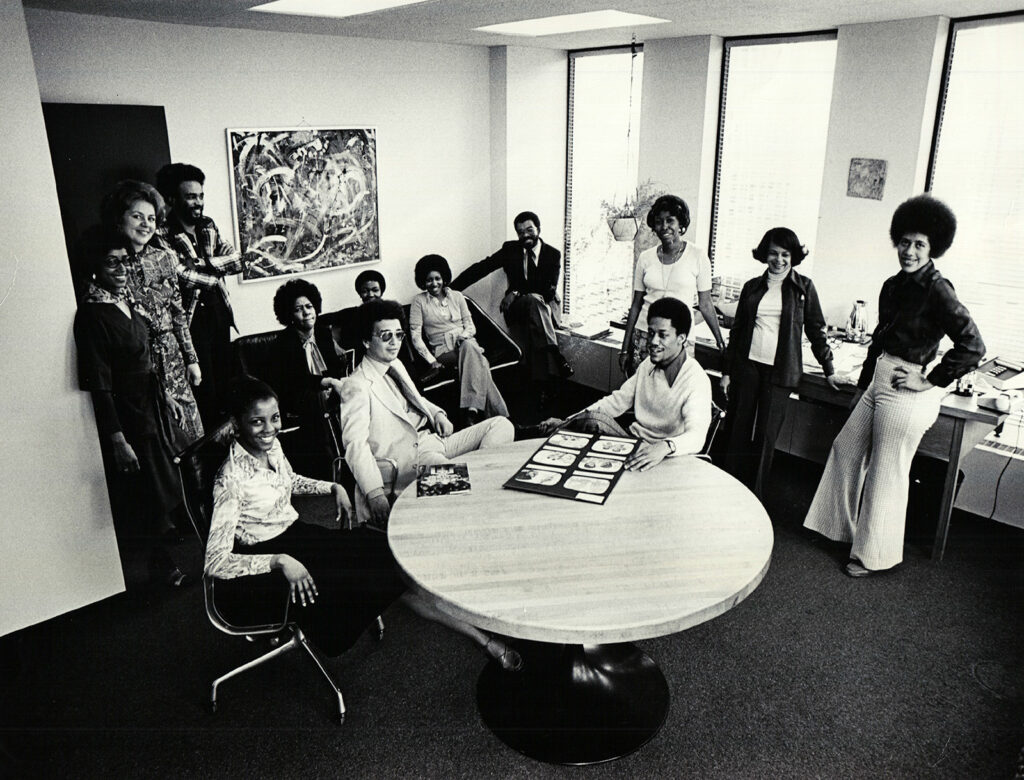
Burrell’s career, first as a copywriter and then as an agency owner of the Burrell Communications Group, spans more than 40 years. He created an approach to advertising, “positive realism,” that is still utilized today in the field.
Burrell has been elected to the American Advertising Federation Hall of Fame, one of the industry’s highest honors. He also received the Albert Lasker Award for Lifetime Achievement in Advertising and the Missouri Honor Medal for Distinguished Service in Journalism. In 2017, he became the first African American creative elected to the One Club Creative Hall of Fame.
Despite the many challenges he faced throughout his career, Chambers said Burrell provided an opening into advertising for African Americans who likely otherwise would not have found one, giving them a place to learn the business, to develop as professionals, and to be themselves.
“Tom Burrell is unquestionably a pioneer in the field of advertising,” Chambers said. “He helped to normalize the image of African Americans in advertising.”
The Sandage Department of Advertising will host a luncheon for students and faculty to meet Burrell while he is on campus.
“Both awards are contested greatly by surrounding schools and programs. Their accomplishments with wins, even nominations, are truly resume builders,” said Kenneth Erdey, journalism instructor and technical coordinator for Richmond Studio, where UI7 broadcasts take place.
NATAS Mid-America EmmyAwards
Best Non-Fiction Longform – A.I. Uncovered: Produced by Piper Pascarella and journalism students from JOUR 445: Advanced Television Reporting last fall—including Hannah Lonergan, Kaitlyn Devitt, Maggie Knutte, Layli Nazarova, Daniel Branand, Ashley Gilbert, Rylee Jones, Jessie Cleverly, and Anna Koh—this UI7 special report looked at how artificial intelligence is reshaping our world.
Watch the segment:
Best Sports Program – Power Play: Produced by journalism students John Shay and Andrew Burkey, this pre-game sports show delivered insightful and engaging coverage of Illinois Hockey. Mazie Gierat (journalism), Peter Hanson (English major, journalism minor), and Caleb Noble (BS ’24, journalism) also played key roles in the show’s production.
Watch the segment:
Honorable Mention, Photography – Illini Boxing Club: Nathan Gonzalez (journalism) earned well-deserved recognition in the photography category for his work covering the Illini Boxing Club for Good Morning Illini.
SINBA Awards
The Illinois News Broadcasters Association announced the winners in the 2025 Student Awards, including several students from the UI7 Newsroom. These student broadcasters were honored Saturday, April 26, during the INBA Spring Convention in Bloomington.
The journalism student winners and their programs include:
First Place in Outstanding Hard Television Program – UI7 Presents Decision 2024: Piper Pascarella, Maggie Knutte, and Hannah Lonergan
First Place in Outstanding Sports Television Program – Illini Sports Night: Emily Richie and John Shay
Second Place in Outstanding Soft Television Program – Good Morning Illini: Hannah Lonergan, Mallory Miller, and Caroline Tadla
Nancy Benson, professor emerita of journalism, died on April 21, 2025. She was 72 years old.
In 1996, she was hired as a visiting professor in the Department of Journalism and became an assistant professor in 1997. She was promoted to associate professor in 2003 and to full professor in 2014. Before retiring in 2019, she served as interim head of the Department of Journalism.
During her 40-year career in broadcast journalism at various television and radio stations across the Midwest, including morning drive anchor and reporter at WMAQ radio in Chicago, Benson won numerous awards for reporting.
The highlight of her teaching career was developing an international reporting course. After a term of teaching about a particular country, she traveled with her students to that country. There, they would research and produce stories about issues that otherwise had been ignored. Nancy took students to Peru, China, Romania, Italy, and Turkey.
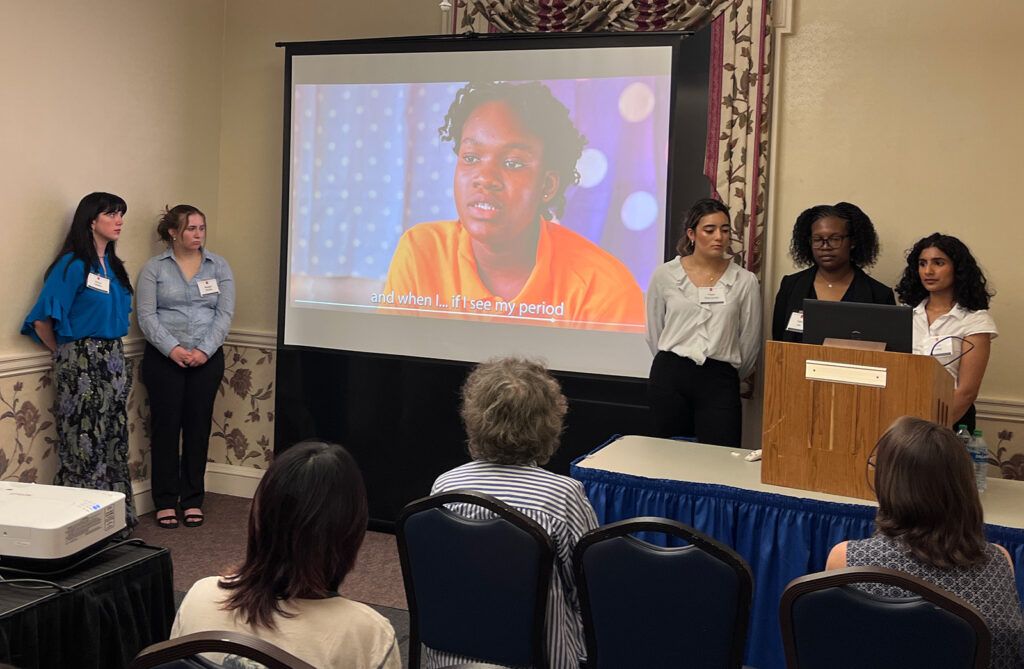
Update May 29, 2025: Congratulations to the students who presented “Uman Tok: Tailoring Hope, Renewing Futures in Sierra Leone” for receiving an award for Outstanding Oral Presentation at the Undergraduate Research Symposium from theOffice of Undergraduate Research! Some of these students previously won an award in 2024 for Outstanding Exhibit on this same research topic, which they continued work on in 2025.
Updated April 28, 2025
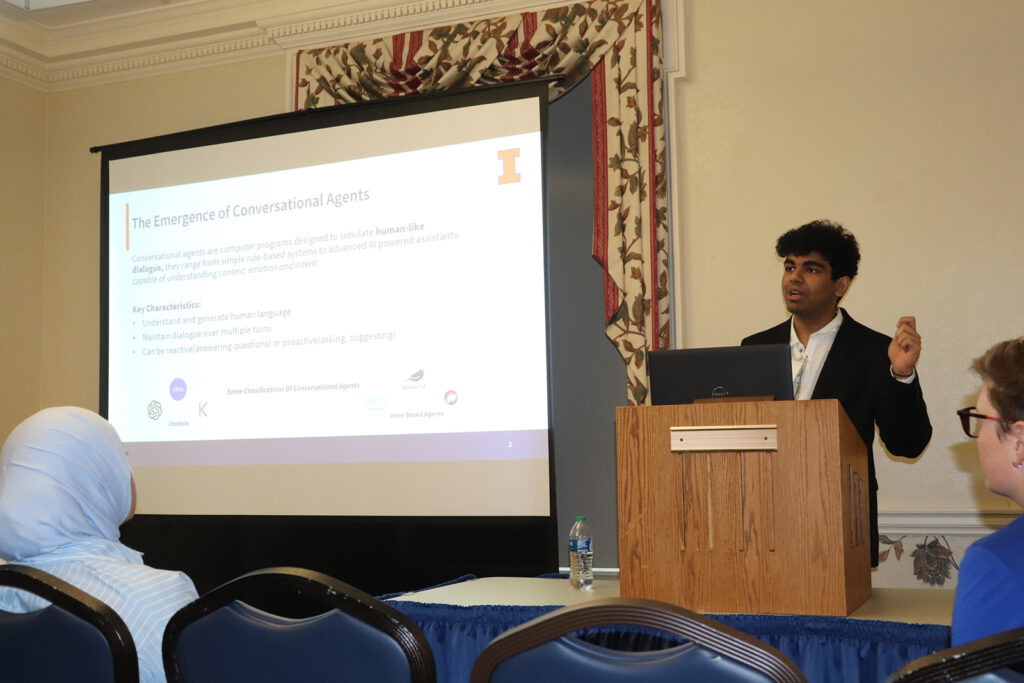
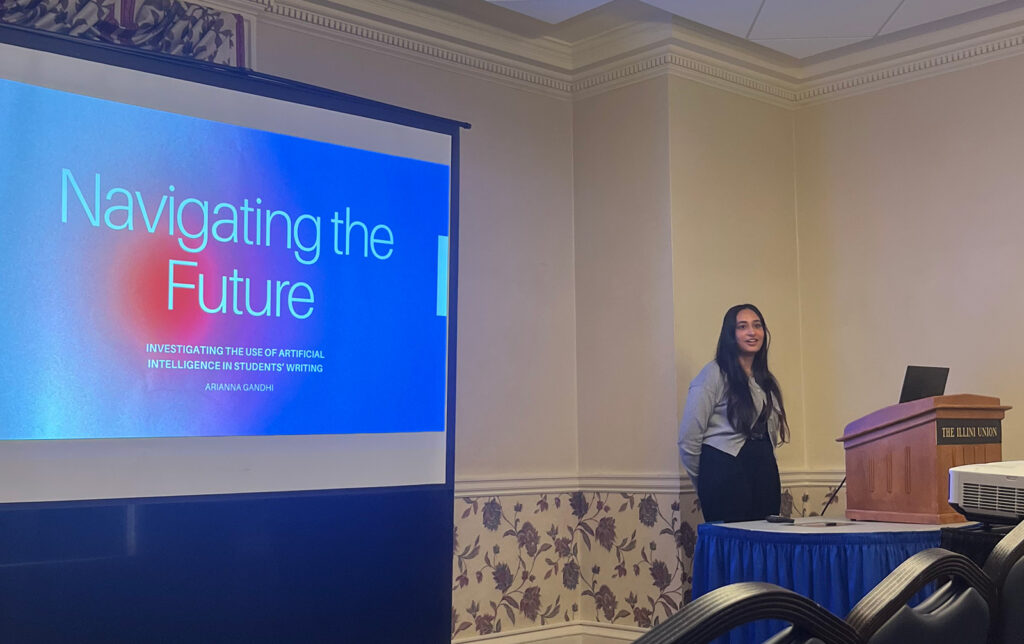
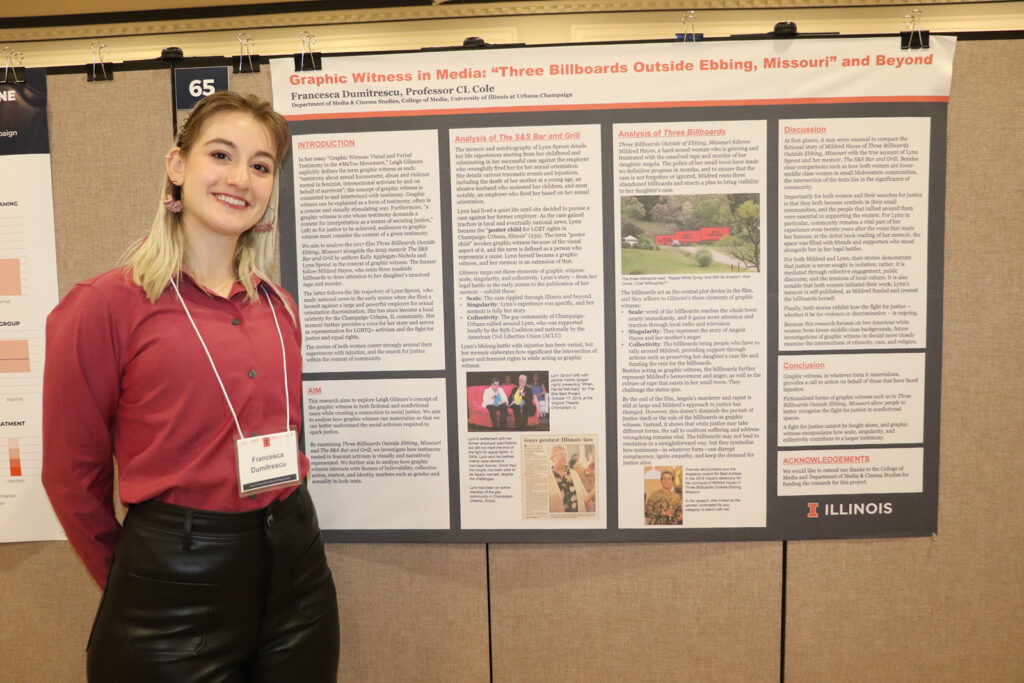
Students from all four majors in the College of Media participated in the annual University of Illinois Undergraduate Research Week, held April 20-26.
The Undergraduate Research Symposium, the signature event held on Thursday, April 24, at the Illini Union, features presentations, posters, and performances from students across campus.
Below is a list of Media student presentations as well as acknowledgements of Media graduate students and faculty who have mentored students presenting at Undergraduate Research Week.
Oral Panel
Health Modalities
“Evaluating the Persuasiveness of LLM-based Chatbots in Health Communication”
Tuesday, April 22, 4-6 p.m., Illini Union Rooms A, B, C, and South Lounge
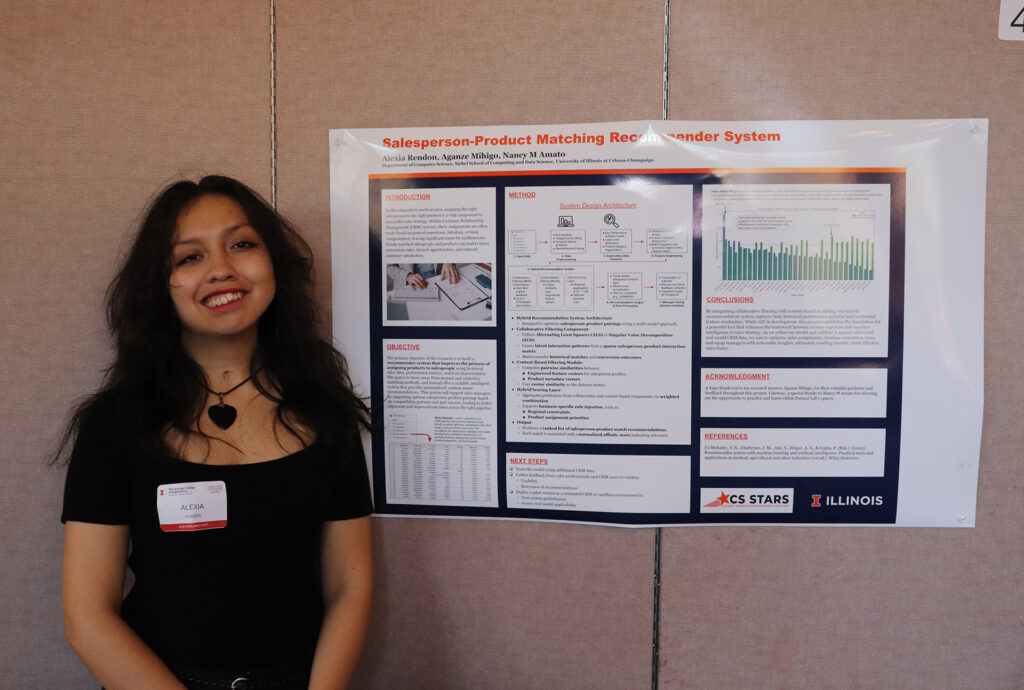
“Salesperson-Product Matching Recommender System”
Alexia Rendon, Junior, Computer Science + Advertising, COM
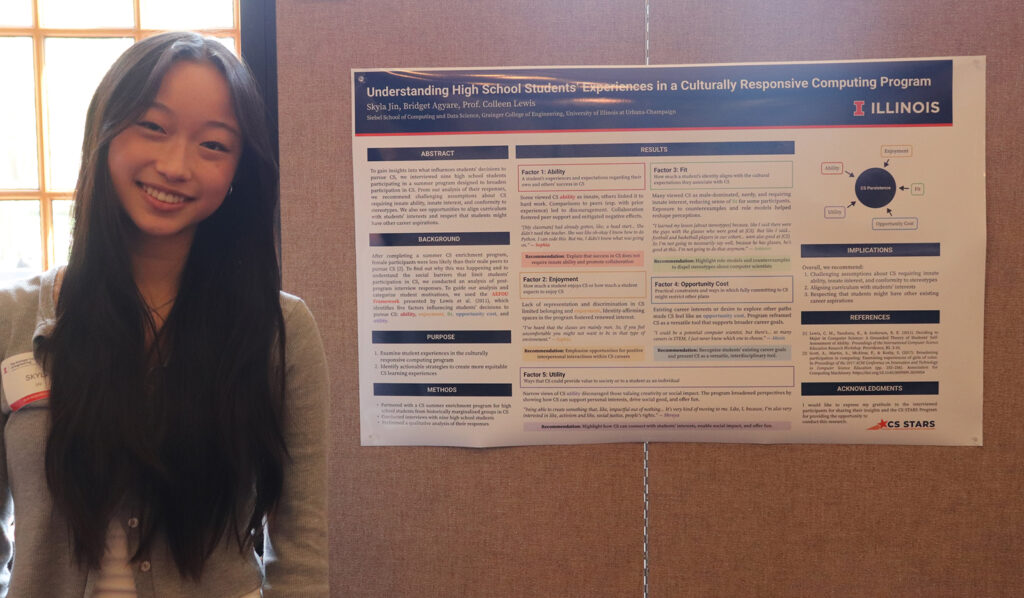
“Understanding High school Students’ Experiences in a Culturally Responsive Computing Program”
Skyla Jin, Freshman, Computer Science + Advertising, COM
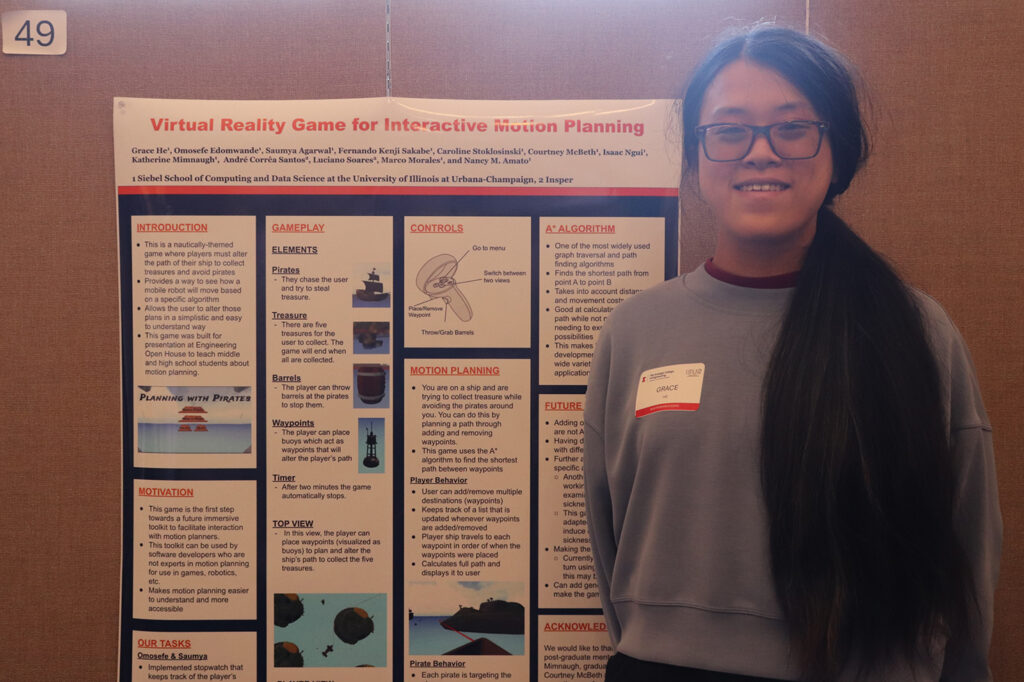
“Virtual Reality Game for Interactive Motion Planning”
Grace He, Junior, Computer Science + Advertising, COM
Omosefe Edomwande, Freshman, Computer Science, ENG
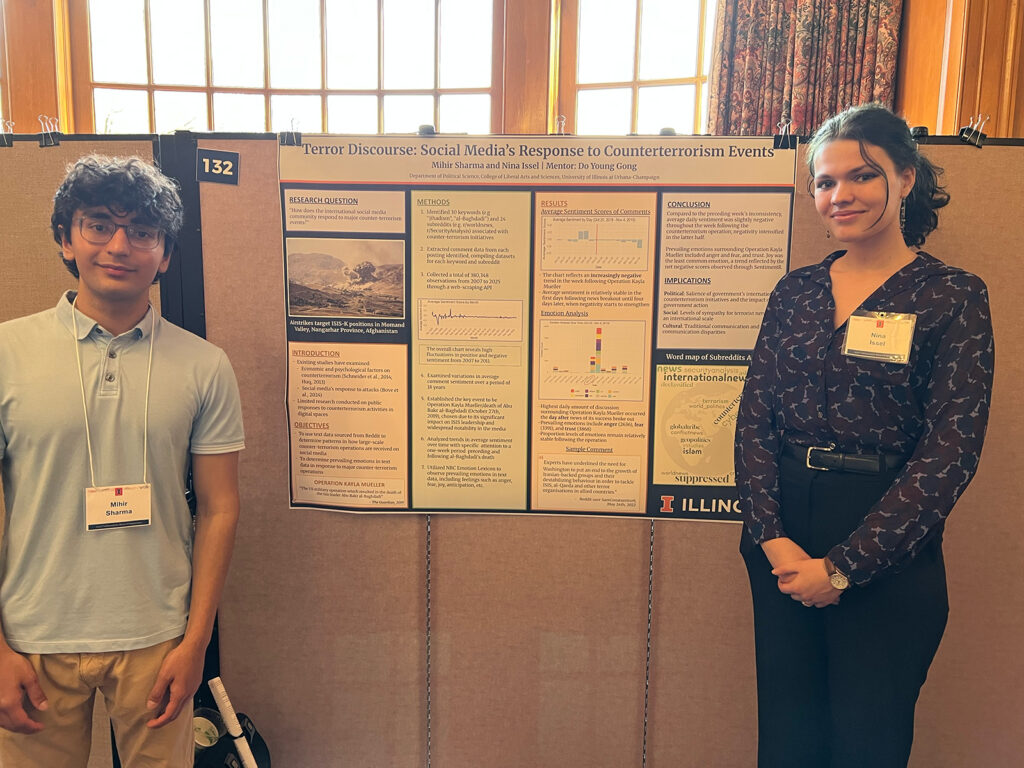
Undergraduate Research Apprenticeship Program
The Undergraduate Research Apprenticeship Program offers undergraduate students with little or no research experience the opportunity to work with graduate students and postdoctoral scholars on their research projects, explore the culture and process of research, and build on their existing abilities within a community of scholars.
Nina Issel, Sophomore, Journalism (COM)
Media Research Mentors
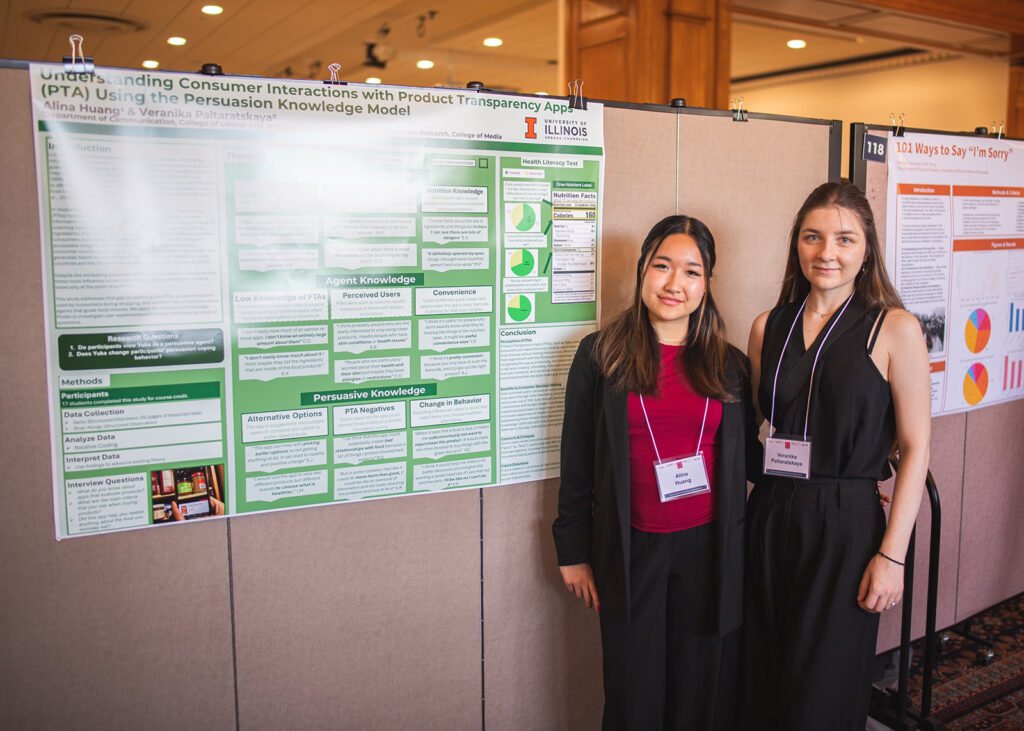
Doctoral student Veranika Paltaratskaya (above right), Institute of Communications Research, was the research mentor for Alina Huang, sophomore in communication and psychology (LAS), who presented “Understanding Consumer Interactions with Product Transparency Apps (PTAs) Using the Persuasion Knowledge Model” as part of the Social Science & Human Behavior poster presentations.
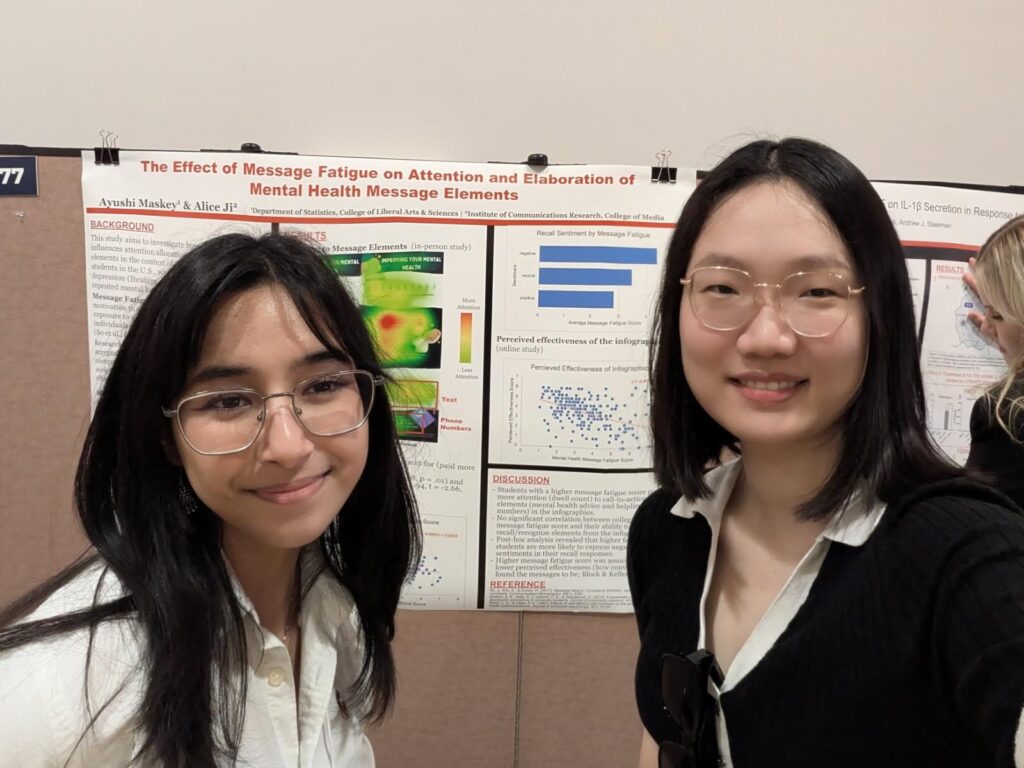
Doctoral student Alice Ji (above right), Institute of Communications Research, was the research mentor for Ayushi Maskey, junior in statistics + computer science (LAS), who presented “The Effect of Message Fatigue on Attention to Mental Health Messages” as part of the Heath & Wellness poster presentations.
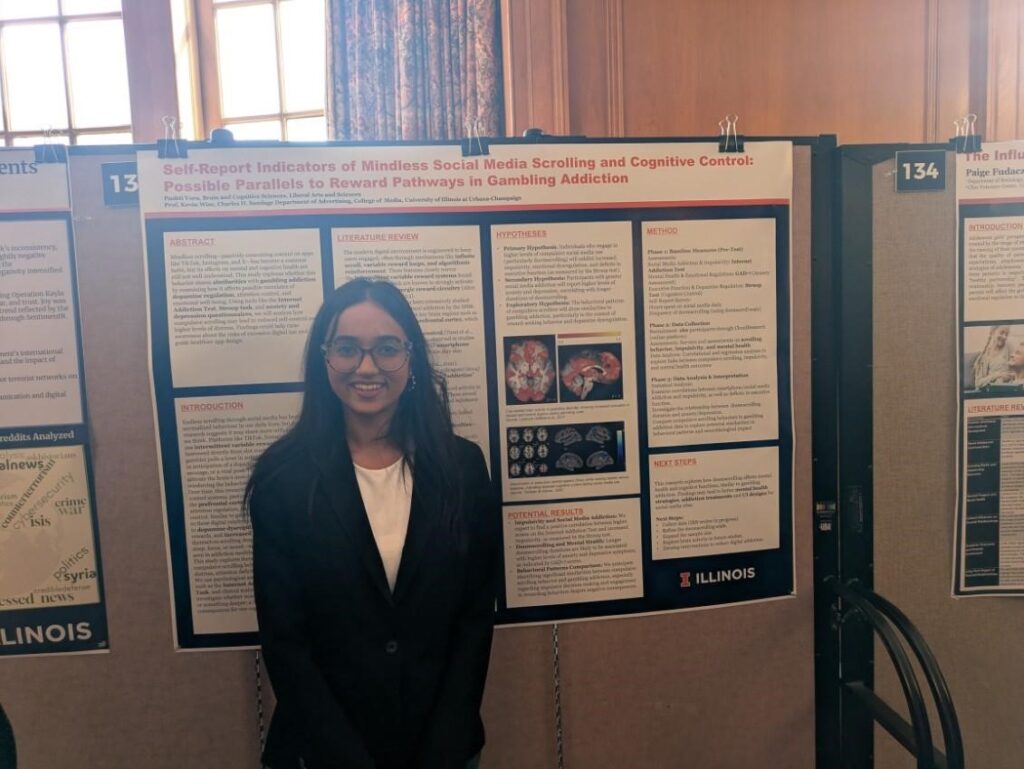
Kevin Wise, professor of advertising, was the research mentor for Pushti Vora, junior in brain and cognitive sciences (LAS) who presented “The Impact of Mindless Scrolling on Dopamine Regulation and its Parallels to Gambling Addiction” as part of the Social Science & Human Behavior poster presentations.
April 14, 2025 | Ruth Kwak, Office of the Chief Information Officer, Technology Services
When the Website Management Center of Expertise collaborated with the College of Media, the College of Law and the School of Social Work to solve the challenges on each unit’s websites, the result was three new websites and a roadmap for building more.
Launched just one year ago from the grassroots efforts of the Website Implementation Guidelines Group, the Web CoE was established as part of the universitywide Operational Excellence initiative. With a mission to streamline dedicated resources and centralize expertise, the Web CoE now serves as a vital resource for helping units campuswide create and manage secure, accessible, and Illinois-branded websites.
How does it work?
At the heart of the Web CoE is its Website Management Consulting Service, designed to serve any group on campus—regardless of their levels of web experience. Groups can submit a ticket to start the consultation process, whether they’ve inherited an outdated website or are building one from scratch. The consulting team meets with the group to understand their specific goals, audience, technical capacity and needs. Based on this consultation, the team provides expert recommendations and, when appropriate, full-service migration support. Visit the Website Management Consulting Service webpage to learn more about the details of the process.
One of the biggest draws of working with the Web CoE is that it guarantees the final product will meet the university’s standards for accessibility, privacy, security and branding.
Previous Website Implementation Guidelines Group co-leader and current program director for the Website Management Center of Expertise, Cordelia Geiken shared more about why the Web CoE was identified as a part of the Operational Excellence initiative.
“People have been making websites at U of I since Mosaic in 1993, but it’s been all over the place. Our goal is to make things more streamlined, and to enable people to get the help they need in order to be accessible, secure and also branded…. Illinois branding is still pretty new. People are really excited about it and want to improve the user experience on their sites. If you’re on a University of Illinois site, you should know you’re on one.”
People have been making websites at U of I since Mosaic in 1993, but it’s been all over the place. Our goal is to make things more streamlined, and to enable people to get the help they need to be accessible, secure and branded.
Cordelia Geiken
Program Director for the Website Management Center of Expertise
Early adopters
This spring, the Web CoE completed full website implementation engagements with its first three early adopters: the College of Law, the College of Media and the School of Social Work. These projects were not only impactful for the individual units, but also valuable learning experiences for the Web CoE itself. The Web CoE engaged in a full website migration for each early adopter.
Geiken said that the early adopters each had a unique situation that the Web CoE had to work through. “All of campus will benefit from the unique situations those units faced,” Geiken said.
The College of Media
Without a web developer on staff, Holly Rushakoff, director of communications for the College of Media, was seeking assistance to update the college’s site when she was connected with Cordelia Geiken.
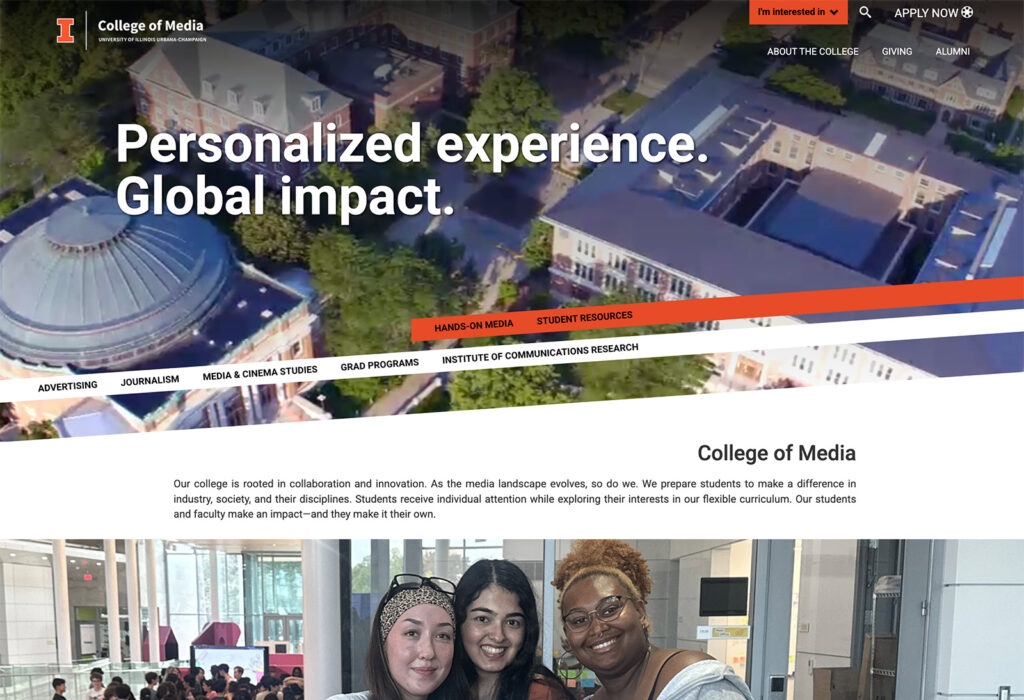
The College of Media’s previous homepage.
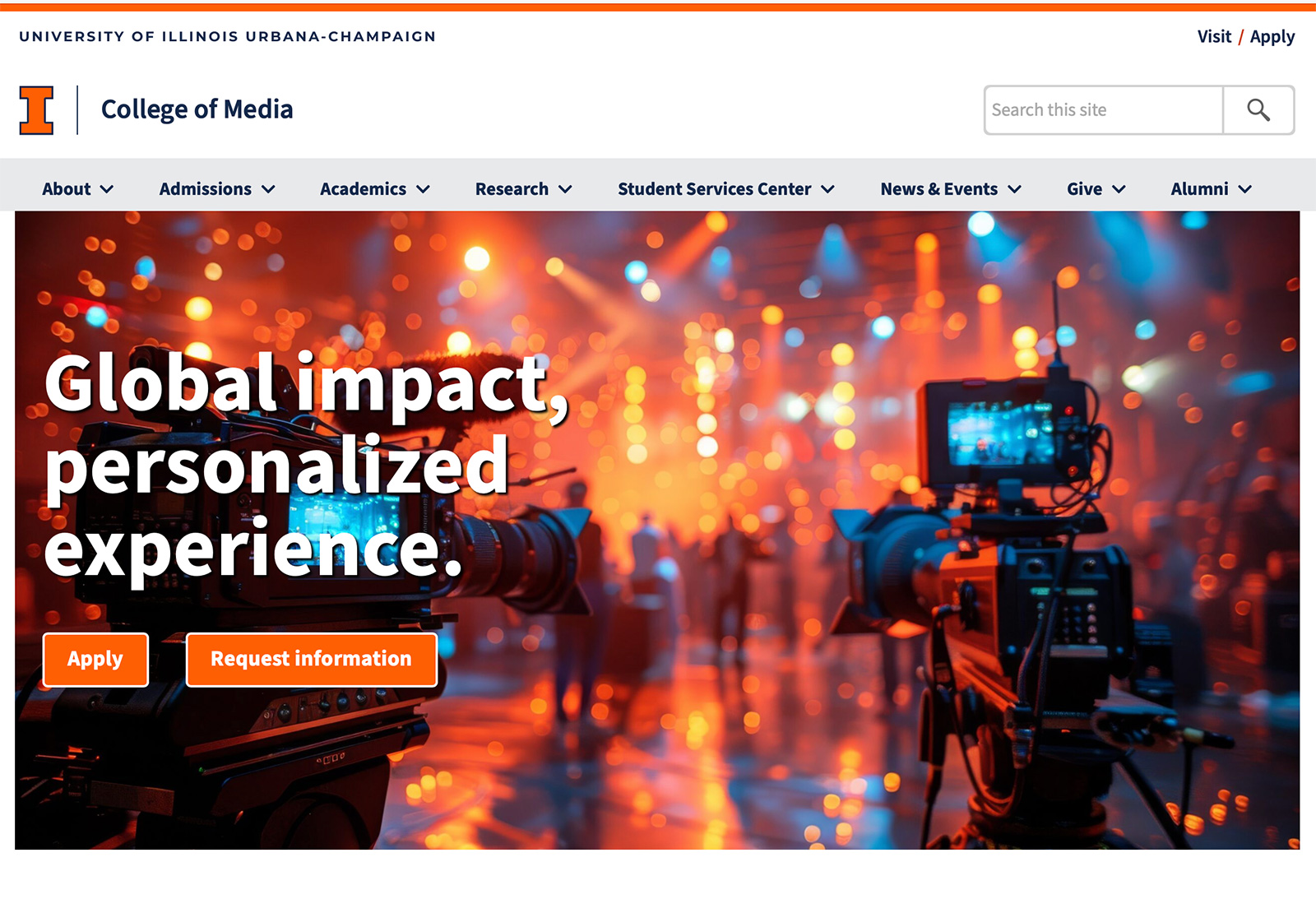
Media’s previous website was on Drupal and was a redesign that had been completed in 2019. According to Rushakoff, the web design of their page had impactful landing pages, but the other pages were simple with limited design and functionality options. Rushakoff also explained that the photos had to be a certain width or else it would break the flow of the page. These limitations were addressed with the Web CoE.
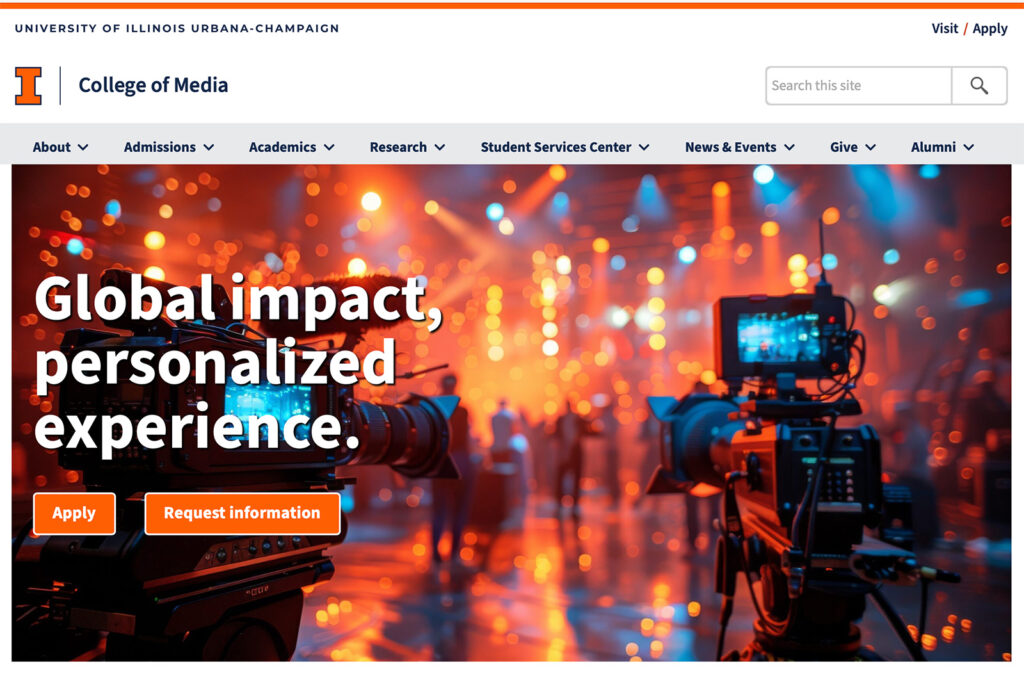
“The new website has accessibility enhancements and an incredible selection of design and layout options, from buttons to call-to-action blocks to clickable cards, plus photo slideshows, pull-quotes, and many header styles—and of course Illinois orange and blue templates to choose from. These design features enable us to make our stories much more visually dynamic and pull readers through the story or a landing page in a more engaging way, with multiple entry points,” Rushakoff said.
Working on the site was a year-long process, with many working meetings between Rushakoff and her Web CoE liaison, Liz Shallenberger, user experience design specialist at Technology Services.
The College of Media’s new website adheres to campus brand guidelines.
“The Web CoE team offered a wide range of expertise in web, graphic and user experience design, information architecture, accessibility and more. There were no questions they couldn’t answer! It was incredibly helpful and reassuring to have guidance from the Website Management Center of Expertise team throughout the entire process,” Rushakoff said.
Throughout the engagement, the College of Media was responsible for tasks such as auditing and organizing their content, tracking accessibility reviews, redesigning past stories with the new story template, updating short URLs and testing the development site for any issues before launch.
“I had an excellent experience working with the team from the Website Management Center of Expertise! Although it was a lot of extra work, it was primarily a joyful process because we could see the exciting transformation as we worked on the development site and chipped away at our milestones,” Rushakoff said.
The final product is a new Illinois-branded, accessible and secure website hosted on the Tech Services server, with people from the College of Media ready to perform site maintenance.
Krista Gaedtke, senior director of strategic marketing and communications for the College of Law was always looking for ways to stay connected with what was happening with website design at a campus level. The College of Law had been needing a refresh for a while, and so when talks about the Website Management Center of Expertise reached Gaedtke, she immediately submitted a ticket requesting available resources.
“Our previous site was not in terrible shape – it was nicely designed, well-structured, responsive and accessible, but it was decidedly not ‘on brand.’ There were also a few features that we were using on our previous site that didn’t provide the level of customization or flexibility that we needed, so finding viable alternative solutions was also a priority for the migration,” said Gaedtke.
According to Gaedtke, WordPress had been meeting their needs sufficiently, and so they opted to migrate their old WordPress site onto another WordPress site, focusing on minor re-structuring instead of changing the host.
“The end result is a website that is now fully compliant with Illinois brand guidelines and accessibility standards and takes advantage of many of the design features and components available within the Illinois web theme,” Gaedtke said.
In addition, Gaedtke noted that they were able to complete the website migration at no cost to the College of Law.
“Having gone through the process for a full-service website redesign project within the past ten years, I am well aware of the significant cost savings we were able to achieve with this partnership,” Gaedtke said. “I think we can easily say that we saved the College of Law at least $50,000 on this project, if not more.”
Gaedtke also mentioned several other benefits to partnering with the Web CoE, including regular access to the developers who were building the tools, the ability to offer feedback at will, see adjustments being made in real-time and suggest future developments.
Geiken said that the Web CoE worked with the College of Law for a full migration, and the College of Law then opted to perform their own future regular maintenance. However, as an official user of the Illinois Web theme, the College of Law will now have first access to all new product releases on the Illinois Web theme and tech support whenever needed.
“There was a point person for the project on both the Web CoE team and on our team. Dena Strong was assigned as our Web CoE liaison for the project; her background is user experience design, but she had to wear many different hats throughout our project, and she was an absolute rockstar. We met on a bi-weekly basis,” Gaedtke said.
Dena Strong, the Web CoE liaison for the project, is a senior information design specialist at Technology Services.
Gaedtke explained that the Web CoE drove the overall management of the project, prioritized action items, migrated all the content over to a development site, worked with them to make it look how they wanted; they performed troubleshooting and also advised on how to utilize certain tools.
On the other hand, Gaedtke’s team worked on making sure all the content was accurate and up-to-date, structured as they wanted it to be, and designed consistently across pages. As the site was on the College of Law’s server, they were also responsible for ensuring that they were aligned to the College of Law’s privacy and security best practices.
“There were certainly some growing pains along the way… simply because this was the first time that either of our teams were engaged in this type of project,” said Gaedtke. “We are really pleased with the end result.”
Over the years, the School of Social Work has had many conversations with units on campus about their lack of internal web support. Without internal staff dedicated to web support, they had been working with an external vendor.
“We started with well-designed, accessible, highly customized site that was expensive to maintain. Through migration [with the Web CoE], we transitioned to a clean, fresh design with significantly improved content organization. The new site aligns with our brand, enhances user experience and will hopefully be much easier to maintain in the long run,” said Becky Ponder, director of communications for the School of Social Work.
The previous site was a vended site hosted on WordPress with extensive customization.
“We had to do custom scripting in order to export their site out from their old environment to their current one. They don’t have staff to maintain their site, so we came up with a solution to address that, working with field consultants at Tech Services. We were able to hire a part-time field consultant to do maintenance for them,” Geiken said.
According to Ponder, the Website CoE managed more of the technical aspects of the site, while the School of Social work’s team focused on content, design preferences and identifying functional needs.
Social Work partnered up with Web CoE liaison and lead consultant for the project Huaqi Zhang, user experience design specialist at Technology Services.
“It was a true partnership, with both teams working diligently to ensure the site met our goals,” Ponder said.
The result was a full migration to a fresh site with dedicated web maintenance support from Tech Services. Receiving overall website support from campus has resulted in significant cost savings for the School of Social Work.
“One of the biggest takeaways from this migration is how complex website transitions can be, even with a great support team. Every website has unique needs, and ensuring all integrations function properly takes time and patience. It was a learning experience for everyone involved! While it was a complex transition, we’re grateful to have the new site launched and are very happy with it,” Ponder said.
The Web CoE has created a list of campus web resources for anyone at the university. This list of resources will be ever-evolving, updated with resources to support groups with all web-related concerns.
“Not everybody needs someone else to set up or maintain their sites. So we wanted to provide some resources for those who do have staff who can do all this for them. This is where collaboration comes in, and this is what this resources page and what our group is all about. We are trying to create a place for people to collaborate, to use whatever resources they have to join in the efforts to unify and protect our websites. So far, it has produced a much better product across the board,” Geiken said. Following the work on the three early adopter’s websites, the Web CoE will be reflecting and refining the program processes while engaging with the College of Applied Health Sciences on a website migration. The Web CoE will be ready to work with more units in the later summer of 2025. If you’re interested in learning more or working with the Web CoE, submit a ticket to start a conversation or to get on the list.