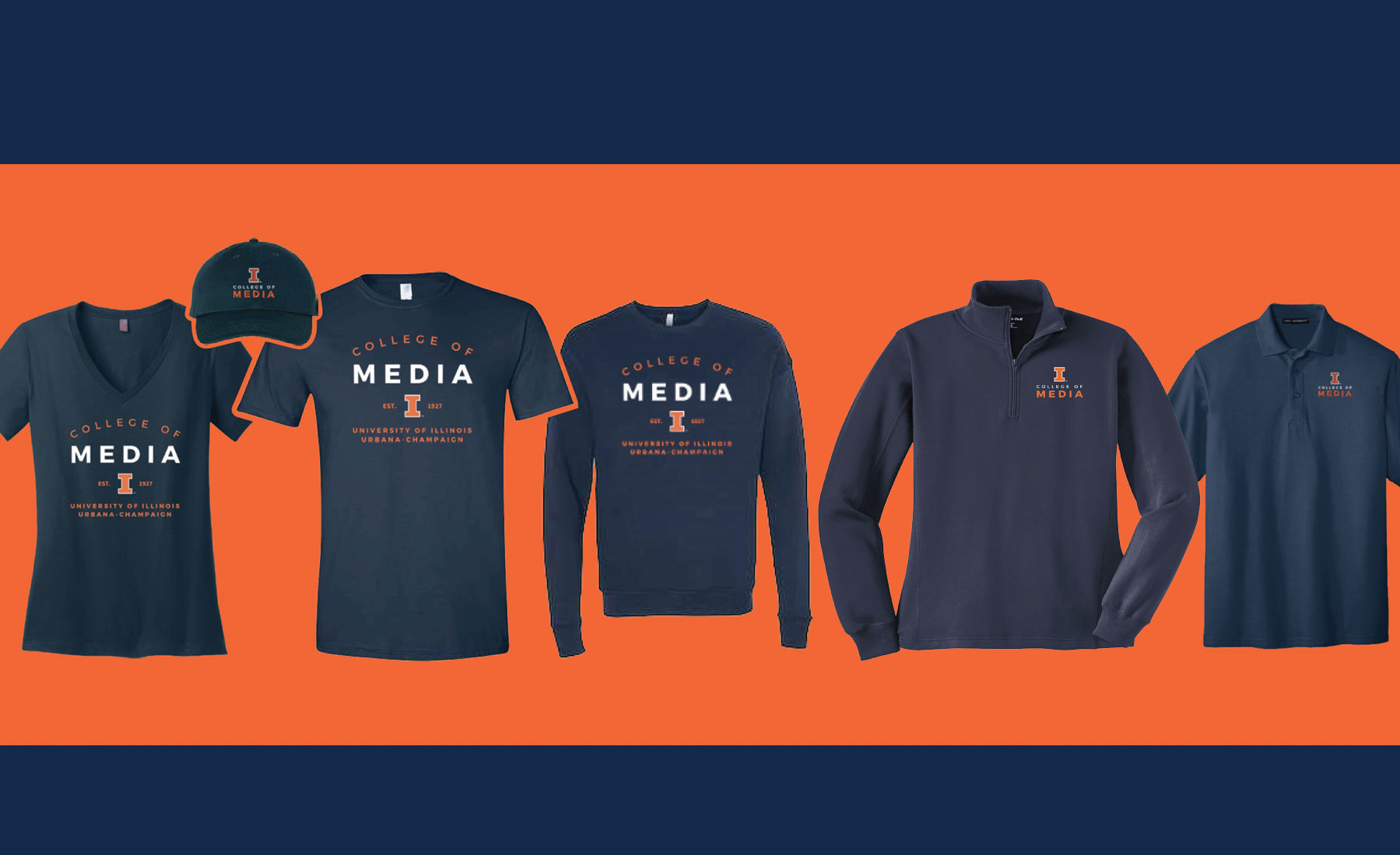
College of Media apparel on sale through May 24


Media apparel shop

Show off your University of Illinois College of Media pride with branded apparel! 

From May 7 through May 24, a College of Media apparel shop will be open with items to purchase including branded quarter-zip pullovers, polo shirts, sweatshirts, ball caps, and T-shirts.

The College of Media, the Charles H. Sandage Department of Advertising, and the Institute of Communications Research all have apparel items available.

Orders will be ready to ship or pick up locally beginning Monday, June 10. Customers can select shipping via USPS Priority Mail, UPS Ground shipping, or USPS International Priority Mail. You can also select the option to pick up your order from Dixon Graphics at 312 S. Neil in Champaign (open Monday-Friday, 8 a.m.-5 p.m.), and will receive a notification when your order is ready. 

To browse the shop, visit go.illinois.edu/media-store.

The shop will close at 11:59 p.m. on Friday, May 24.

Projects involving College of Media faculty, doctoral students receive funding from Chancellor’s Call to Action Research Program


Campus

Two faculty members in the College of Media were named recipients of the 2024-25 Chancellor’s Call to Action Research Program to address system bias and social injustice through cross-disciplinary research. This year, the program focuses on areas that span domestic, international, and transnational spaces.

Victor Font, a lecturer in the Department of Media & Cinema Studies, is collaborating on a project called “Co-creating Knowledge for Antiracist and Transnational Solidarities through Radical Practices of Care, Hope and Human Urbanisms.” His team will receive $99,560.

Anita Say Chan, associate professor in the School of Information Sciences and in the Department of Media & Cinema Studies, received $100,000 for a project she leads called “Activating a Peer-to-Peer Train the Trainers Network for Digital Equity Network in East Central Illinois: Advancing Racial Justice in Non-Profit Digital Navigation Programs.” Doctoral students at the College of Media’s Institute of Communications Research, Jorge Rojas Alvarez and Jiwon Oh, will also work on this initiative.

In its third year, the Chancellor’s Call to Action Research Program will distribute $1.2 million in funding to 11 research projects that support the vision of the University’s Campus-Community Compact to Accelerate Social Justice and partner with community organizations to solve and/or understand historical and current social injustices as they intersect with race.

Learn more about the College of Media-affiliated projects below. Read a full list of the projects funded for 2024-25.


Co-creating Knowledge for Antiracist and Transnational Solidarities through Radical Practices of Care, Hope, and Humane Urbanisms

This project aims co-create non-hierarchical learning spaces for our long-time collaborators, working across campus-community and social-spatial divides, to share social justice pedagogies and digital media methods as pathways for realizing antiracist, transnational solidarities we wish to forge across global color lines.

We build on decades-long relations of trust that faculty members at University of Illinois Urbana-Champaign have nurtured with academics and community groups in the U.S., South Africa, and Brazil to co-create knowledge about everyday practices of care and reciprocity that marginalized urban communities use to struggle beyond dominant divisive lines of race, gender, class, ethnicity and nationality. We refer to such ideals as humane urbanism, where life, not profit, is centered.

Using traditional action research along with emerging digital humanities methodologies, we host digital stories online through a multilingual multimedia website and host activist-in-residence at the University of Illinois Urbana-Champaign campus to gather direct narratives and counter-narratives of urban activists, and uncover how concealed daily practices of radical care and reciprocity in marginalized communities nurture hope and activate imagination of an alternative just future.

The goal of this project facilitating knowledge co-production among academics and community-based organizers is to learn possible paths and pragmatic strategies toward shared ideals of transnational justice.

Project leaders include Faranak Miraftab, College of Fine and Applied Arts; Ken Salo, College of Fine and Applied Arts; Helen Neville, College of Liberal Arts and Sciences; Magdalena Novoa, College of Fine and Applied Arts; Victor Font, College of Media; Teresa Barnes, College of Liberal Arts and Sciences; Atyeh Ashtari University of Memphis; Ricardo Nascimento UNILABE, Brazil; Efadul Hug, Smith College; Sarah Bassett, Arizona State University; Koni Benson, University of Western Cape; Greg Ruiters, University of Western Cape; Clarissa Freitas, Federal University of Ceara; Jose Ricardo Vargas de Faria, Federal University of Paraná; Giselle Tanaka, Federal University of Rio de Janeiroc. Community Members: Rob Robinson, Partners for Dignity and Rights; Dawn Blackman, Randolph Street Community Garden; James Kilgore, First Followers; Ann Rasmus, University of YMCA.


Activating a Peer-to-Peer Train the Trainers Network for Digital Equity Network in East Central Illinois: Advancing Racial Justice in Non-Profit Digital Navigation Programs

The “Peer-to-Peer (P2P) Train-the-Trainers for Broadband Equity” Digital Navigators Program is a collaborative initiative jointly led by the Community Data Clinic at UIUC and the Urbana-Champaign Big Broadband (UC2B) non-profit to address persistent issues of Broadband and Digital Inequity in East Central Illinois EC-IL, particularly affecting historically marginalized and infrastructurally underserved populations.

Leveraging existing partnerships with five community organizations – the Housing Authority of Champaign County, Cunningham Township, Project Success of Vermilion County, Champaign-Urbana Public Health District and First Followers, this project aims to establish a Digital Navigators Network and seed a new EC-IL Broadband Equity Community Hub in Champaign Park District’s multi-purpose Martens Center.

The partnership network will support the development of a local Digital Navigators Program, training 36 new community-facing Digital Navigators, equipping them with new or refurbished laptops, and leveraging resources developed in two years of prior work around broadband equity education and programming with this network.

This project’s overarching goals will enhance affordable broadband adoption, empower community members with essential digital skills, and enhance access to community technology centers. By bringing together expertise from diverse organizations, the initiative seeks to bridge the digital divide and create opportunities for improved digital connectivity and inclusivity in EC-IL. This project was developed in alignment with and prior funding from the Illinois Office of Broadband’s Digital Equity + Inclusion Programming

In addition to Chan, project leaders include Tracy Smith, Technology Services; Paul Hixson, Urbana-Champaign Big Broadband Not-for-Profit; Julian Chin, School of Information Sciences; Jessica Black, Lead for America Fellowship Program. Doctoral students at the College of Media’s Institute of Communications Research, Jorge Rojas Alvarez and Jiwon Oh, will also work on this initiative.

Clifford Christians receives AEJMC’s Eleanor Blum Distinguished Service to Research Award


Christians wins AEJMC Blum Award

Clifford Christians, research professor emeritus of communications, and professor emeritus of media studies and of journalism, will receive the 2024 Eleanor Blum Distinguished Service to Research Award from the Association for Education in Journalism and Mass Communication. The award will be presented at AEJMC’s 107th annual conference in Philadelphia this August.

“I am convinced that Dr. Christians should get credit for creating, leading, and developing the entire subfield of media and journalism ethics, not just in the United States, but in the world. At the least, without his work and his inspiration, media ethics would be entirely impoverished and thin,” said Linda Steiner (PhD ’79, ICR), editor of Journalism & Communication Monographs.

The Blum Distinguished Service to Research Award was created to recognize people who have devoted substantial parts of their careers to promoting research in mass communication, and those who have spent much of their professional lives to mentoring students in areas of research. It is named in honor of the first recipient, Eleanor Blum, a long-time communications librarian at the University of Illinois Urbana-Champaign. 

Christians (PhD ’74, ICR) is a former director of the Institute of Communications Research at the College of Media and chair of the doctoral program in communications, positions he held from 1987-2001 and from 2007-2009. 

The Association for Education in Journalism and Mass Communication is a nonprofit, educational association of journalism and mass communication educators, students, and media professionals. AEJMC’s mission is to promote the highest possible standards for journalism and mass communication education, to cultivate the widest possible range of communication research, to encourage the implementation of a multi-cultural society in the classroom and curriculum, and to defend and maintain freedom of communication in an effort to achieve better professional practice and a better informed public.

Journalism alumna publishes article in ‘Newsweek’

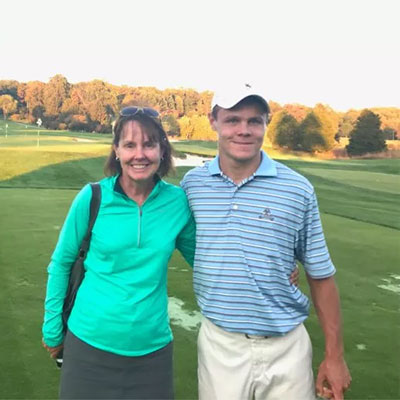
Mary Lynch Snowdon (BS ’86, journalism) wrote an article that was published in Newsweek recently titled “My Talented Son Has Autism. As a Mother, I Feel Like a Dual Citizen.” In the article, Snowdon writes about her experience parenting her son with autism, who is now in his mid-20s and a talented golfer.

Snowdon is a lawyer, consultant, and advocate. She currently resides in Annapolis, Maryland. 

Mary Snowden

Media students present at 2024 Undergraduate Research Symposium


Undergraduate Research Symposium

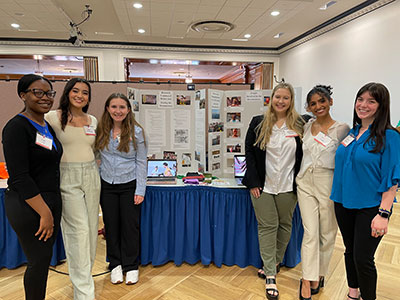
Update June 4, 2024: Congratulations to the students who presented “Exploring Period Poverty in Sierra Leone” (pictured below) for receiving an award for Outstanding Exhibit at the Undergraduate Research Symposium from the Office of Undergraduate Research! Learn more about their trip to Sierra Leone.


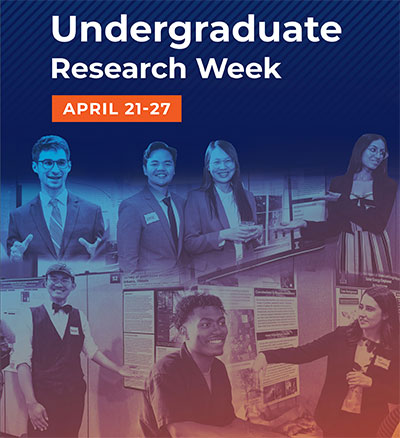
Students from the College of Media are participating in the annual University of Illinois Undergraduate Research Week, held April 21-27. The Undergraduate Research Symposium, the signature event held on April 24 at the Illini Union, features presentations, posters, and performances from students across campus. 

Media student presentations include:

Sierra Leone group presentation

On Exhibit: Robots & Medical Technology
“Exploring Period Poverty in Sierra Leone” 

  • Faith Lee, junior in journalism
  • Piper Pascarella, sophomore in journalism
  • Maggie Knutte, junior in journalism
  • Stephanie Wayda, senior in journalism
  • Nour Longi, junior, journalism
  • Elena Cleary, junior in agricultural communications (College of ACES)
  • Research Mentors: Alison Davis and Charles “Stretch” Ledford, Department of Journalism
     
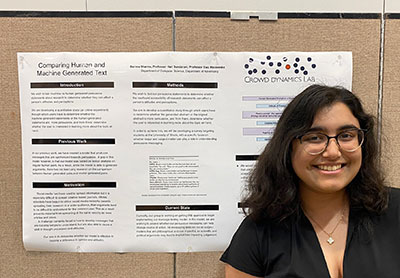
Garima Sharma

CS Student Ambassadors/Research Scholars
Illinois Scholars Undergraduate Research Program Research Expo
“Comparing Human Generated Text with Machine Generated Text”
Garima Sharma, senior in CS + advertising
 

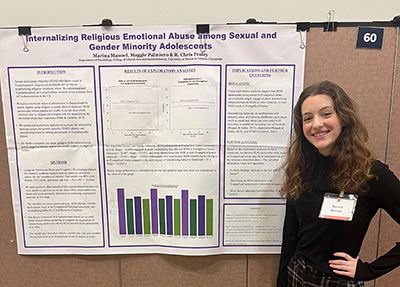
Marina Manuel

Poster Presentation: Social Science & Human Behavior 
“Mental Health and Wellbeing Outcomes among Gender and Sexuality Diverse Individuals Raised in Fundamentalist Religious Environments: Exploratory Analyses and Study Design”
Marina Manuel, senior in media and cinema studies
Research Mentor(s): Chris Fraley and Maggie Palmiero, Department of Psychology (College of LAS)

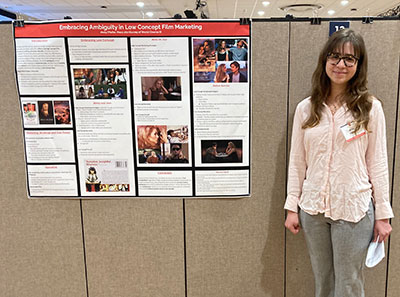
Pfeifer

Jenny Oyallon-Koloski, assistant professor of media and cinema studies, was the research mentor for Molly Pfeifer, senior in psychology (College of LAS) and cinema studies minor, who is presenting “Embracing Ambiguity in Low Concept Film Marketing” as part of the Humanities, Arts & Social Sciences poster presentations. 

View the Undergraduate Research Week program.

Journalism alum Lawrence Ingrassia weaves personal loss with scientific discoveries in second book

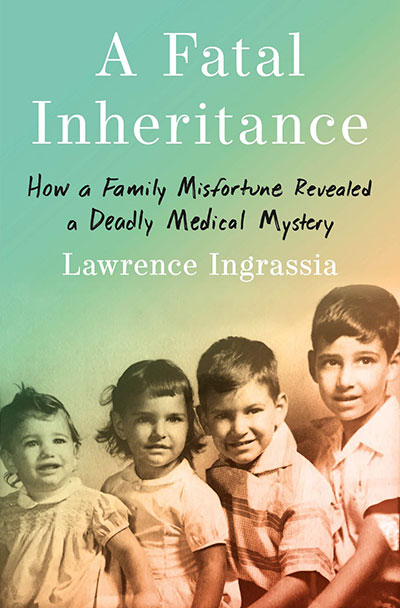
Lawrence Ingrassia (BS ’74, journalism) has written a new book, A Fatal Inheritance: How a Family Misfortune Revealed a Deadly Medical Mystery.

A Fatal Inheritance, which will be available on May 14, 2024, narrates the tale of a team of dedicated researchers who solved the medical mystery behind seemingly unrelated cancers devastating his and other families. 

The book has been described as “a compelling personal chronicle of tragedy and triumph.”

Ingrassia is a former business and economics editor and deputy managing editor at the New York Times, having previously spent 25 years at the Wall Street Journal, as Boston bureau chief, London bureau chief, money and investing editor, and assistant managing editor. 

He also served as managing editor of the Los Angeles Times. The coverage he directed won five Pulitzer Prizes as well as Gerald Loeb Awards and George Polk Awards. 

His first book, Billion Dollar Brand Club, chronicles the rise of popular direct-to-consumer e-commerce brands and was shortlisted for several best business book awards for 2020. 

Ingrassia book

Advertising alum Andrea Campos to be alumni speaker at College of Media Convocation


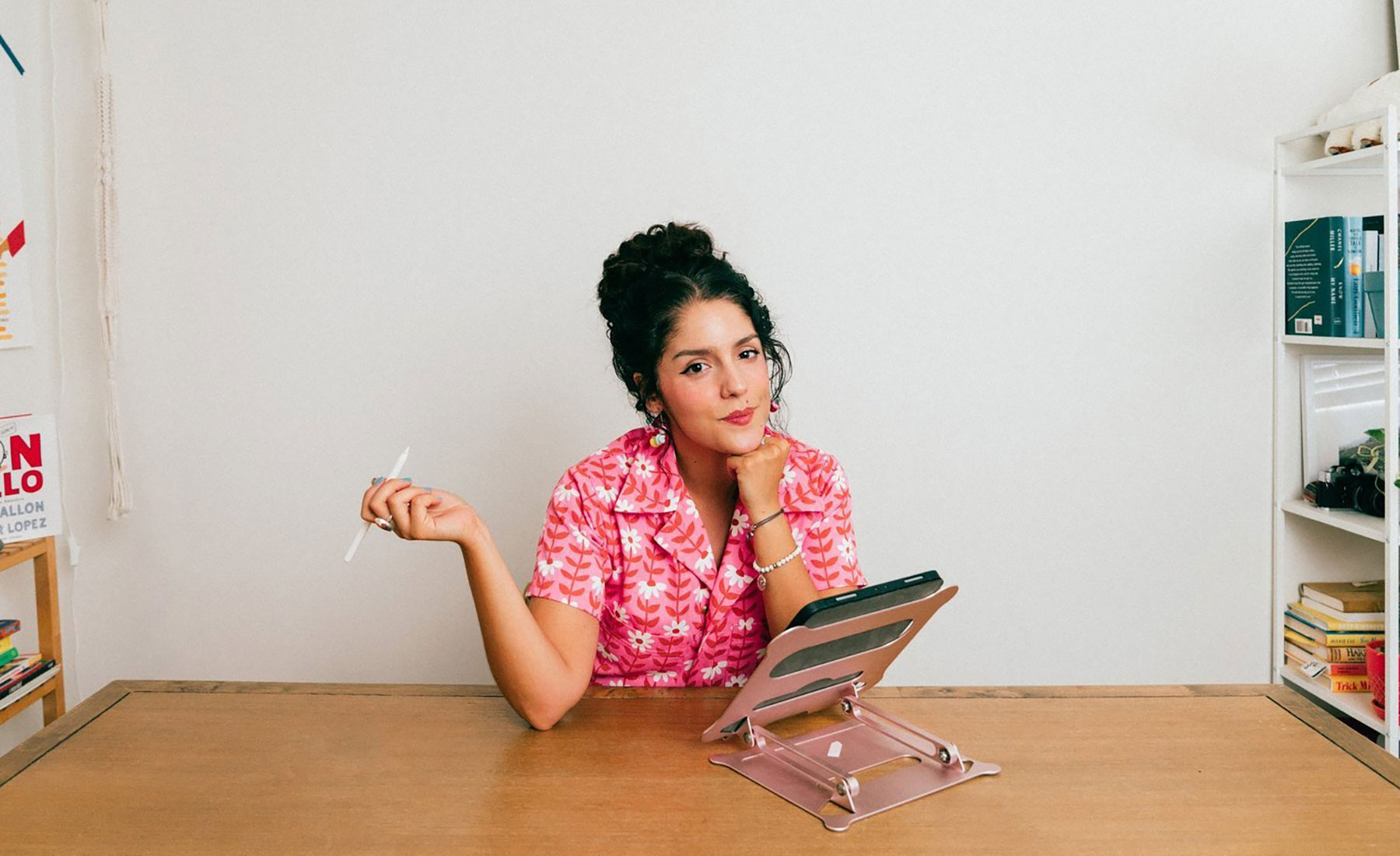
Andrea Campos

When Andrea Campos graduated from Illinois with a bachelor’s degree in advertising, she had no idea she’d be returning 12 years later as the alumni speaker at the 2024 College of Media Convocation ceremony. 

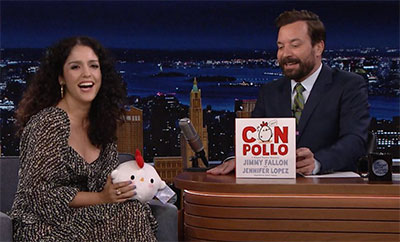
But as an artist and creative entrepreneur whose recent career accomplishments include illustrating a New York Times-bestselling children’s book with celebrities Jimmy Fallon and Jennifer Lopez, Campos has realized life is full of happy surprises, especially if you dare to follow your dreams. 

“If you would have told me in 2012 that I was going to be standing up there (on stage at Convocation), I wouldn’t believe you. I didn’t have it on my radar,” Campos said. “I never would’ve imagined it. Maybe that’s something I’ll touch on in my speech—that we all need to dream bigger, because too often, we like to count ourselves out.”

Campos, who currently resides in Los Angeles, has managed to build a successful career around spreading happiness. 

“I like that I can be an island of joy or a little space of hope in an otherwise stressful world,” Campos said. 

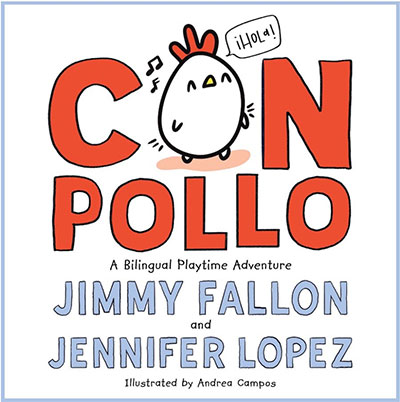
Her bright, colorful, fun illustrations can be found in children’s books like Con Pollo: A Bilingual Playtime Adventure and printed on lunchboxes and other products for children and infants. 

Con Pollo by Andrea Campos

Ironically, the happiness she exudes through her artwork emerged from a time when the entire world was experiencing sadness. 

In March of 2020, after nearly a decade of working as a marketing professional for companies like Gap Inc., Campos was planning to set off on a new path as a freelance photographer.  

“It really felt like it was now or never,” Campos said of her decision to switch careers. “My last day at my full-time job was March 8. And then, you know, days later the world shut down.”

With every photography project canceled due to the COVID-19 pandemic, Campos was left wondering what to do next.

Thankfully, she had saved some money so she decided to concentrate on rebuilding her creative confidence and sought out ways to relieve stress during a chaotic time.

“I decided to focus on creative activities during quarantine, simple things that would bring me joy. You know, the kind of things we used to do as kids when we were sitting at home bored,” Campos said.

She started baking, going on photo walks, and drawing, a childhood hobby she’d neglected since her high school days.     

“As part of my at-home artist residency I started drawing again, and I began to notice that it not only made me feel good, but it also helped me process my emotions,” Campos said. “It’s kind of crazy to think that if it weren’t for the world coming to a halt due to the pandemic, I would have left these treasures buried deep inside of me.”

Campos used an iPad and the Procreate app, which essentially lets users sketch on digital paper, to create “playful, positive, joyful artwork.” 

She started an Instagram page called @dreasdoodles to share her illustrations with family and friends she couldn’t connect with in person. 

Campos said she didn’t realize it at the time, but her Instagram page, which she described as her “little pocket of the Internet where it’s always sunny,” was going to completely change her life.

Campos, who was never formally trained as an artist, gained thousands of followers over the next several months.

Eventually she started to get requests from brands and small business owners to create logos and other marketing materials. 

Almost one year to the day of the inception of @dreasdoodles, Campos received an email that would change her life forever. 

An art director at Macmillan Publishers reached out to ask if she’d be interested in illustrating a celebrity children’s book. 

“When I got that email, my jaw was on the floor,” Campos said.

Later, Campos learned she was one of two artists being considered for the book, which included a chicken named “Pollo” as the main character. 

“Even though I had zero experience, I thought to myself, ‘I am going to do everything in my power to draw the cutest, baddest little chicken the world has ever seen because I know this was meant for me,’” Campos said.

She submitted her designs in April and heard in June that she got the project. 

“It was months and months of me just shaking every time I opened my email. And when I finally got that email, I just started sobbing, like straight up ugly crying,” Campos said. 

Andrea Campos on Jimmy Fallon Show

Soon after, another email came inviting Campos to be a guest on The Tonight Show Starring Jimmy Fallon. Campos went on to do several more interviews with Fallon to help promote their book.

“That was one of those moments that was just so surreal and so special. The book launch for Con Pollo is one of those things I look back at whenever I’m having a bad day and say to myself, ‘I did that,’” Campos said.

After the whirlwind of illustrating a best-selling children’s book, Campos had to consider her next step and knew her advertising and marketing experience could help her build a sustainable art business.

“Sure, I’m not working on campaigns in the same way that I was before, while at agencies. But I am still very much in the business of telling stories through my work,” Campos said. “And that skill set undoubtedly took root right here at U of I.”

Campos said Jason P. Chambers, professor of advertising and associate dean for diversity, equity, and inclusion, made a big impact on her with his teaching style and the way he weaved history into the broader advertising campaigns. 

Steve Hall, senior lecturer in advertising, also stood out in her mind due to his leadership in extracurricular student activities, such as the American Advertising Federation and the National Student Advertising Competition. 

Campos was involved with AAF and, during her senior year, presented at the NSAC. She was awarded AAF’s Most Promising Multicultural Student in 2012, which allowed her to travel to New York for networking opportunities. There, she was able to connect with someone at Energy BBDO, who offered Campos her first advertising job after graduation. 

Campos is grateful for her time at Illinois and was happy to return last fall after Hall invited her to speak to some of his advertising classes. 

These days, Campos is focusing on licensing her artwork, brand collaborations, and speaking engagements, presenting workshops at companies like Google, LinkedIn, and eBay about the power of creativity and the importance of giving yourself time to play. She also is working on writing and illustrating her own picture book.

“My biggest North Star with everything I do is being playful with a purpose and I’m trying to encourage that not only in kids but also in adults,” Campos said. “The last four years have taught me amazing things can happen if we just give ourselves the time to do something just for fun.”

As a first-generation Latina woman, part of her purpose is sharing the beautiful aspects of her Mexican heritage and culture.

When speaking to young children at schools, Campos sees firsthand how much representation matters.

“I’ve had little kids just so excited that someone who speaks Spanish is doing this,” she said. “That’s the stuff that I think will have an impact that I’ll never be able to measure and that’s what makes me so happy.”

Campos has a lot of advice to share. She encourages students to consider their priorities and to remember that growth isn’t always going to be linear.

“Your career doesn’t have to be a ladder. Chances are, it’s going to be a jungle gym,” Campos said. “It’s okay to change your mind and try different things—in fact, I think curiosity is one of the most valuable skills you can have.”
College of Media collaborates with University, community partners to offer local children access to new opportunities in education, technology


Steve Hall with Boys & Girls Club
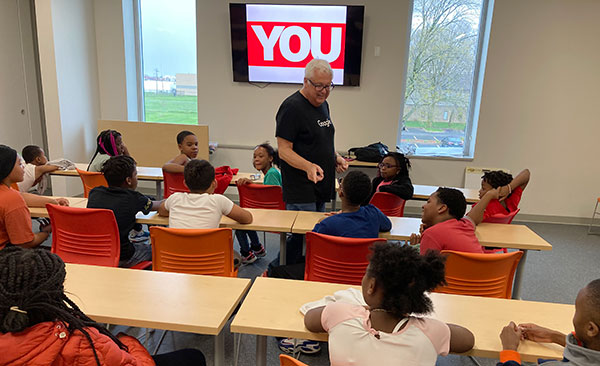
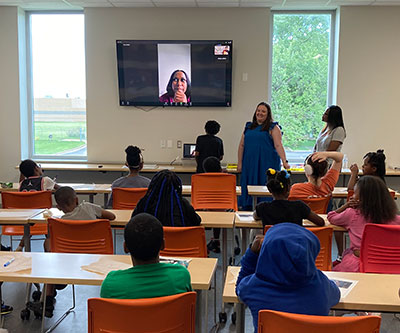
Steve Hall, senior lecturer in advertising, leads Boys & Girls Club students through a workshop on “Advertising for Good.” (Photos by Paige Duncan.)

The College of Media is collaborating with University of Illinois and community partners to present educational workshops to local children this spring as part of a new public engagement effort.

The collaboration between the College of Media and the Center for Social and Behavioral Science focuses on creating hands-on educational content appropriate for 3rd– and 4th-grade students in the Don Moyer Boys & Girls Club of Champaign, which is housed at the Martens Center in Champaign. 

“One of the College of Media’s priorities is to enhance our activities in public engagement and access,” said Jason P. Chambers, associate dean for diversity, equity, and inclusion, and professor of advertising. “Faculty and staff were eager to sign up to share their expertise in fun, engaging ways with schoolchildren.” 

College of Media faculty are leading four programs in April, offering new opportunities in education and technology and helping students understand different media topics.

Boys & Girls Club students

“This first-time collaboration between the University and the Martens Center is not just exciting but a big game changer for community outreach and education, providing a unique opportunity for the University of Illinois to deliver transformative experiences to our community,” said Paige Duncan, community engagement specialist at the Center for Social and Behavioral Science.

Duncan said the College of Media was selected as the pilot module for the CSBS area of programming because their goal is to give elementary school students an introduction to a breadth of science learning opportunities, including different concepts from the social and behavioral sciences.

“We are excited about the College of Media’s programming because it gives children a window into the making of different types of media, which is likely to increase their media literacy. We hope they will become better consumers of media—for example, in terms of judging the veracity of advertisements and movies,” Duncan said.

Steve Hall, senior lecturer in advertising, held the first workshop, about “Advertising for Good.”

“It was a remarkable opportunity to help [the children] learn how they have the ability to positively impact the world with their ideas, creativity, and advertising,” Hall said. “The kids were super energetic, enthusiastic, always asking questions, and full of insights.”

The joint effort between the University units, the Champaign Park District, and the Boys & Girls Club is part of the Chancellor’s Call-To-Action Campus-Community Compact to Accelerate Social Justice. 

The College of Media workshops include:

Advertising for Good
Steve Hall, senior lecturer in advertising
Students will learn how advertising and creativity can be used for public and social good through the power of storytelling. Plus, a fun, hands-on creative challenge will allow students to generate their own ideas to create a positive impact in their own schools and communities. 

Fly Like Harry Potter: How Green Screens Work
Victor Font, lecturer in media and cinema studies and Susan Muirhead, advertising staff and adjunct faculty
This hands-on workshop teaches students about the green screen process and how this technique is used in films. Students will be able to dress up in costume, pretend to fly on a broomstick, and then watch the editing process to remove the green background creating the final effect. 

Fruit campaigns

Advertising Literacy
Michelle Nelson, professor and head of the Charles H. Sandage Department of Advertising, and Marisa Peacock, lecturer in advertising
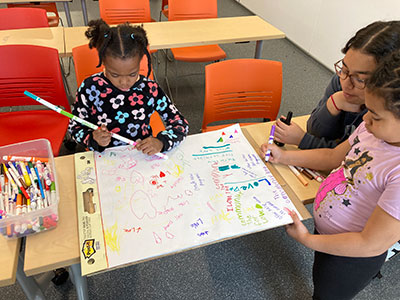
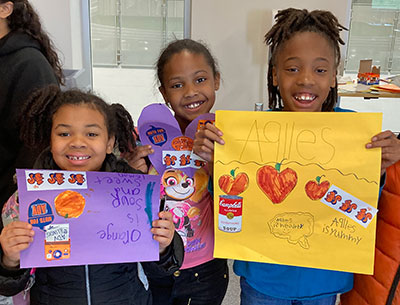
This session will provide students with an understanding of the purpose and fun one can have with advertising. Through discussion, brainstorming, and hands-on activities, students will create an ad promoting healthy food products. 

Interviewing Genesis Bryant

Introduction to Journalism and the Role of Reporters
Colleen King, director of the Richard and Leslie Frank Center for Leadership and Innovation in Media and clinical assistant professor in journalism, and Faith Lee, Mark L. Brandt Public Engagement Fellow and a junior in journalism
Following a presentation about what a journalist does, Genesis Bryant, a guard on the Illinois women’s basketball team will join the student group via Zoom for a Q&A. Using a guided worksheet, students will then write a story about the student athlete.

(Photos by Paige Duncan.)

Recent MACS alum reflects on film production ahead of Ebert Center screening

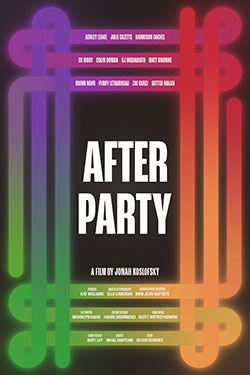
After Party cast+crew

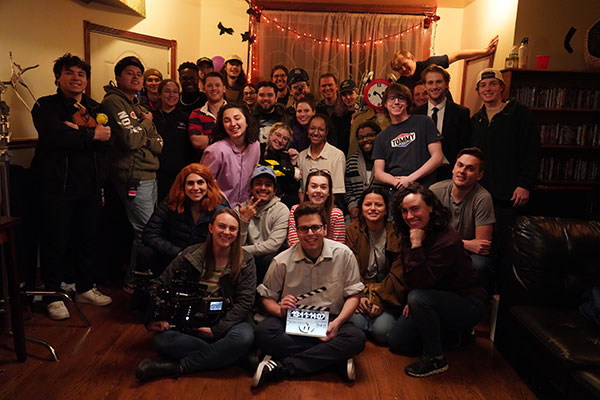
After Party, a short film produced by alum Kat Williams (BS ’22, media and cinema studies), will be featured on Thursday, April 4, at the Knight Auditorium of Spurlock Museum, as part of the screening series presented by the Roger Ebert Center for Film Studies. This year’s Ebert Fellows, who curated the evening’s films, chose the 20-minute short to be shown before the main film screening of Portrait of a Lady on Fire.

Williams worked as producer for After Party in her first major project since graduating in 2022. Based in Chicago, Williams has held various production assistant roles in the independent movie scene.

In a recent interview, Williams described the making of the film and what her time at the University of Illinois taught her about filmmaking. Director Jonah Koslofsky also shared insights on Williams’ impact on After Party and what he hopes viewers will take away from the film. 

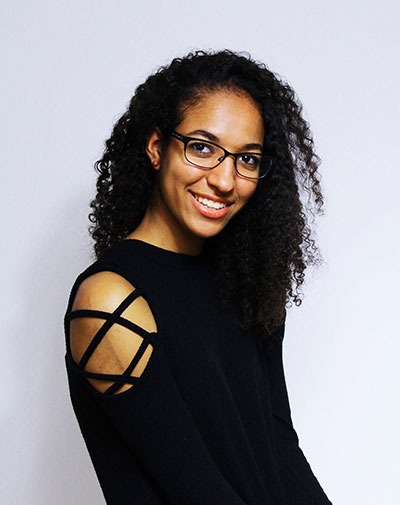
Kat WilliamsWhat is After Party about?
Kat Williams
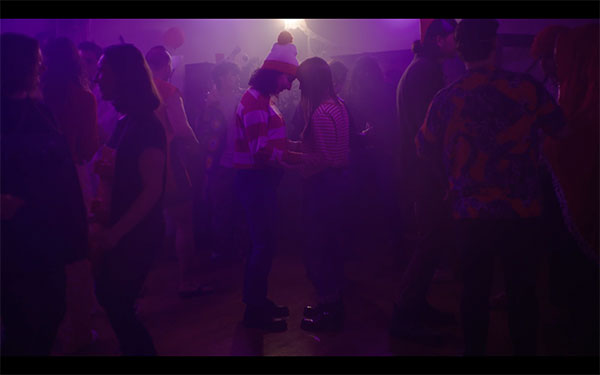
: After Party is a short film about a group of college friends who haven’t seen each other in a while, coming back together post-COVID when we all started hanging out again outdoors. It looks at the changes in their relationships, their dynamics, and how they figure those out and move forward. It’s about connection. It’s about people. It’s about shenanigans. 

What was the filmmaking process like?
Williams:
I first met with director Jonah Koslofsky about this project in October of 2022 and then we started shooting in April of 2023. It was one week of production—we shot for five days. Before that, it was a lot of coordinating, ordering things, finding our location, finding our crew, stuff like that. Then we shot for a week and spent the next several months going through editing, color, sound, and music. This was my first time producing a project front-to-back like that, so it was very fun for me to really explore that and find out what this job is like.

In your role as producer, what did you do for this film specifically?
Williams:
A producer really oversees the project from start to end. A lot of people, when they think of film production, think of just the days that you’re on set. But there’s so much more on the front end and on the back end of that. In the year that we spent working on this project, we were only on set for a week. As a producer, what I do on a day-to-day basis is start with doing a breakdown. You take the script and figure out what you need and then you have to figure out where to get things, and how much it’s going to cost. You start talking to potential crew members, people that you would trust to help you take this from page to screen. Things just kind of fall together. If you get the right people together, you can make anything happen and we were really lucky to have had a good group.

What did Kat Williams bring to the project?
Jonah Koslofsky:
She provided essential feedback and encouragement as I was writing the script. Once the writing was complete, she organized and constructed the budget for the project, and then she and I coordinated the crowdfunding of said budget. She set up our Backstage page and provided valuable input throughout the casting process. She helped assemble our incredible crew and communicated with our entire team so that our shoot was able to come together. Then she found our editor, post-sound editor, and composer so that our post-production could be completed in a timely manner, and now, she’s devising our festival strategy and building our website and press materials. 

This is by no means an exhaustive list of things Kat brought to the project, but more than anything else, she was a support for me and the whole movie when things became particularly stressful or uncertain. Whenever I found myself close to an edge, Kat was able to pull me back to stable ground and towards actually solving the problem. She always believed in the project, and worked day after day to make sure it did not fall apart. After Party would not exist without her.

After Party still

What do you hope students take away from the film? 
Koslofsky:
I hope students enjoy the film! I hope that they are able to see themselves in the ensemble; I hope students recognize the experience of re-entering the world as the pandemic ended and finding oneself increasingly confused. I hope that they read into the film and draw their own conclusions—we were very particular with where certain shots start and end, how certain characters reflect each other. And I hope they laugh at the jokes.

After Party posterHow do you feel about something that you worked on being screened in Champaign-Urbana?

Williams:
I’m so excited. I learned so much about what I do at the University of Illinois. It means a lot to me to get to share this with the campus community and to have the Ebert Fellows sharing this with Portrait of a Lady on Fire, which is one of my favorite movies and also a huge inspiration for the film. It means a lot to have this all coming together like this.

Koslofsky: Screening in Urbana is a huge honor. I love Champaign-Urbana, and I’m so excited to bring the film to the audience here. While the film is set in Chicago, it’s packed with Urbana DNA—in addition to Williams and myself, our director of photography Ella Lubienski is also an Urbana native. It’s a movie made by Urbana people, so it really makes sense to show it to Urbana people.

Are there any particular classes or experiences at the College of Media that helped you for this role? 
Williams:
I took MACS 100 with Dr. Amanda Ciafone, and realized I’m supposed to be studying movies and making them. That changed everything for me. I really loved all those MACS classes, and all of the professors were fantastic. Victor Font was also a huge help with teaching theory, and learning how to apply that on set, learning what all these positions are, what all the equipment is, and how to function on a set. I was also able to get a minor in critical film production, a minor in creative writing, and I got a certificate in international global studies. All of that has really come together in a way that I’m having a lot of fun with now and I get to use those skills all the time, which is exciting.

What advice do you have for MACS and College of Media students?
Williams:
I think the biggest thing is just talking to people—find your people, use your network, make friends. And just have fun with it. Because for me, the whole reason that I started doing this was because I wanted work to be fun and I wanted to enjoy what I’m doing and have something beautiful at the end of it that I can show people.

—Vivian La, Communications Intern

Dr. Mike Yao explains how AI bias reflects back human beliefs


There are biases in AI in how it works, biases in the data that we feed to the AI to train them, there are biases in the way in which AI is being used and implemented, and then there are also biases and psychological processes at the psychological level that we bring naturally when we interact with AI technology.

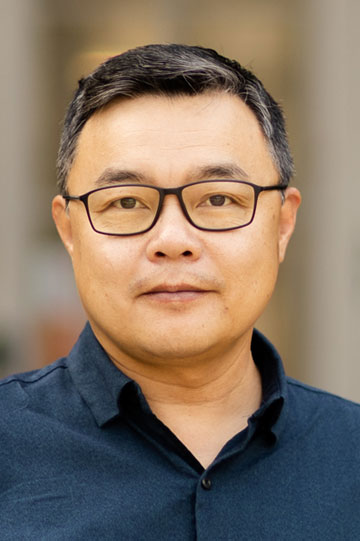
headshot of Mike Yao

Mike Yao, professor of digital media in the Charles H. Sandage Department of Advertising and director of the Institute of Communications Research, explained to NPR’s Community Voices how AI bias is generated by humans and reflects back what it learns from inputs humans provide it. He also discussed how AI can be helpful when designed with human needs in mind.

DEV College of Media
119 Gregory Hall
810 S. Wright St.
Urbana, IL 61801
217-333-2350