Media students present at 2023 Undergraduate Research Symposium


Students from the College of Media are participating in the 16th annual University of Illinois Undergraduate Research Symposium, held Thursday, April 27, in the Illini Union. The symposium features presentations, posters, and performances from students across campus. (View the program.)

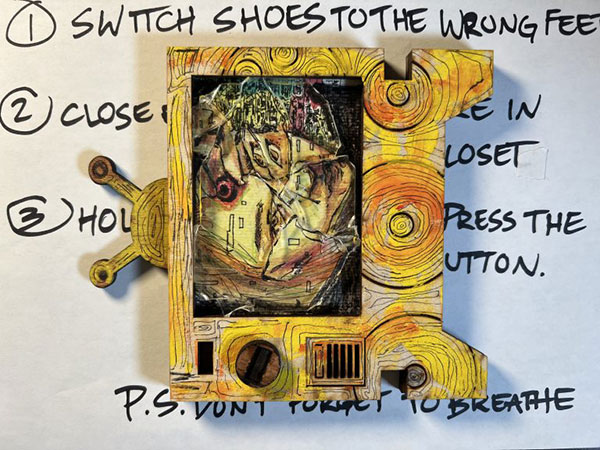
Alex Gallegos image

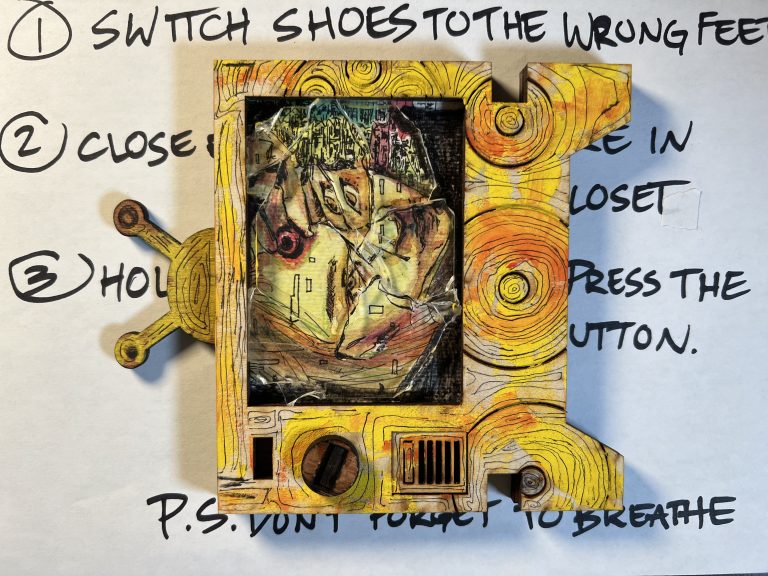
Pictured above is “Yellow Hollywood” by Alex Gallegos, a sophomore in media and cinema studies, who was a semi-finalist in the Image of Research competition. Read his description about his image, which was inspired by the film Everything Everywhere All At Once. The winners’ and semi-finalists’ images are on display as part of the symposium.


Media student poster presentations include:

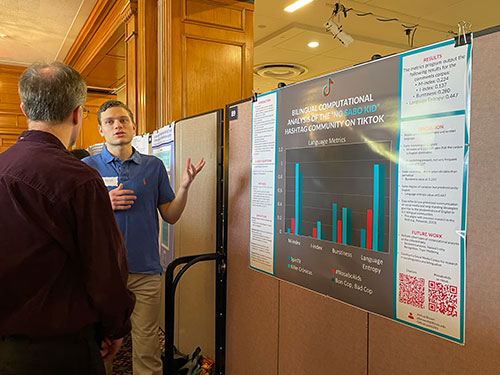
Joshua Brown

“Bilingual Computational Analysis of the #nosabokid Hashtag Community on TikTok” (#89)
9:00 AM – 10:15 AM, Illini Union South Lounge

  • Joshua Brown, Sophomore, Computer Science + Advertising

Research Mentor: Salvatore Callesano, Spanish & Portuguese


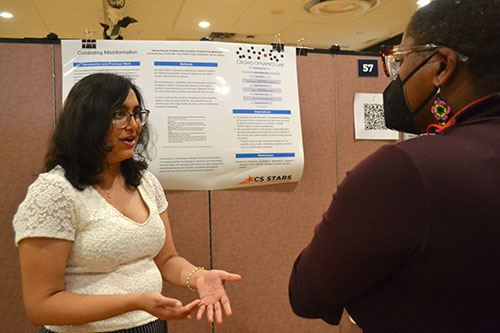
Garima Sharma

“Combating Misinformation” (#56)
10:45 AM – 12:00 PM, Illini Room C

  • Garima Sharma, Junior, Computer Science + Advertising

Research Mentors: Ewa Maslowska, Assistant Professor of Advertising; Hari Sundaram, Computer Science


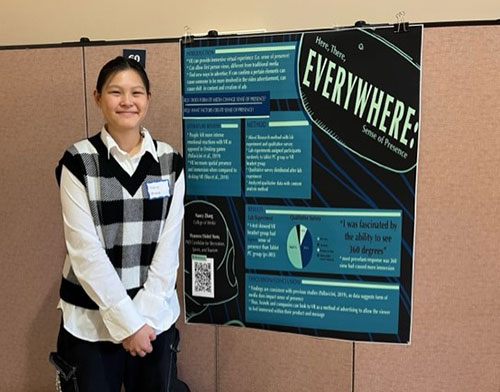
Nancy Zhang

“Here, There, Everywhere: Sense of Presence” (#60)
10:45 AM – 12:00 PM, Illini Room C

  • Nancy Zhang, Freshman, Computer Science + Advertising

Research Mentor: Hyunseo (Violet) Yoon, Recreation, Sport & Tourism


J. Sidney Malone

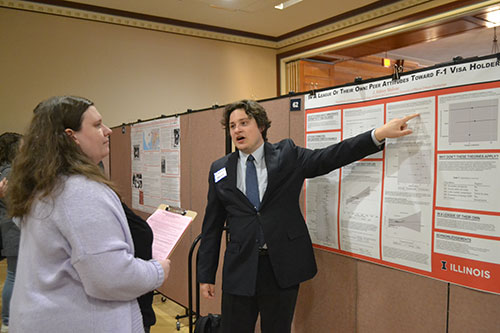
“In A League of Their Own: A Study of Peer Attitudes Toward F-1 Visa Holders” (#62)

  • J. Sidney Malone, Senior, Political Science and Journalism 

Research Mentor: Yujeong Yang, Political Science


Alex Gallegos

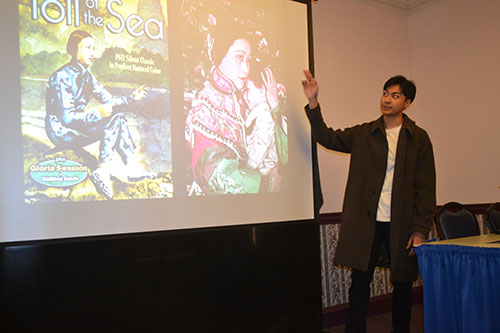
“Yellow Hollywood: Disparities, Representation and Contemporary Problems of Asian/Asian Americans in the Hollywood Film Industry”
11:00 AM – 12:00 PM, Illini Union Room 217

  • Alex Gallegos, Sophomore, Media & Cinema Studies

Research Mentor: Rachel Kuo, Assistant Professor, Media & Cinema Studies


Yun Hyuk Alex Choi

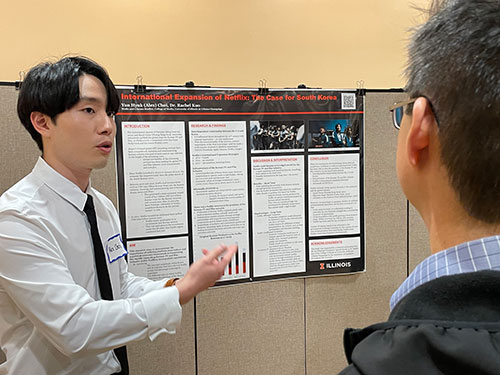
“International Expansion of Netflix: The Case for South Korea” (#18)
3:45 – 5:00 PM, Illini Room A

  • Yun Hyuk (Alex) Choi, Senior, Media & Cinema Studies

Research Mentor: Rachel Kuo, Assistant Professor, Media & Cinema Studies


As part of the Undergraduate Research Apprenticeship Program to assist advanced graduate students with their research projects, Nancy Zhang, a freshman in computer science + advertising, worked with research mentor Hyunseo Yoon in the Department of Recreation, Sport & Tourism.

Jenny Oyallon-Koloski, assistant professor of media and cinema studies, was the research mentor for Gehan Jia, a junior in mathematics and computer science (LAS) for their presentation on “Howl’s Moving Castle Moving.”


Q&A with Josh Heuman

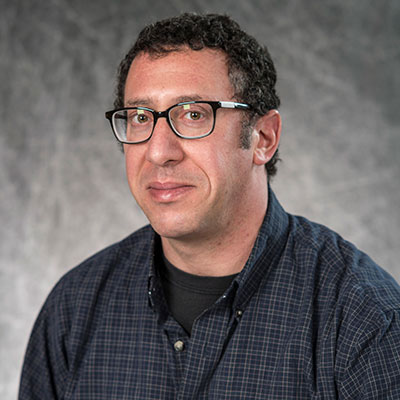
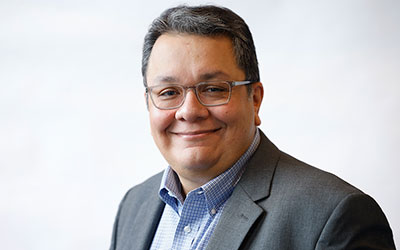
Get to know some of our College of Media faculty. Josh Heuman is a teaching assistant professor in the Department of Media & Cinema Studies and the Department of Journalism. He received the 2022 College of Media Award for Excellence in Undergraduate Teaching by a Specialized Faculty Member. 

Josh Heuman

What is your favorite class to teach? 
We’re not supposed to have favorites, like you don’t have a favorite child. Usually, we get to teach courses that we want to teach. Even when you are teaching something that you didn’t necessarily pick yourself, you find the interest in each class you teach. 

I do enjoy all the courses I teach, but Creative and Information Economies (MACS 264) is probably my favorite because it’s a material that’s closest to my own work and it is always changing. This course gives a broad introduction to media industries. We take a really close look at film, music, and television industries. I think part of the fun of the course is looking at things that cut across all different kinds of media industries. So before too long in the course, we’ll talk about things like labor markets and geographies of media industries, allowing lots of interesting comparisons.

What are some other classes that you teach?
I usually teach the History of American Journalism course (JOUR 205), and then this semester I’ve just started the Media Law course (JOUR 311), which is really exciting for me; that’s what I taught at other universities in the past. 

What are some projects that you are involved in?
The big project that I’m interested in pursuing over the long term is looking at the historical development of radio and television and writing, and especially the way that we come to the role of the radio and television writer as a professional. I think in a lot of cases, when we do look back on the history of radio and television writing, or other kinds of writing as well, we’re telling the stories of the triumph of art or the defeat of art, as if that’s what that kind of work should be.

When you go back to the beginnings of the field, they were very ambivalent about this ideal of art. I think looking more closely at how early radio and television writers imagine themselves, how they were shaped by outside forces, gives a much more complicated picture of what that role was at the time.

What are some past projects of yours? 
I think a lot of my projects revolve around questions of industry and regulation. By looking at television writers’ contracts and the idea of the figure of the showrunner is really interesting. This really reflects specific transformations in television. I am also interested in writers as it relates to authorship and ownership of series formats.

How do you conduct your research?
I think with different projects, it works out in different ways. Usually, I find myself looking at documents from a particular time period. I’m really thinking about radio and television writing. I was just flipping through Writer’s Digest—the writer magazines with amateur writers from the ’20s through the ’60s, and just seeing what they’re saying. I was thinking about two questions: How does one do radio and then television writing? What are the characteristics of a radio or television writer and the way that that gets defined in those materials for aspiring writers?

What made you want to teach?
I think going to graduate school and having the excitement of looking at these complex systems that shape our world and the interest of working within those systems was something that has always been present in my life. Media is incredibly interesting. I also think that when I was entering into graduate school was a particular moment when media and cultural studies were colliding. If you wanted to know about the world, the field of media and cultural studies was and is an especially exciting place to work. I’m really glad to be in Illinois and teaching the kind of students who are really engaged, really interested. 

What is some advice you want to give to students? 
Be curious. Sleep well. Watch and listen and play and read as much as you can. I think we forget that part of our cultural citizenship is not watching everything, but try to watch and listen widely, you have to be in it to win it. I think too often when opportunities are put in front of us, there’s a tendency to say, “Oh, that’s not for me.”

Talk to your teachers. I feel like it doesn’t happen a lot, but if things are going wrong, better communication would help solve those problems. If things are going right, we can help you reach that next level. 

—Interview by Paige Terando, New Voices Intern

MSNBC legal analyst, author, podcast co-host and alumna Jill Wine-Banks to speak at Media Convocation


Jill Wine-Banks

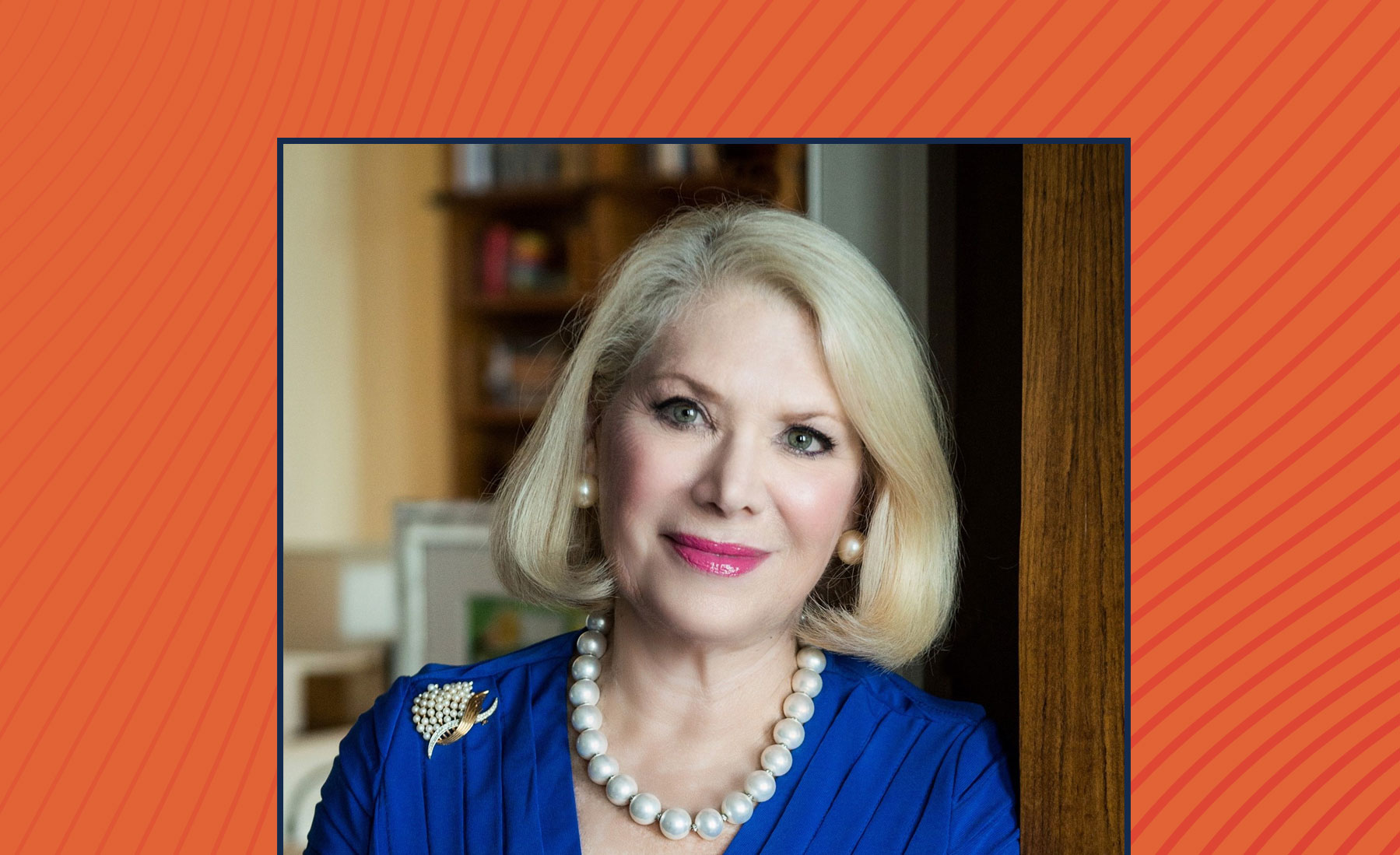
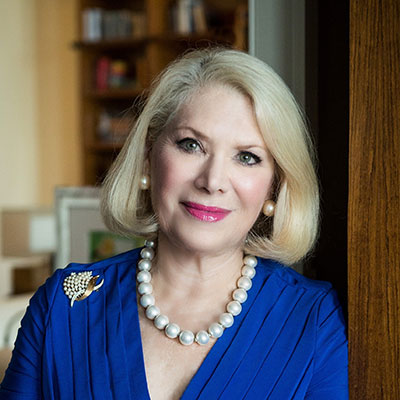
Jill Wine-Banks (BS ’64, journalism), MSNBC legal analyst, author, and podcast co-host, is excited to return to the University of Illinois to serve as the alumni speaker at the College of Media Convocation ceremony on Sunday, May 14—marking her first visit back to campus in 44 years. 

“Obviously the University has changed a good deal since 1979 and so I’m very much looking forward to seeing the physical campus, walking around to see what’s happened to my sorority house, to the library, Kam’s, and Greg Hall, of course,” Wine-Banks said. “But mostly I remember my friends and professors.”

She also plans to visit Krannert Center for the Performing Arts as well as the Alma Mater statue and the Quad, just a few of the many landmarks that come to mind when she recalls her time on campus.

“Those are the kind of things that I think of, but I also think of all the doors that the University opened for me,” Wine-Banks said. “If it hadn’t been for a good education at UIUC, I wouldn’t have gotten into an Ivy League law school, I wouldn’t have become a journalist now, or a lawyer before that. I’m grateful for the education I got.”

Wine-Banks says after graduation, gender discrimination was prevalent in journalism, and she was only offered jobs to write for the “women’s pages,” so she decided to attend the prestigious Columbia Law School in New York to improve her chances of being considered for more hard news opportunities. 

“I ended up in law school to get a better job in journalism, and it worked 50 years later,” she said. 

Wine-Banks started her notable law career as the first woman to serve as an organized crime prosecutor at the U.S. Department of Justice in Washington, D.C. Less than five years later, she was named one of the three Assistant Watergate Special Prosecutors, and the only woman, for the obstruction of justice trial against President Nixon’s top aides. She became a major player in the Watergate tapes hearing that preceded the trial, cross-examining Rose Mary Woods, President Nixon’s secretary, about the 18 ½-minute gap in a key White House recording.

She also had a couple of female role models who inspired her, including an early pioneer in television journalism, Nancy Hanschman Dickerson, whom she heard speak during her freshman year at the University of Illinois. A couple of years later Wine-Banks represented her sorority Iota Alpha Pi at a national convention in New York and visited the United Nations where she saw UN correspondent Pauline Frederick. Seeing these two women excelling in their exciting careers had a big impact on Wine-Banks. 

“I’d have to say that both of those women influenced me, as did [Pulitzer Prize-winning reporter and New York Times columnist] Anthony Lewis,” she said. 

Her legal career also includes service as the first female General Counsel of the U.S. Army where she helped integrate women into the Regulate Army by eliminating the Women’s Army Corps, and into West Point; as the first Solicitor General of Illinois where she argued in the U.S. Supreme Court and first female Deputy Attorney General; and as the executive vice president and chief operating officer of the American Bar Association, the only woman to have held that position. 

In addition to her post at MSNBC, Wine-Banks is also co-host of two Politicon podcasts: #SistersInLaw with three other MSNBC contributors discussing the hottest legal issues of the week, and iGen Politics with a 21-year-old college junior bringing an intergenerational approach to political issues, interviewing leading politicians, cabinet officers, activists, and journalists. 

She describes her podcast iGen Politics as a dream come true because “anybody who I can think of [to interview] I can call, and they say yes.” Some of her most memorable interviewees include former U.S. Secretary of State Madeleine Albright and Pulitzer Prize-winning journalist Nicholas Kristof, along with numerous senators and Congress members. 

The Watergate Girl

Wine-Banks is also the author of a memoir, The Watergate Girl, that was optioned by Katie Holmes to become a movie, and is beginning work on a second book that looks at the Trump administration through her pins, a tradition with its own hashtag: #JillsPins. 

Wine-Banks wears a different pin that has topical relevance and posts a photo on her website and social media in advance of her appearances on MSNBC. 

“I have always loved brooches as accessories. You will see in my high school yearbook, I’m wearing a pin. If you look carefully at the Watergate pictures [taken during the trial], I’m wearing pins,” Wine-Banks said. 

During her first appearance on MSNBC to discuss an op-ed piece she wrote, she donned a pin of an eagle holding a shield. 

Viewers went to Twitter, which was new to her at the time, to ask about the pin and Wine-Banks realized simply wearing the pin had the power to send a message. Now she finds pins at flea markets, antique shows, Etsy, and frequently receives them as gifts from her followers.

For the Media convocation ceremony, Wine-Banks has already set aside an “Illinois” pin to wear.

Media faculty and TAs make list of teachers ranked as excellent

CongratsCongratulations to all of the College of Media faculty and teaching assistants who were ranked as excellent by their students!

This list is based on Instructor and Course Evaluation System (ICES) questionnaire forms completed by students during the Fall 2022 semester. Only those instructors who distributed ICES forms at least once during this time period and who released their data for publication are included in the list. View the complete list.

Note: * denotes that the instructor ratings were outstanding.


ADVERTISING

JACOB FISHER – ADV 305 

STEVE HALL – ADV 150, ADV 392 

* CHANG-DAE HAM – ADV 587 

JACQUELINE HITCHON – ADV 310 

* TERRY KASDAN – ADV 409 

SHACHAR MERON – ADV 283, ADV 498 

SUSAN MUIRHEAD – ADV 290 

* MARISA PEACOCK – ADV 491, ADV 498 

* SELA SAR – ADV 550 

LEONA YI-FAN SU – ADV 480 

RASHMI TENNETI – ADV 490 

* KATIE WATSON – ADV 350 

KEVIN WISE – ADV 483


JOURNALISM

CHRISTOPHER BALL – JOUR 101

STEPHANIE CRAFT – JOUR 505

ALISON DAVIS – JOUR 240, JOUR 340

CHRIS EVANS – JOUR 200

COLLEEN KING – JOUR 210

CAROL LOMBARDI – JOUR 220


MEDIA & CINEMA STUDIES

* AMANDA CIAFONE – MACS 391 

COURTNEY M. COX – MACS 224 

VICTOR FONT – MACS 140 

RACHEL KUO – MACS 351 

DEREK LONG – MACS 284 

* JENNY OYALLON-KOLOSKI – MACS 485 


STRATEGIC BRAND COMMUNICATION

SHACHAR MERON – SBC 500


TEACHING ASSISTANTS

* C. ARREAZOLA – ADV 150 

U. CHUNG – ADV 284 

Y. LEE – ADV 150 

S. PARK – ADV 283 

M. WANG – ADV 150 

* J. CINTRON – MACS 100 

Y. GAO – MACS 101 

J. ROBINSON – MACS 100


Journalism alumni to be inducted into Illini Media Hall of Fame

The Illini Media Company will honor 10 inductees into the Illini Media Hall of Fame Class of 2023 during a ceremony on Saturday, April 29, in Chicago. Five of the inductees are journalism alumni from the College of Media. Illini Media, which oversees The Daily Illini student newspaper, WPGU 107.1 FM radio station, and the Illio yearbook, aims to recognize the distinguished careers and contributions of alumni through the annual Hall of Fame award.  

The College of Media inductees include: 

  • Anita Banerji (BS ’98, news-editorial journalism), senior program director for media and tech at the Leadership Conference on Civil and Human Rights
  • Andrea Darlas (BS ’94, broadcast journalism), award-winning anchor and reporter at WGN Radio and WGN-TV in Chicago, and currently senior director of constituent engagement for the University of Illinois; Darlas will also be the emcee at the Hall of Fame luncheon event
  • Ed Epstein (BS ’74, journalism), journalist for various news outlets including the Chicago Sun-Times, the San Francisco Chronicle, and Washington and Capitol Hill correspondent
  • Kyung Lah (BS ’93, broadcast journalism), CNN senior national correspondent based in Los Angeles
  • Erika Rosenberg (BS ’91, news-editorial journalism), president and CEO of the nonprofit Center for Governmental Research

Aranda named assistant news editor with American Heart Association

After a 24-year career at the Charlotte Observer, journalism alum Rogelio Aranda has become assistant news editor with the American Heart Association. He will continue to be based in Charlotte, North Carolina. 

In his new editorial role, Aranda will help to raise awareness around heart disease and stroke through the AHA’s news service. He will also contribute to the AHA’s Spanish-language news site, overseeing the translation process.

Aranda worked in a variety of positions at the Charlotte Observer, including news and sports copy editor and designer, wire editor, interim sports editor, and, most recently, local news editor. 

Before moving to North Carolina in 1998, Aranda worked at the copy/design desk at the Daily Herald, suburban Chicago’s largest daily newspaper. 

Rogelio Aranda

Anderson Cobb produces play about insurrection

Update March 7, 2023:

Anderson Cobb facilitates workshop on her play about insurrection

Nicole Anderson Cobb (MS ’16, journalism) recently facilitated a community workshop about her play Homegrown: An Insurrection Play, following a free screening at the First Mennonite Church of Champaign-Urbana. 

The play had previously run at the Station Theatre in Urbana in December and was also available to view virtually in February.  

During the workshop, community members gathered to discuss the themes of the play and how they relate to a person’s civic duty. 

Learn more about her play in this News-Gazette feature.


12/15/22

Nicole Anderson Cobb (MS ’16, journalism) was recently featured on Illinois Public Media radio program The 21st to discuss her play, Homegrown: An Insurrection Play. The play ran December 2-11 at The Station Theatre in Urbana. During the interview, she discussed the insurrection and the process of writing and producing the play. 

Anderson Cobb, an author, historian, and playwright, said Homegrown: An Insurrection Play considers the impact of January 6, 2021, on a fictional church community grappling with the pandemic, political polarization, and racial protest. She holds multiple degrees from the University of Illinois: BA ’95 in political science, MA ’99 in history, and PhD ’07 in history.

Watch the play’s trailer:

‘Illini Sports Night’ airs first show on B1G+ network


Update 5/9/2023: Congratulations to the students who produced this broadcast! They won the 2023 NATAS Mid-America Student Production Award in the College Sports Program category.

Illini Sports Night pregame show
(Photos by Carla Erdey.)

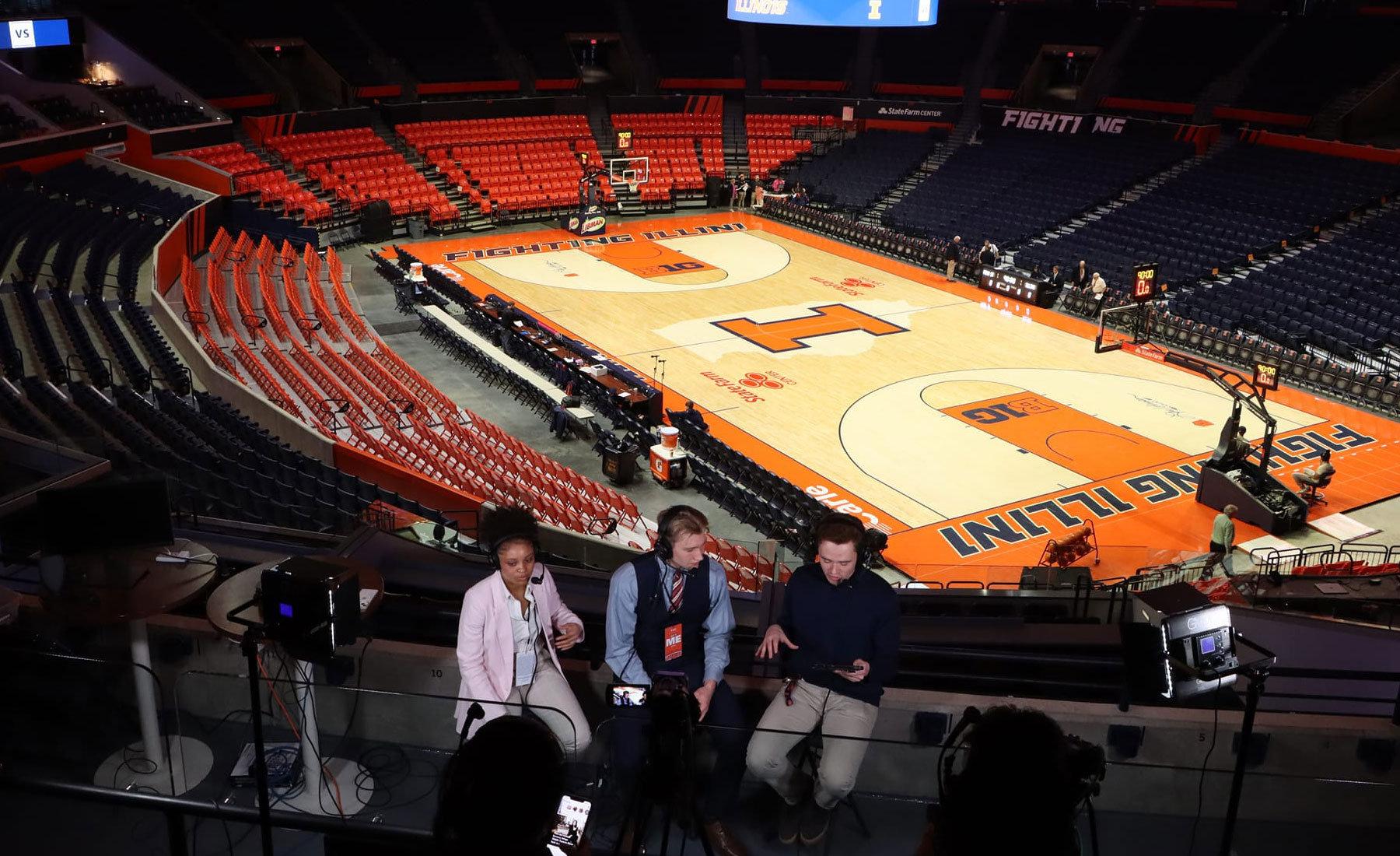
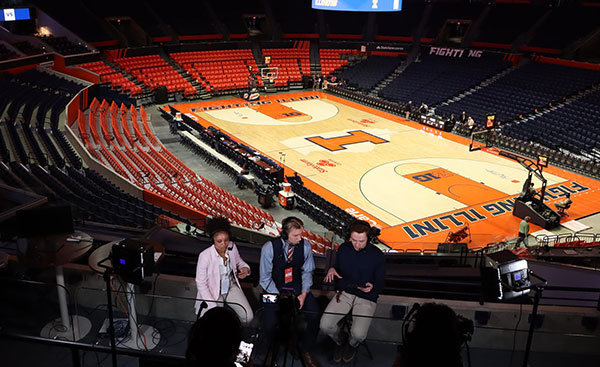
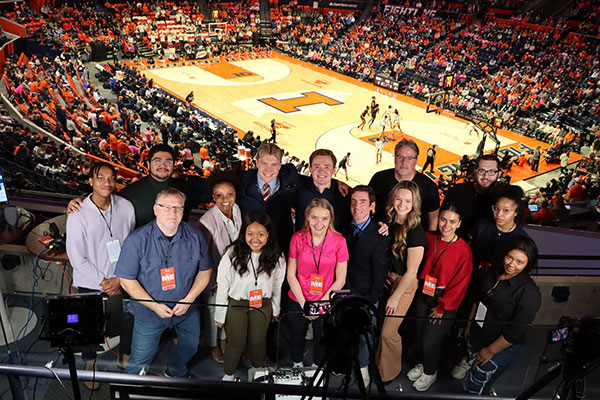
Illini Sports Night hosted a live pregame show at State Farm Center on February 19 before the Fighting Illini women’s basketball game—the first-ever collaboration between the B1G+ network and the student-produced broadcast. The half-hour show aired on B1G+, which livestreams non-televised games.

Emmie Larson, senior in journalism and executive producer of Illini Sports Night, said students prepared for their national broadcast for three weeks.

“It was awesome to see that hard work and preparation create a live show,” she said. “This is something we’ve all never done before. It was cool to know we were capable of doing that.”

The pregame show focused on the Illinois women’s basketball team and the Penn State team, featuring interviews with players on both teams, commentary from the student anchors, and a sit-down with Illinois women’s basketball head coach Shauna Green. (Watch their special broadcast below and see behind-the-scenes photos.)

Illini Sports Night is part of UI7 Newsroom, where students write, produce, and report on all sports at the University as part of the journalism curriculum at the College of Media.

“The Illini Sports Night team had the opportunity to expand the reach of the program on a national scale and gain invaluable experience that will serve them in their future career pursuits,” said Kenneth Erdey, instructor and technical coordinator for Richmond Studio, the site for the student broadcasts.

Illini Sports Night pregame show team

Adrian Carrasco, senior in journalism and producer of the show, said he’s learned a lot from this experience and from his peers.

“That’s the great thing about working here—everybody’s so prepared and on it,” he said.

While their pregame show at State Farm Center did have some unexpected elements, Carrasco said they all took it in stride and learned something new.

During their live show, former women’s basketball head coach Theresa Grentz was honored with a banner unveiling—something the Illini Sports Night team thought would happen after their show ended.

The team quickly adjusted the end of their show, with anchors remarking on the historical impact of the moment, before transitioning to B1G+ programming.

“As our job, we kind of have to be ready for everything,” Carrasco said. “We have to be ready to solve any issues that come and just be on our A-game.”

Larson said one of her biggest takeaways from the show was that you can never be too prepared.

“If you keep your head in the game, you can create something very cool and very successful,” she said.

Illini Sports Night airs Tuesdays at 7 p.m. Watch past broadcasts. 

Richmond Studio to undergo $2M renovation to create state-of-the-art broadcast facility


Richmond Studio

Students in the College of Media will have access to a state-of-the-art broadcast studio and newsroom this fall after nearly $2 million in renovations are completed at the Richmond Studio.

Since 1999, the studio—connected to Campbell Hall, the home of Illinois Public Media—has served as the site for the college’s broadcast journalism courses. Three student broadcasts are currently produced at the studio for the University of Illinois public access TV channel UI7, including UI7 Live, Illini Sports Night, and Good Morning Illini.

The renovation project, which will begin in mid-March and is expected to reach substantial completion before the Fall 2023 semester begins, is made possible thanks to a gift from Richard and Leslie Frank. In 2020, the Franks gave the College of Media $7.5 million—the largest gift in college history—to establish the Richard and Leslie Frank Center for Leadership and Innovation in Media and to renovate Richmond Studio. This project is the first major overhaul of the building since it was erected in 1996, funded by a $2 million gift from Jack C. and Marjorie Laird Richmond.

“Through their enthusiastic support and generosity, Richard and Leslie Frank are ensuring our next generation of broadcast journalists will enter the profession ready to make an impact,” said Mira Sotirovic, associate professor, Karin and Folke Dovring Scholar in Propaganda, and head of the Department of Journalism. 

The renovation project includes a fully remodeled studio with a new control room. A new equipment storage and check-out room will be built, as well as a video and audio production room where students will be able to record podcasts. 

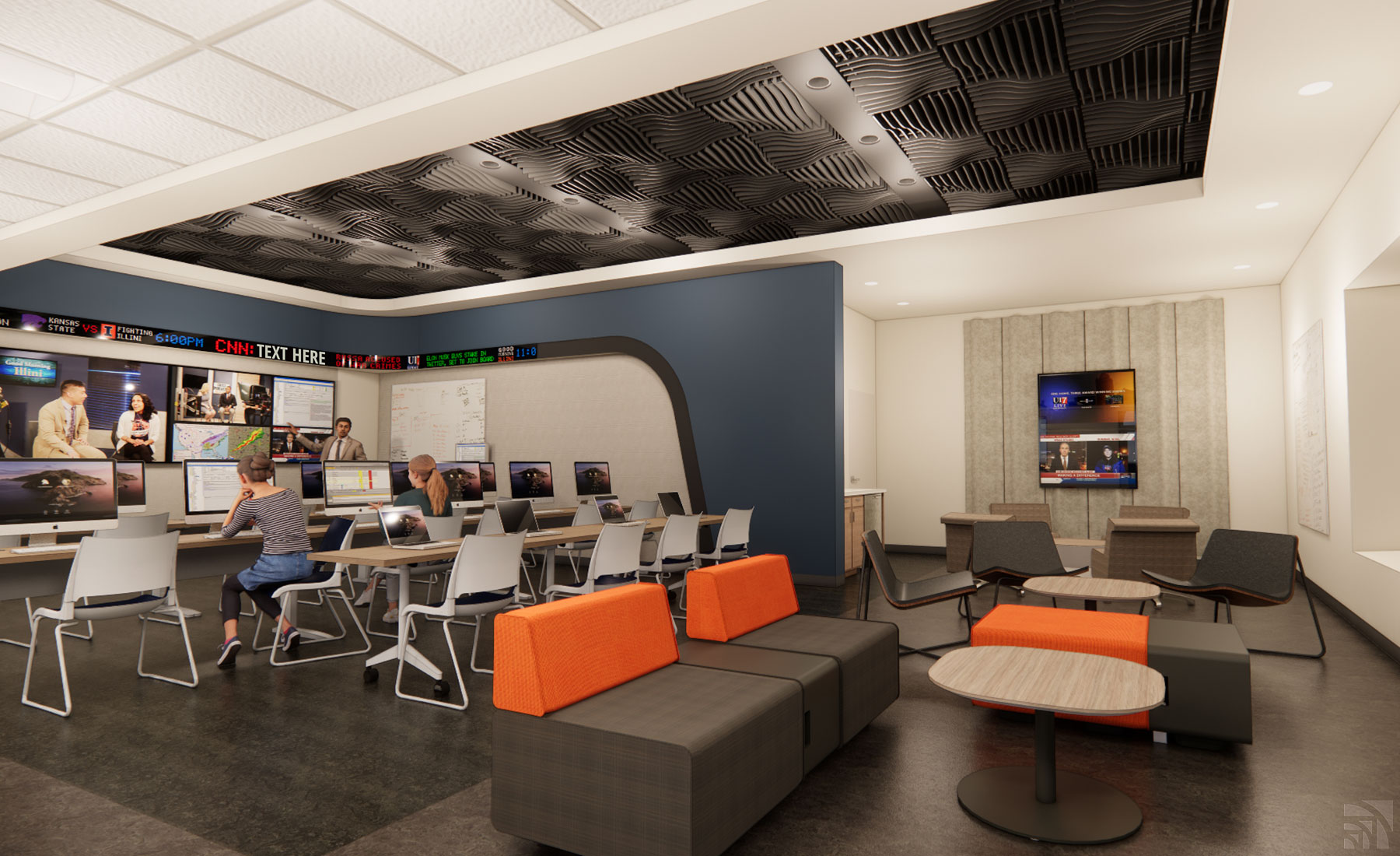
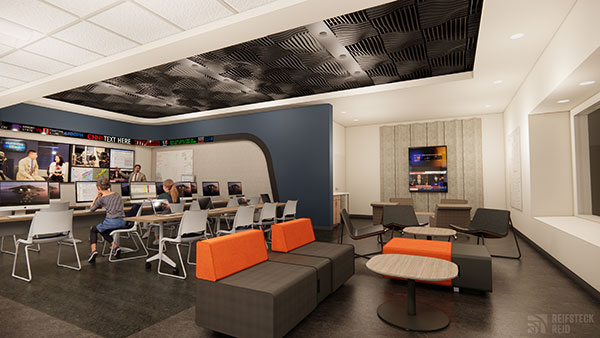
The existing classroom and computer lab located adjacent to the studio will become a collaborative room that serves not only as a class meeting space with a lab but also a newsroom and green room. A scrolling, LED news ticker will be installed around the perimeter of the newsroom and computer lab area. (Pictured above is a rendering of the newsroom and green room.)

Most of the current equipment—including studio cameras, lights, and the control systems—will be upgraded to more modern versions that newsrooms around the country are currently using, allowing students to learn best practices. 

“My commitment to the University of Illinois, and Leslie’s career and passion for journalism, inspired us to want to give back to the journalism program by creating a new, state-of-the art broadcast facility,” Rich Frank said. “We are really impressed with the program here and the people who are dedicated to making it one of the top in the country.”

“Shaping journalists starts at the university level,” said Leslie Frank. “We feel that the University of Illinois has a fantastic journalism program and think our contribution will only enhance it, giving students more advantages and opportunities to become successful in their future journalism careers.”  

Richmond Studio broadcast
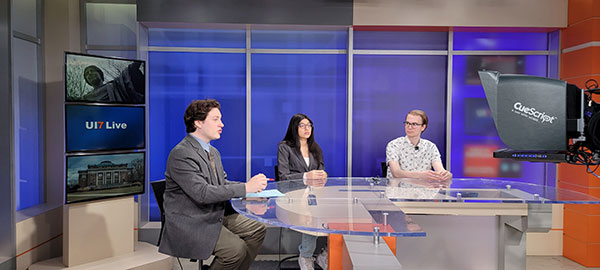
Students on the set of Richmond Studio broadcast an episode of UI7 Live. (Photo by Kenneth Erdey.)

Kenneth Erdey, instructor of journalism and technical coordinator for the Richmond Studio, says he’s excited to see the new opportunities the renovations will bring to students. 

He expects to see expanded televised programming, live reporting from various locations outside of the studio, and more breaking news coverage, which will be beneficial to students. 

“On-camera talent is going to get better because there’s going to be more opportunity for them to [be on-air],” Erdey said. “Newscasts will improve because there will be more opportunities to cover breaking news.”

Alison Davis, lecturer of journalism and Emmy-award winning documentarian, is thrilled about the revamped studio and increased access to experiential learning. 

“The renovated space will not only give students access to the latest technology but it will be a space for collaboration,” Davis said. “We hope students in all classes will use Richmond to further their creativity and journalism skills whether it is joining the UI7 Newsroom RSO, creating a podcast, anchoring a newscast, or producing their own TV show.”

Erdey, who has taught at the studio for 12 years, says his goal has always been to give students a sense of a real, working newsroom. 

“I want this building to be a working experience, but also allow students to make the mistakes they need to make before they get their job,” Erdey said. “The work students are doing here is not just college work, it’s [broadcast] television.” 

March 10 is the last day classes will be held at the studio before it’s closed for construction. However, students will continue reporting for the duration of the semester, making video stories to be uploaded to ui7newsroom.com. Live studio shows will be limited to one special per show. 

“The Department of Journalism is dedicated to preparing students for an industry that will continue to evolve with changes in technology,” Sotirovic added. “When Richmond Studio reopens, the new experiences it will offer will give students a distinct career advantage in today’s dynamic media environment.”

Alumna Karen Petitte’s distinguished career advances gender equality in journalism


Karen Petitte

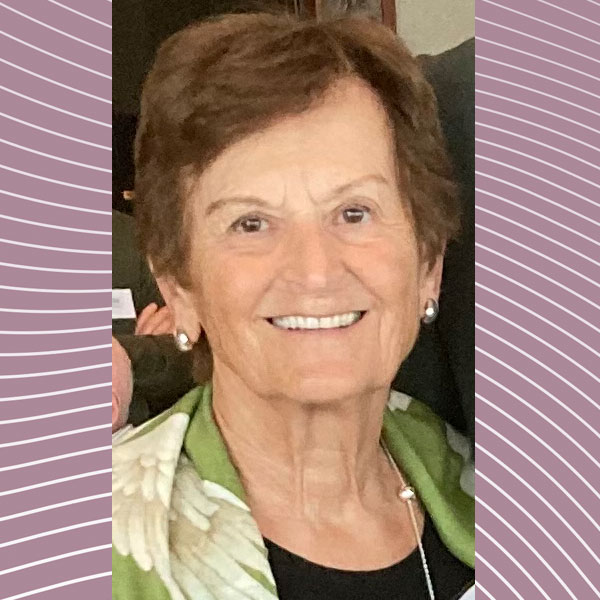
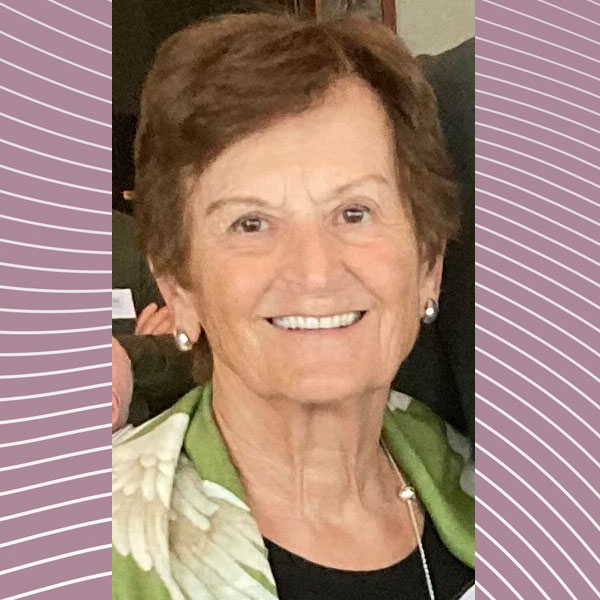
University of Illinois alumna Karen Lucas Petitte pursued a career in journalism at a time when barriers were common for women, and opportunities were few. But that didn’t stop the visionary trailblazer from building an illustrious career as an award-winning journalist—and helping to advance gender equality in journalism along the way. 

Petitte’s inspiration to become a journalist came from an unlikely source—the newspaper comic strip, Brenda Starr, Reporter. Petitte loved following the adventures of chic, newspaper reporter Brenda Starr, who traveled around the globe breaking stories (and, probably, just as many hearts).  

“She was quite glamorous, and I think at some point she met some dashing guy with a patch over his eye, and I thought, ‘Oh, I want to do that. That sounds great,’” Petitte said.  

Petitte, who earned two journalism degrees at Illinois (BS ’63, MS ’67), would eventually become a newspaper reporter like the comic book heroine. But it’s the comic’s creator, Dale Messick, whom she would truly come to emulate.

Dalia Messick, who used the pseudonym Dale Messick to avoid gender bias, was a rarity in those days as a female cartoonist. Like Messick, Petitte would forge her own path through a male-dominant field, opening doors for more women. 

After graduation, Petitte worked briefly at the Chicago Tribune and then joined the Chicago Daily News in 1968, assigned to an education beat. Originally, she had applied for an overnight reporter shift at the Chicago Daily News but was told it was “too dangerous” for women.

Although education was traditionally considered a “woman’s beat,” she was happy for the opportunity to break into the newsroom. In 1973, Petitte and a colleague won first prize from the National Council for the Advancement of Education Writing for an investigative piece on financial misconduct at Malcolm X College in Chicago. 

“It was kind of inspiring to be able to report on some of those activities, trying to bring to light things that many people would just as soon have kept in the dark,” Petitte said. 

After an initial focus on education, and later, consumer affairs, Petitte would go on to cover a variety of news stories including disasters, fires, and gender equality issues. She covered a protest at a local Chicago restaurant that had a men’s-only bar area and wrote about the discrepancies in men’s and women’s salaries. 

Eventually, Petitte was offered a position as assistant city editor at the Chicago Daily News—the first woman to ever be considered—and although she preferred reporting, she knew she couldn’t refuse.

“I didn’t really want to be an assistant city editor at the time; I like to report. But I figured, maybe I better do this, because if we [as women] keep asking for these jobs, and then we don’t take them, they’re not going to take us seriously,” Petitte said.

In 1979, Petitte took a brief detour from journalism and tried government. She spent over three years working as Chicago’s consumer affairs commissioner under Mayor Jane Byrne—the first woman to be elected mayor of a major city in the United States. That appointment enabled Petitte to help enforce consumer regulations as opposed to writing about them. 

When Byrne’s term ended, Petitte considered going into public relations but ultimately decided to return to journalism, this time entering the magazine field. Petitte worked as editor of Consumers Digest and then Modern Healthcare and Modern Physician, published by Chicago-based media company, Crain Communications. Petitte stayed with Crain Communications for 16 years before retiring in 2001. 

Petitte’s 40-plus-year journalism career is comprised of prestigious honors, including the first female president of the Chicago Newspaper Guild, an inductee into the Chicago Journalism Hall of Fame, and among the first women to serve as editor-in-chief of The Daily Illini from 1962 to 1963. 

Petitte, who was inducted into the Illini Media Hall of Fame in 2007, has fond memories of her time at the student newspaper, including working alongside the late film critic Roger Ebert (BS ’64, journalism), whom she recalls as “quite a character” and a “very smart, capable, witty guy.” And because she worked evenings at The Daily Illini, she was provided a key to get into her dorm room after the University’s curfew for women—a perk Petitte valued, knowing she had the freedom to choose her own schedule. 

In the latter part of her career, Petitte was able to mentor younger writers, sharing the skills she’d learned over her many years of reporting. She said that helping young people move along in their career was something she enjoyed more than she expected. 

Ten years ago, Petitte found another way to bring along the next generation of journalists by creating the Karen Lucas Petitte Endowed Scholarship in Journalism.

“It just seemed to me a good way to pay back the college for the education that I received, and the knowledge that allowed me to go on and build a career that was very satisfying and rewarding and fun,” Petitte said.

The endowed scholarship, created in 2003, is based on academic merit and financial need, and has created an impact and connection with students that Petitte finds extremely rewarding.

Petitte has met a few of the scholarship winners and has received many thank-you letters—reminders that she’s still helping to pave the way for future journalists, even in her retirement. 

Petitte said she has seen a gradual shift over the years, with more opportunities available for women in journalism. While she’s hesitant to take too much credit for that progress, she is grateful to have had any impact at all.

“It’s a good feeling to know that you helped change some of the patterns, and that there’s some women who came behind you who have some more opportunity,” Petitte said. “I think that’s what it’s all about.”  
DEV College of Media
119 Gregory Hall
810 S. Wright St.
Urbana, IL 61801
217-333-2350