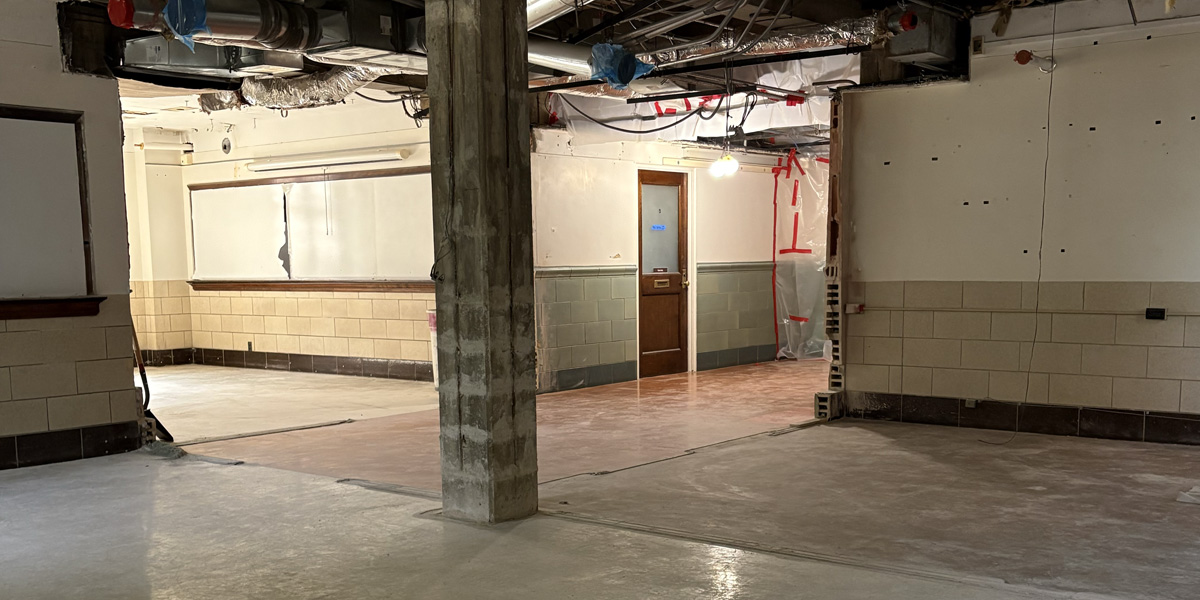
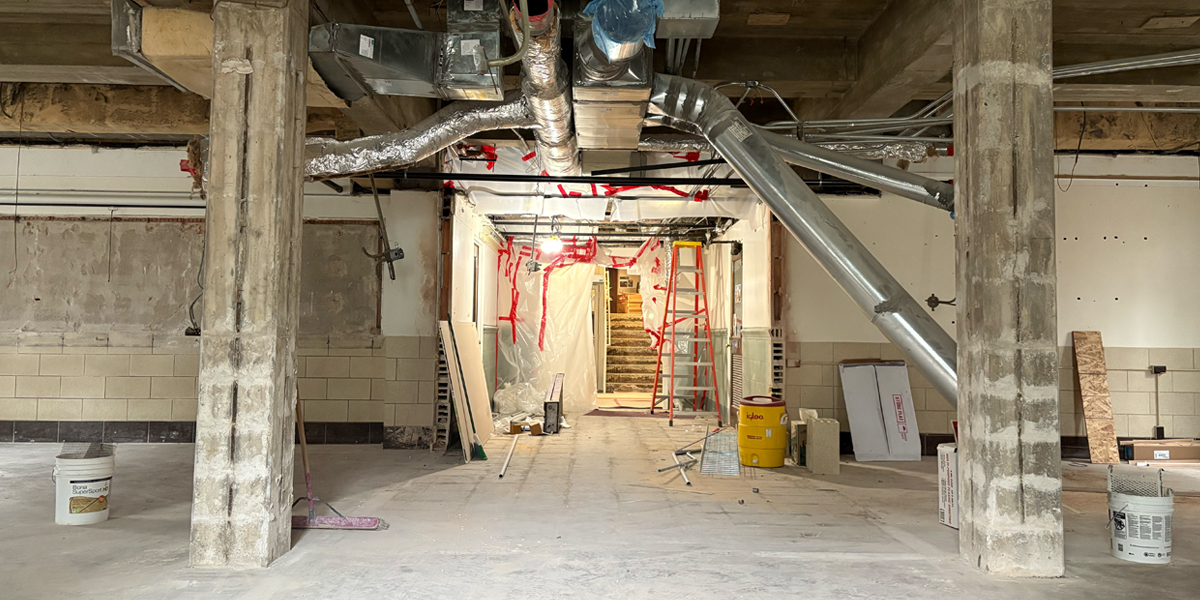
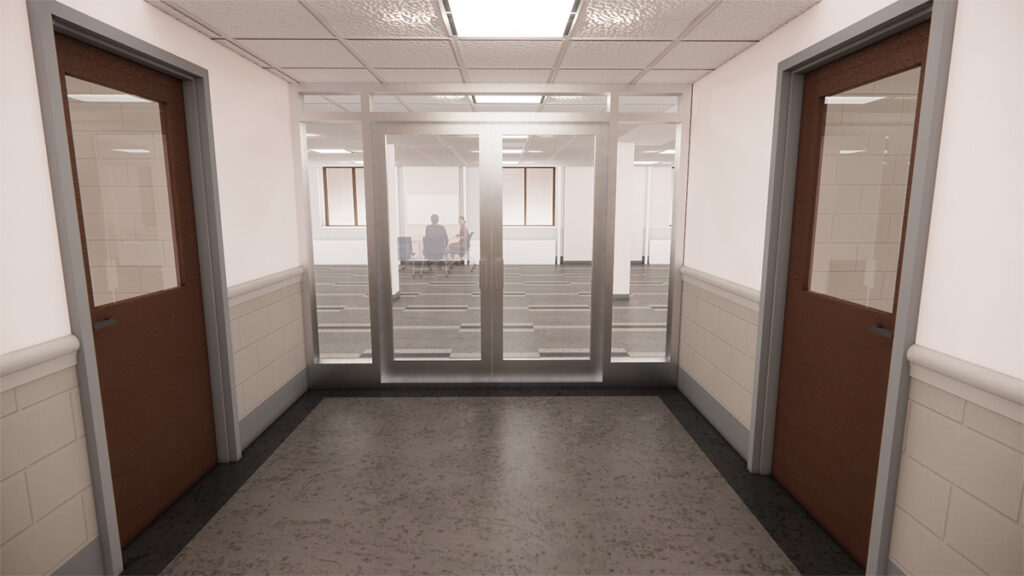
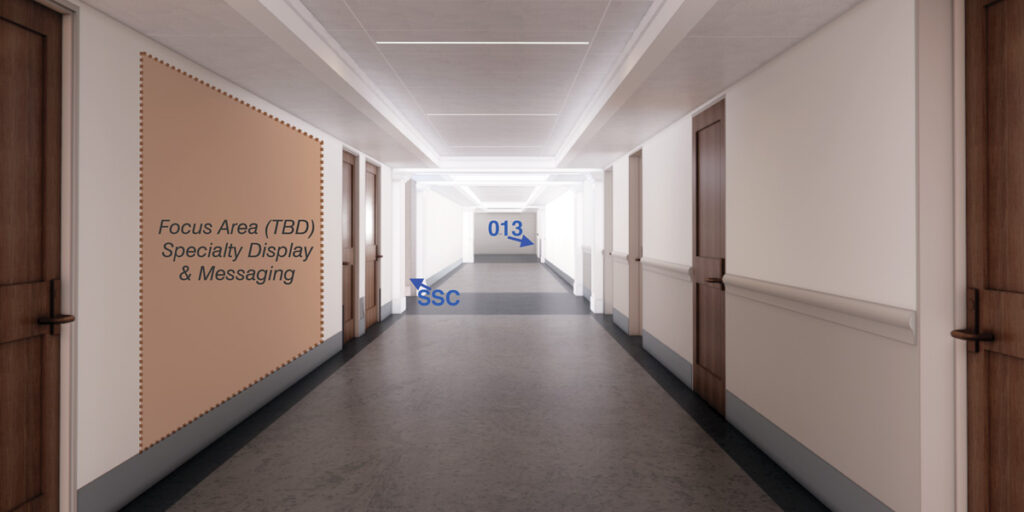
This will result in the creation of a new hybrid/flexible, state-of-the-art classroom (see architectural rendering above), which will open in Spring 2026, and a renovated main corridor, plus updated flooring throughout, including in faculty offices.
See photos depicting the original spaces, the renovation process, and the architectural renderings.
Gregory Hall Lower-Level Corridor
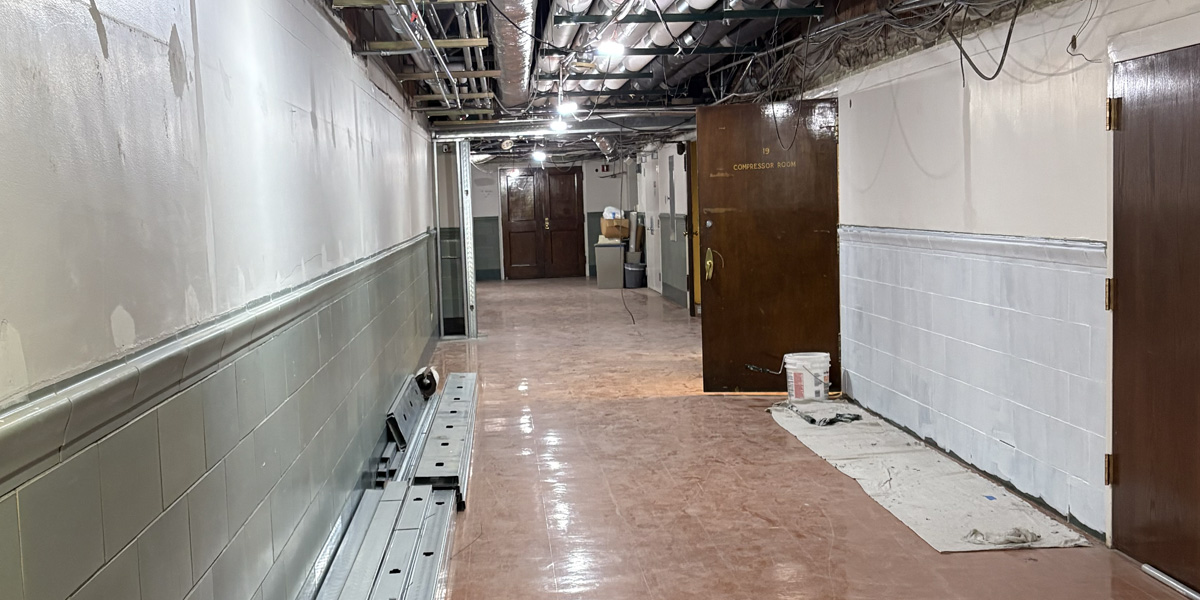
Before Renovations
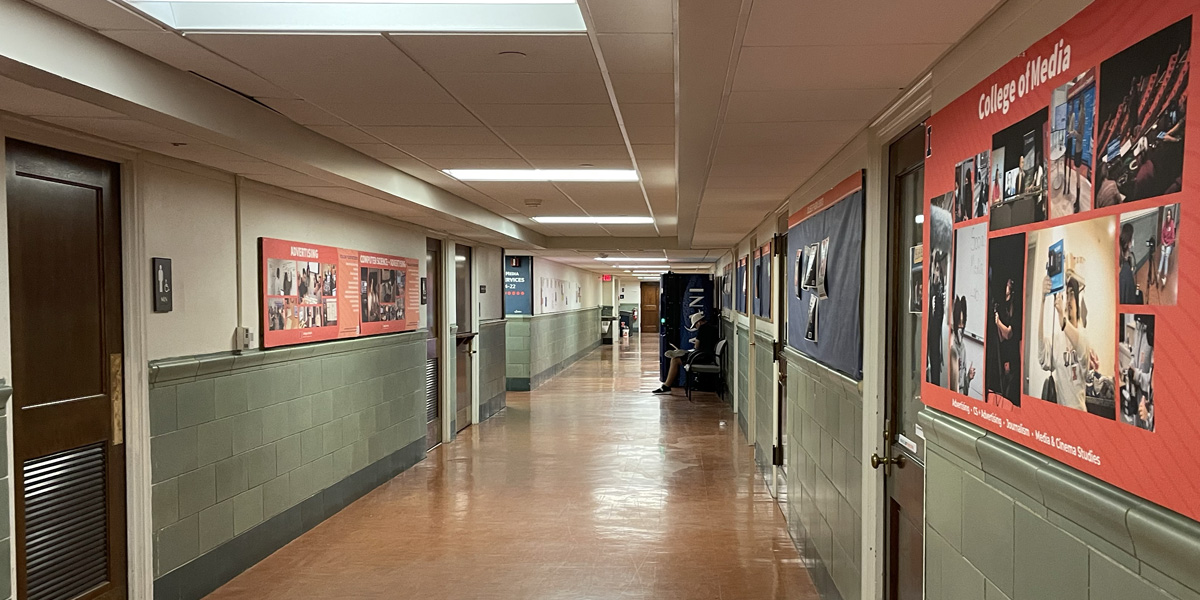
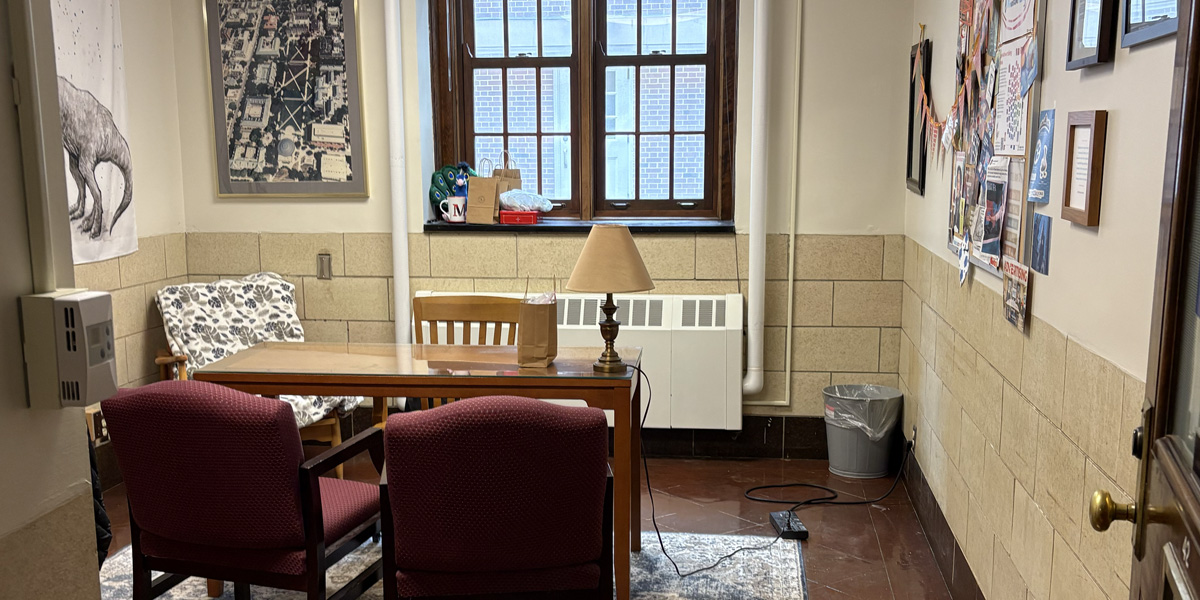
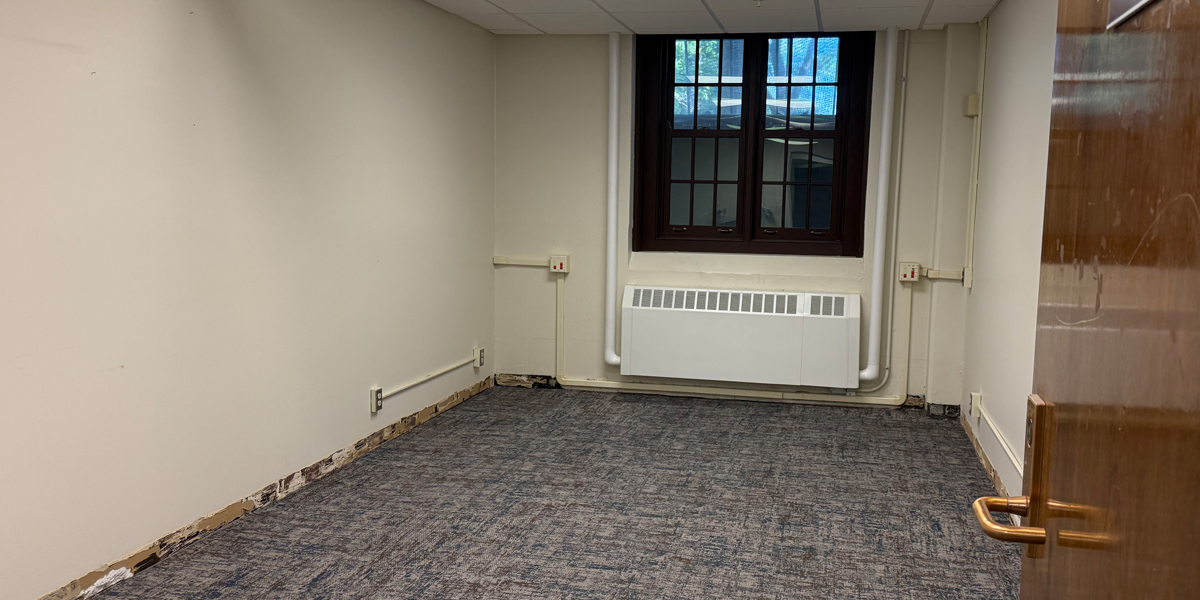
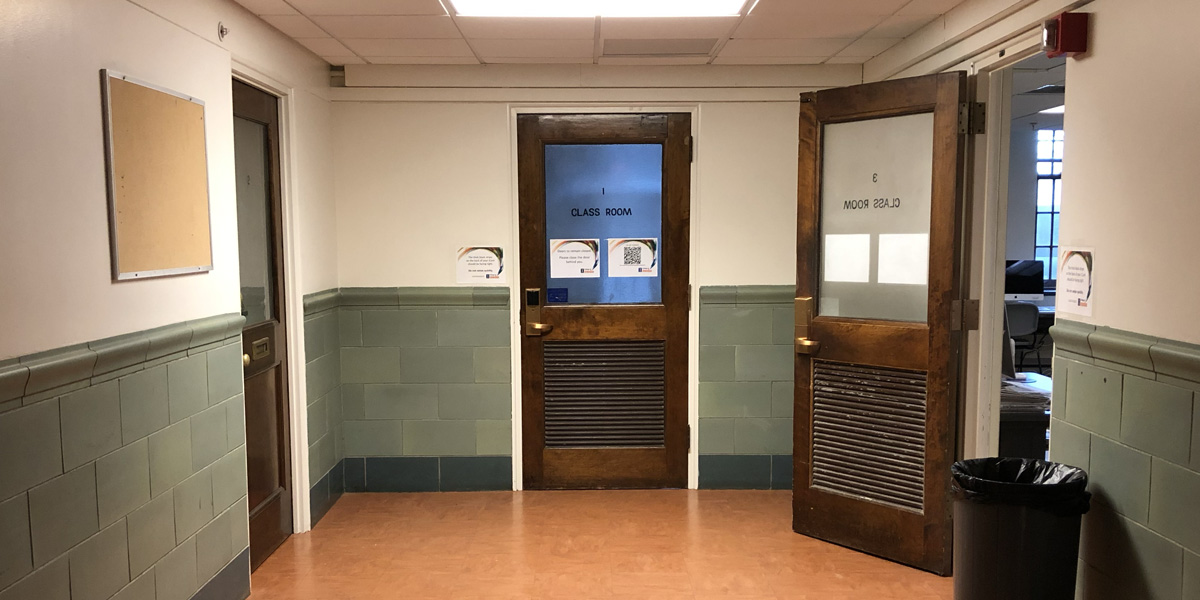
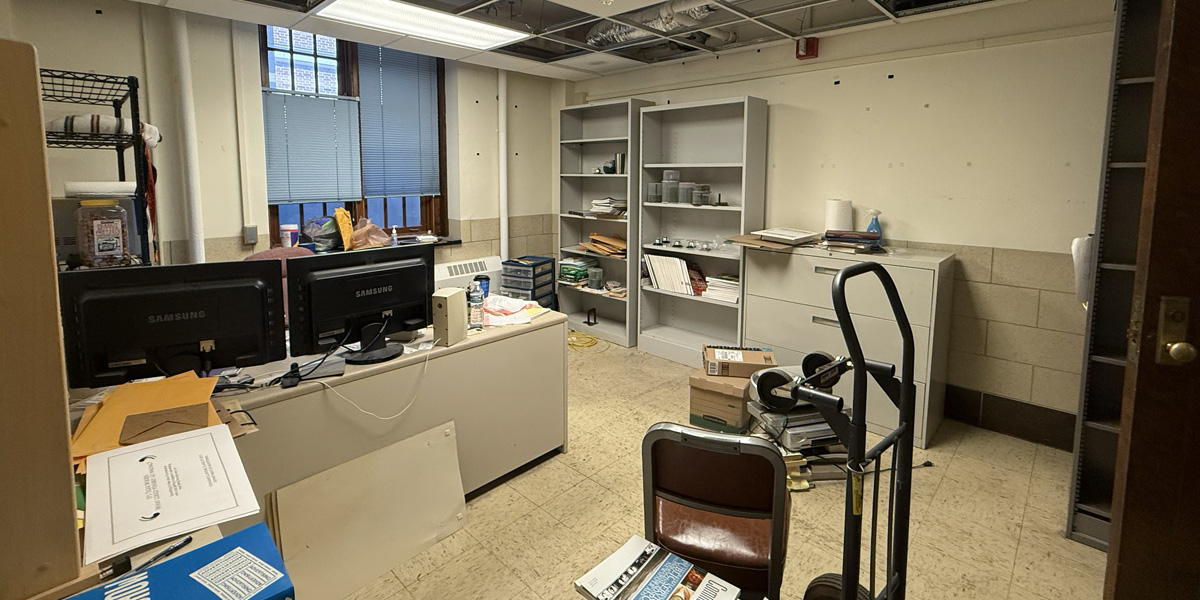
Substantial work in the lower level of Gregory Hall has not occurred since the 1990s. See photos of the original corridor and a faculty office.
Gregory Hall lower level corridor before renovations
Gregory Hall lower level corridor before renovations
Gregory Hall lower level faculty office before renovations
Renovation Progress
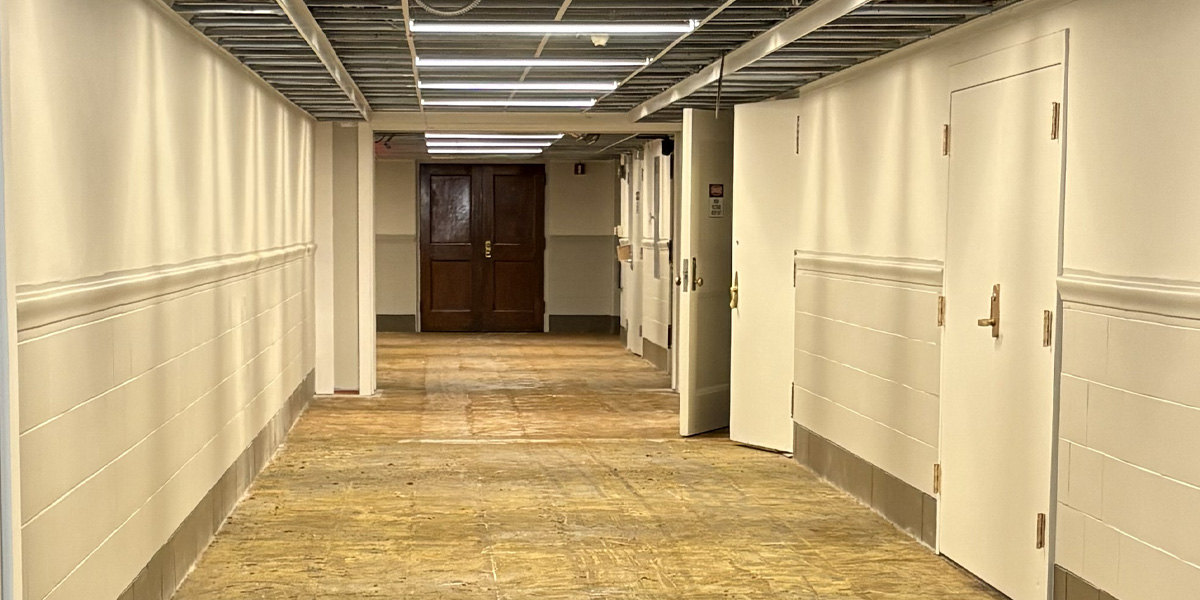
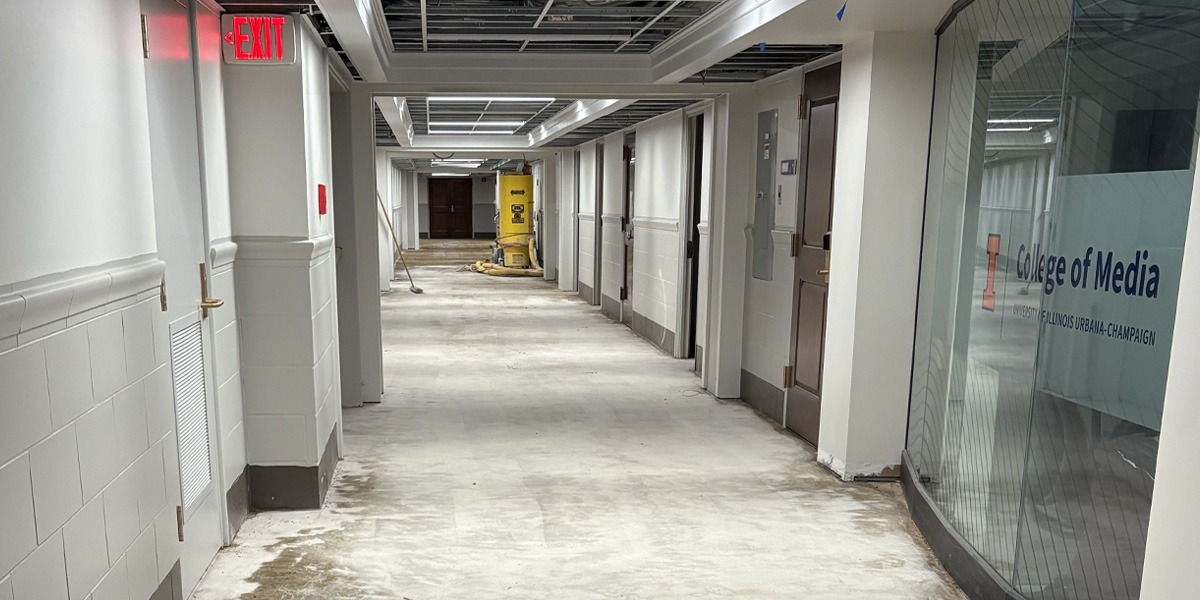
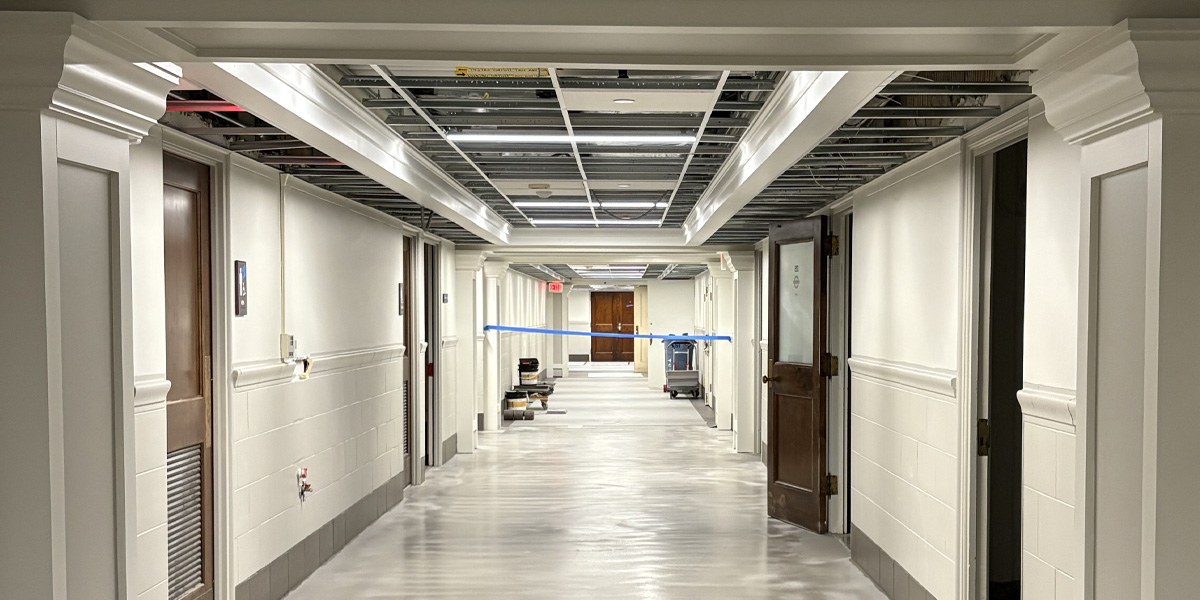
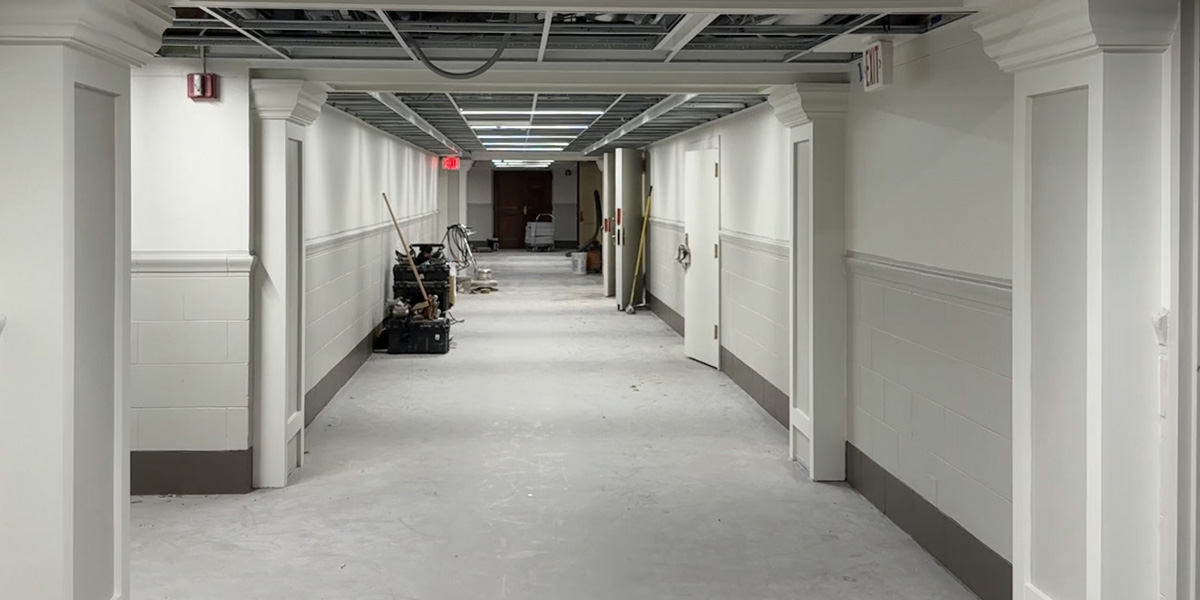
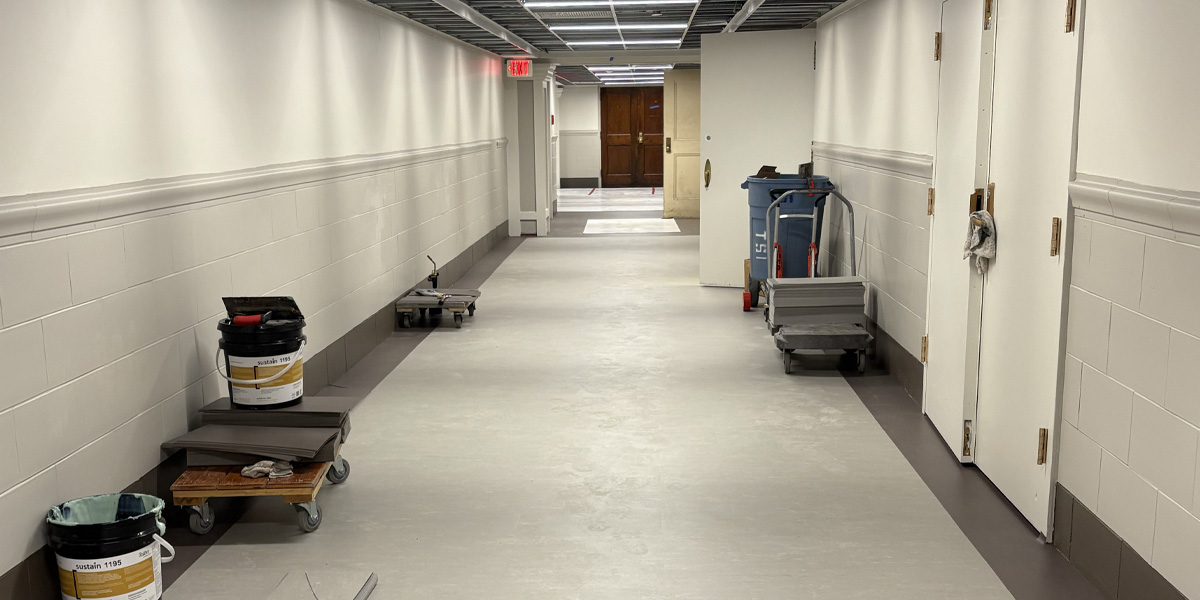
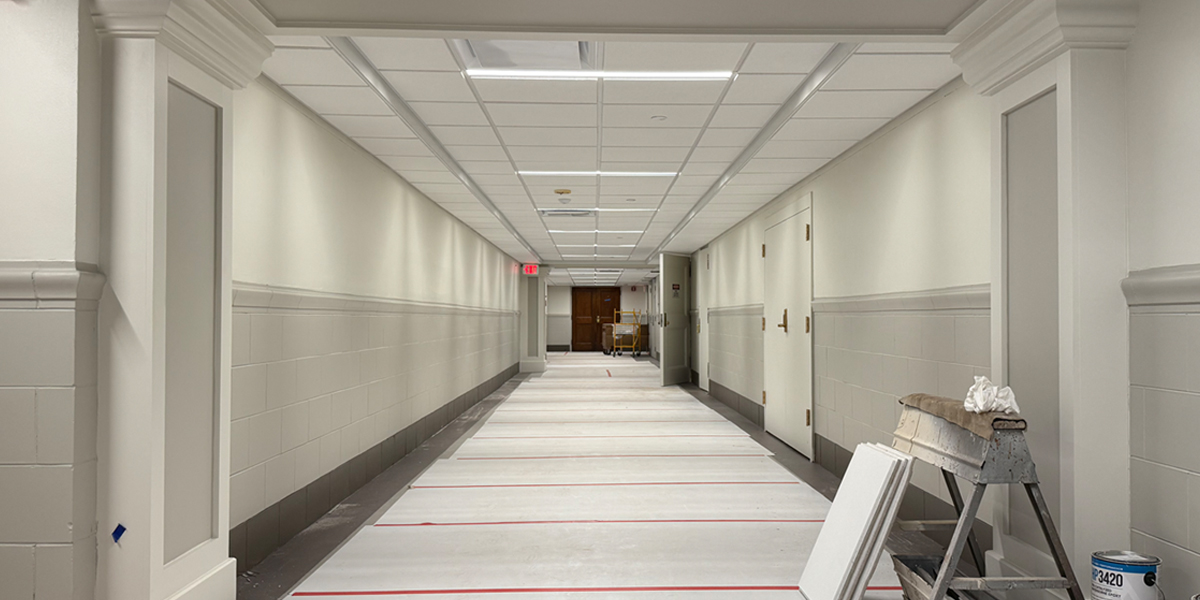
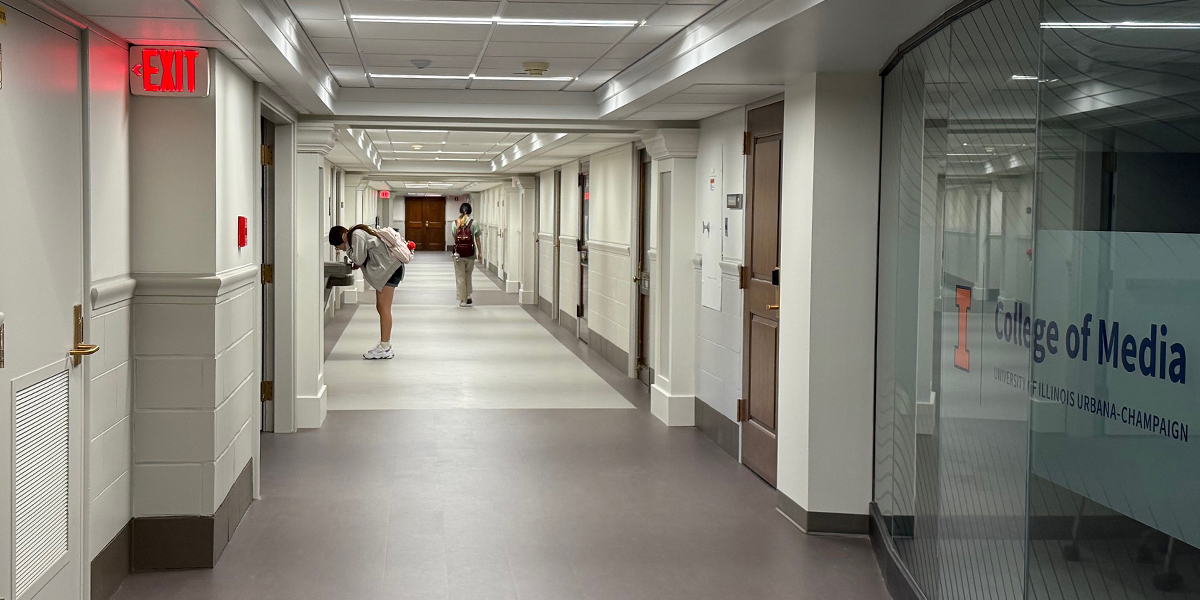
Renovations included painted walls throughout the entire hallway, including the east and west wings, new lighting, and new flooring, including in faculty offices.
Painting primer in the hallways
Painting in the hallways
Lights installed and floor removed
Floor removal process
Floor mitigated, walls painted, lights in, and portals built
Crown molding detail
New floor installed in hallway
New carpet installed in faculty office
Ceiling tiles installed
First day of Fall 2025 classes
Architectural Rendering
The corridor renovations will be complete by the start of Fall 2025. By Spring 2026, new digital signage will be installed in place of bulletin boards that previously lined the walls.
Gregory Hall Room 1
Before Renovations
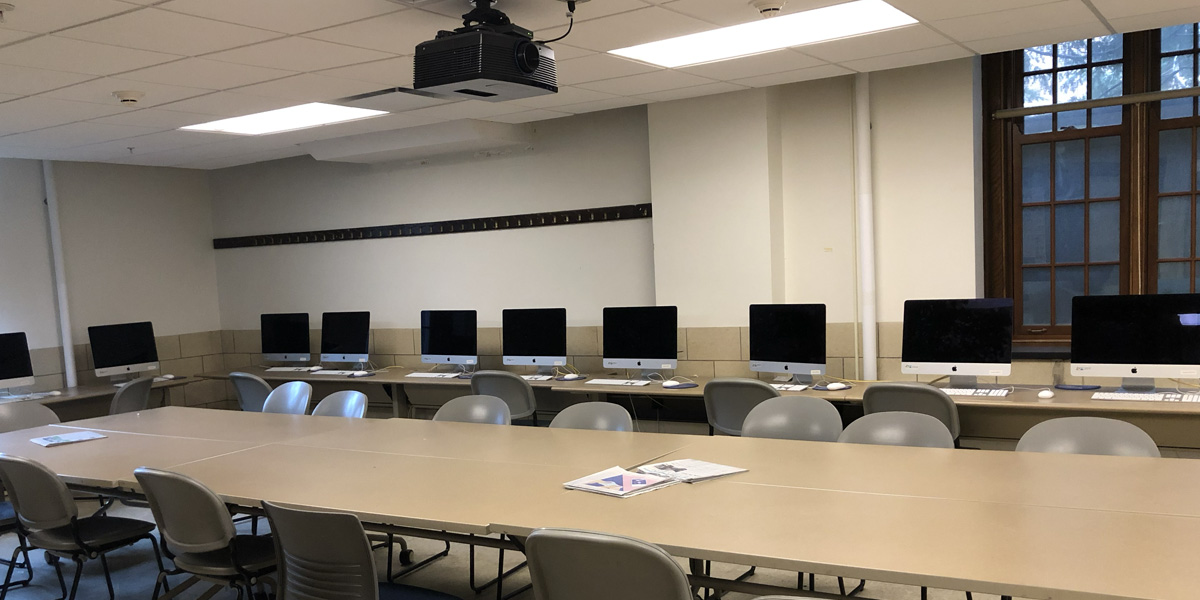
Rooms 1, 2, and 3 on the east wing were two smaller classrooms and a faculty office.
Gregory Hall Rooms 1, 2, and 3 before renovation
Gregory Hall Room 1 before renovation
Gregory Hall Room 2 faculty office moving out before renovation
Gregory Hall Room 3 before renovation
Renovation Progress
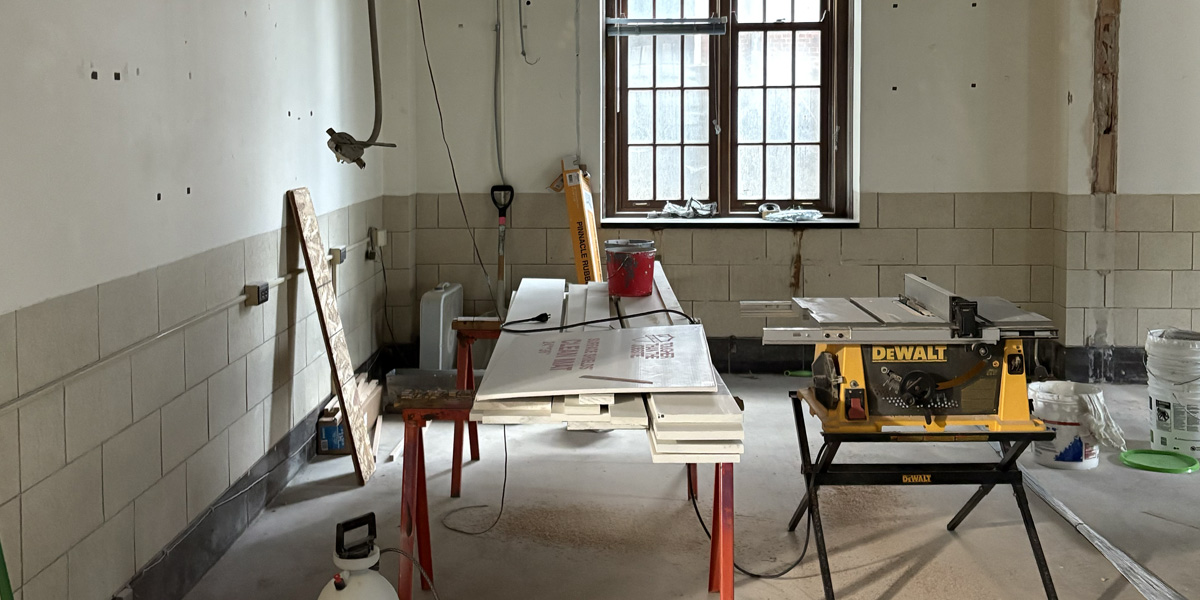
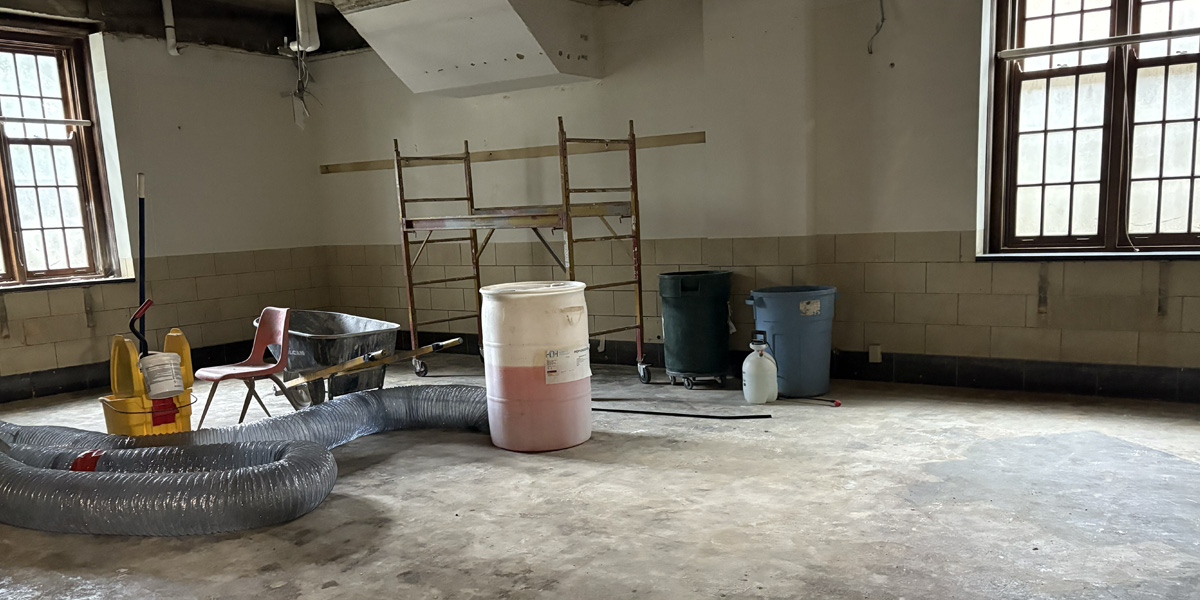
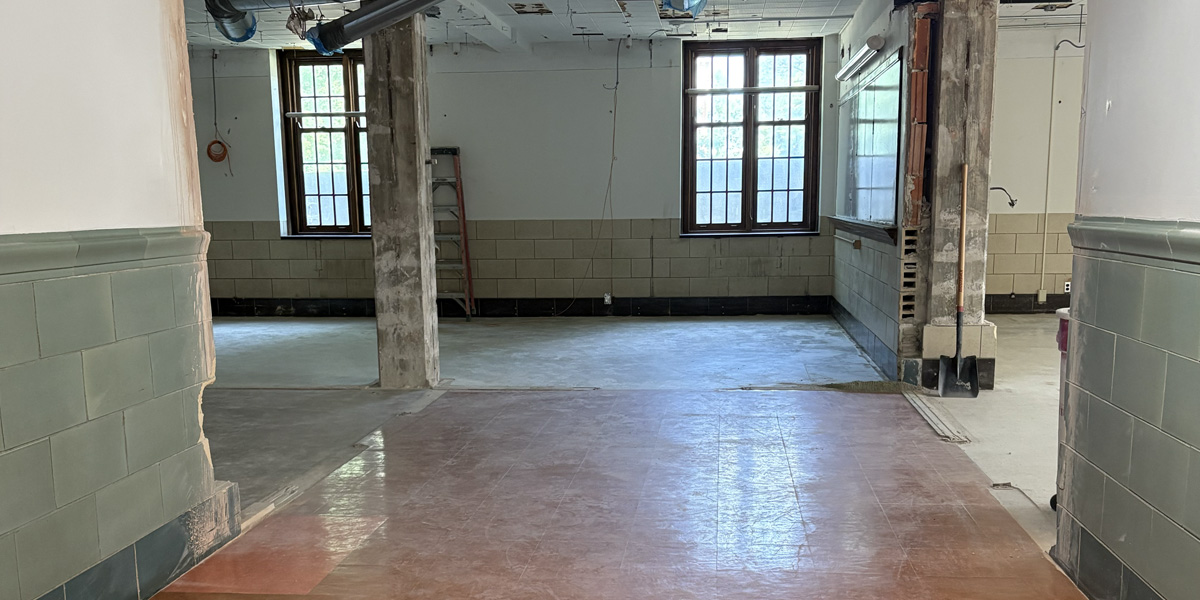
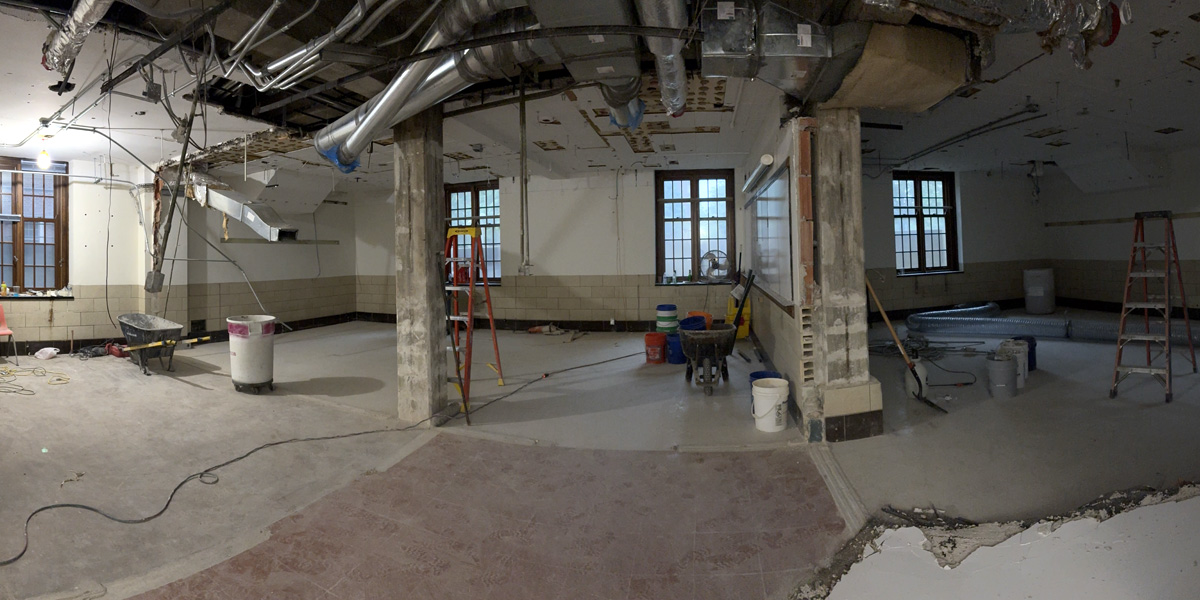
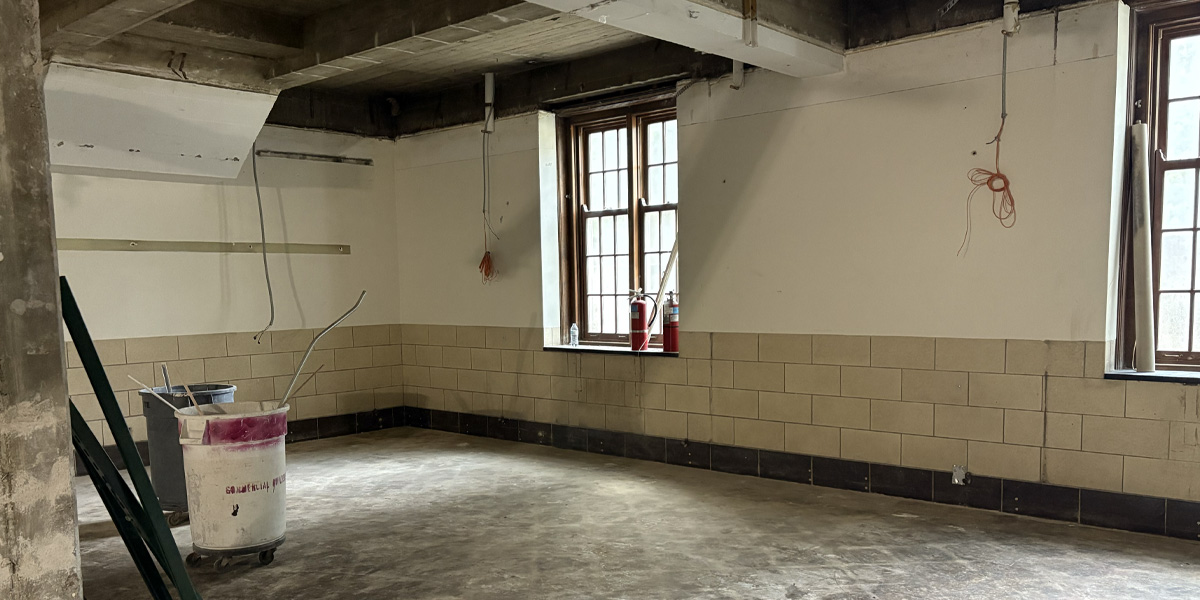
Renovations included knocking down walls to combine Rooms 1, 2, and 3 into a new hybrid/flexible, state-of-the-art classroom.
Gregory Hall Room 1 after demo
Gregory Hall Room 2 after demo
Gregory Hall Room 3 after demo
Gregory Hall Rooms 1, 2, 3 after demo, from hallway
Gregory Hall Rooms 1, 2, 3 after demo
Gregory Hall Rooms 1, 2, 3 after demo, from northwest corner
Gregory Hall Rooms 1, 2, 3, looking south, with the last wall knocked down
Architectural Renderings
By Spring 2026, Room 1 will offer classes by all three departments in the College of Media, supporting activities such as advertising brand consultations, journalism press conferences, and media and cinema studies production, and will enable hybrid teaching and conferencing.
—Photos by Meghan Burnett and Holly Rushakoff. Architectural renderings by Reifsteck Wakefield Fanning.
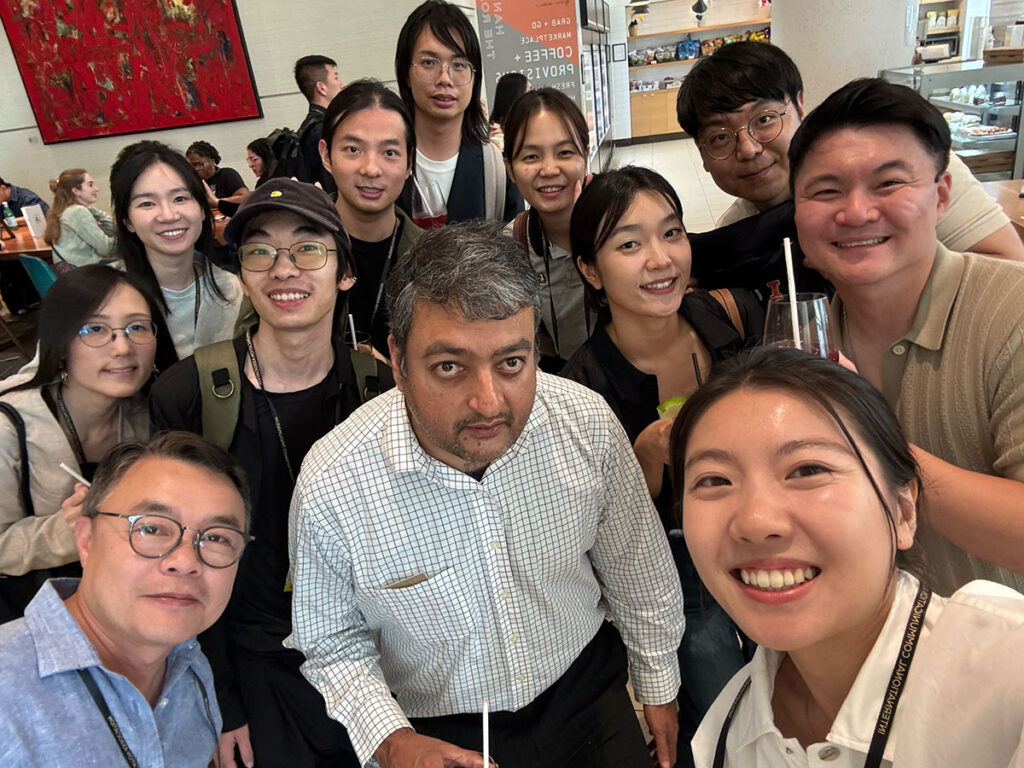
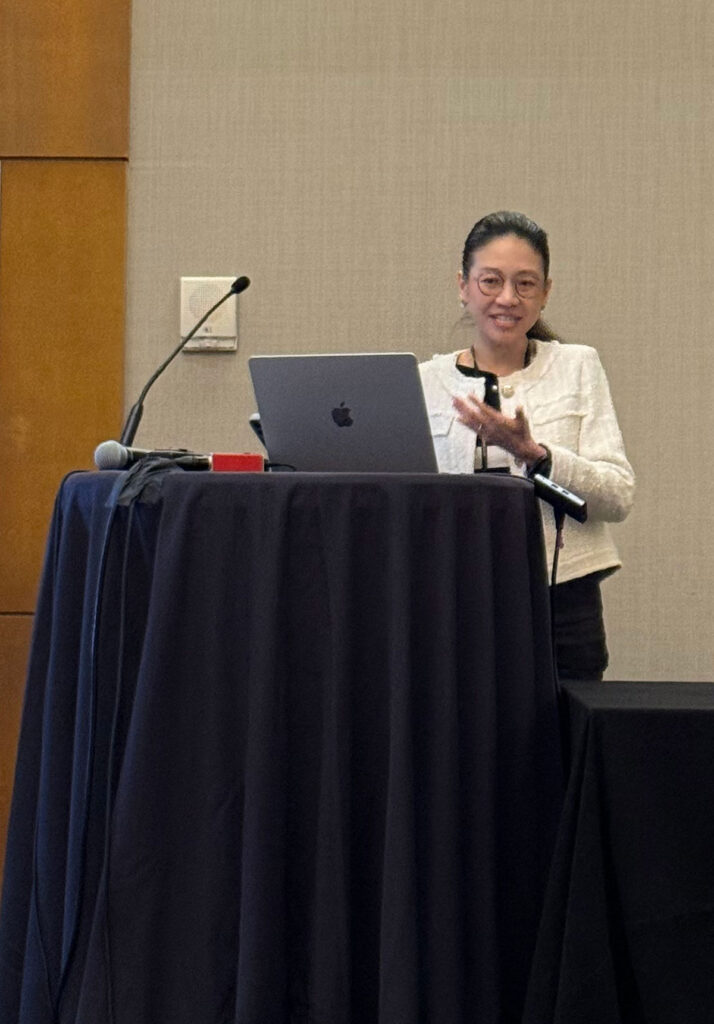
Faculty, graduate students, and recent alumni from the College of Media co-presented various topics of research at the 75th annual International Communication Association Conference—the largest academic conference for communication scholars—on June 12-16, 2025, in Denver, Colorado. The ICA aims to advance the scholarly study of human communication by encouraging and facilitating excellence in academic research worldwide.
This year’s conference theme addressed “Disrupting and Consolidating Communication Research.” College of Media presenters included faculty in the Institute of Communications Research and the Charles H. Sandage Department of Advertising; graduate students in the MS advertising program; and doctoral students in the Institute of Communications Research PhD program.
College of Media research presenters and presentations are listed below in bold. (Please see the ICA conference program for complete listings.)
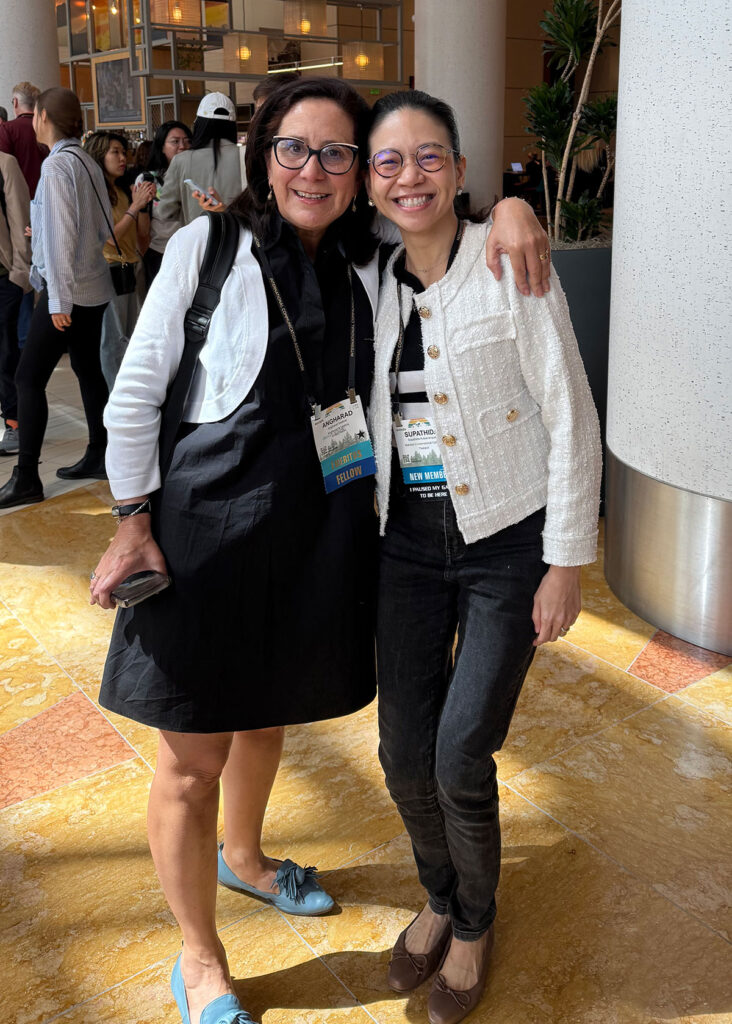
Angharad Valdivia and Supathida Kulpavaropas
Intersectional Experiences of Oppression and Resistance
Chair: Angharad Valdivia, Professor Emerita, Institute of Communications Research
Making Sense of AI Across the Media Industries: Disrupting Communication Research by Bridging Divides
“Enterprise AI: Hidden Ironies for Creators, Marketers, and Media Scholars”
Mike Yao, Professor of Digital Media, Advertising; Director of the Institute of Communications Research
Playing for a Better Life: Serious Games and Gamification
“The Power of Play: The Effectiveness of Serious Game on Depression Stigma”
Nansong Zhou, ICR student
Donghan Fu, Wuhan U, China
Zikun Liu, Wuhan U, China
Feminist Disruptions: Institutionalizing Gender in Communication Studies
“Intersectional FSD, a Utopia Yet to Be Achieved”
Angharad Valdivia, Professor Emerita, Institute of Communications Research
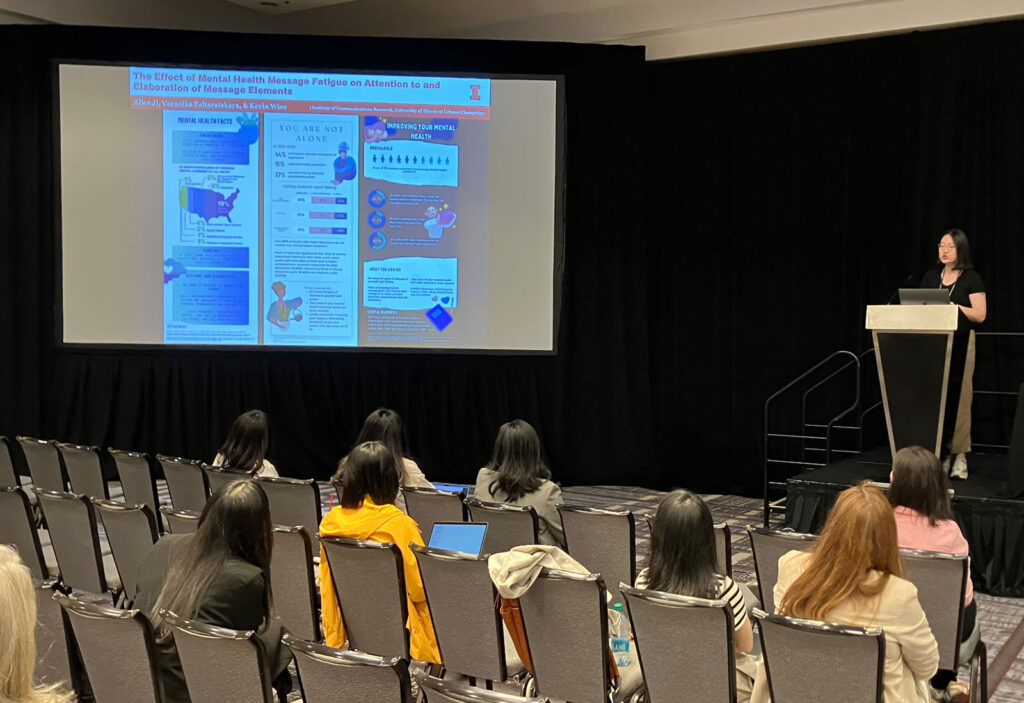
Alice Ji
Media Literacy and Information Environments
“The Effect of Message Fatigue on Visual Attention to, and Elaboration of Mental Health Infographics”
Alice Ji, ICR student
Veranika Paltaratskaya, ICR student
Kevin Wise, Professor of Advertising
Conversations With the Machine (Priming, Tensions, Failure, Impact)
“Competitors or Complements? Examining the Effect of Human-AI Interaction on Human-Human Interaction”
Maggie Zhang, ICR student
Sakshi Bhalla, ICR student
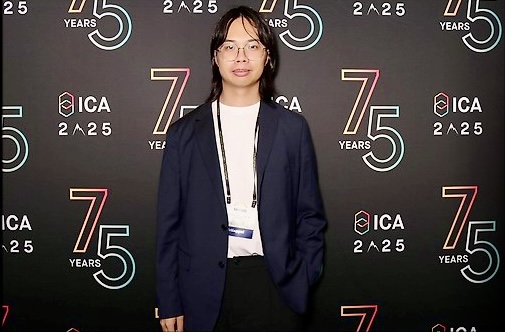
Yanbo Li
Algorithmic Bias and Transparency
Chair: Yanbo Li, ICR student
“Recommendation Transitions on YouTube”
Yanbo Li, ICR student
Sakshi Bhalla, ICR student
Harsh Taneja, Associate Professor of New and Emerging Media, Advertising
Organizers
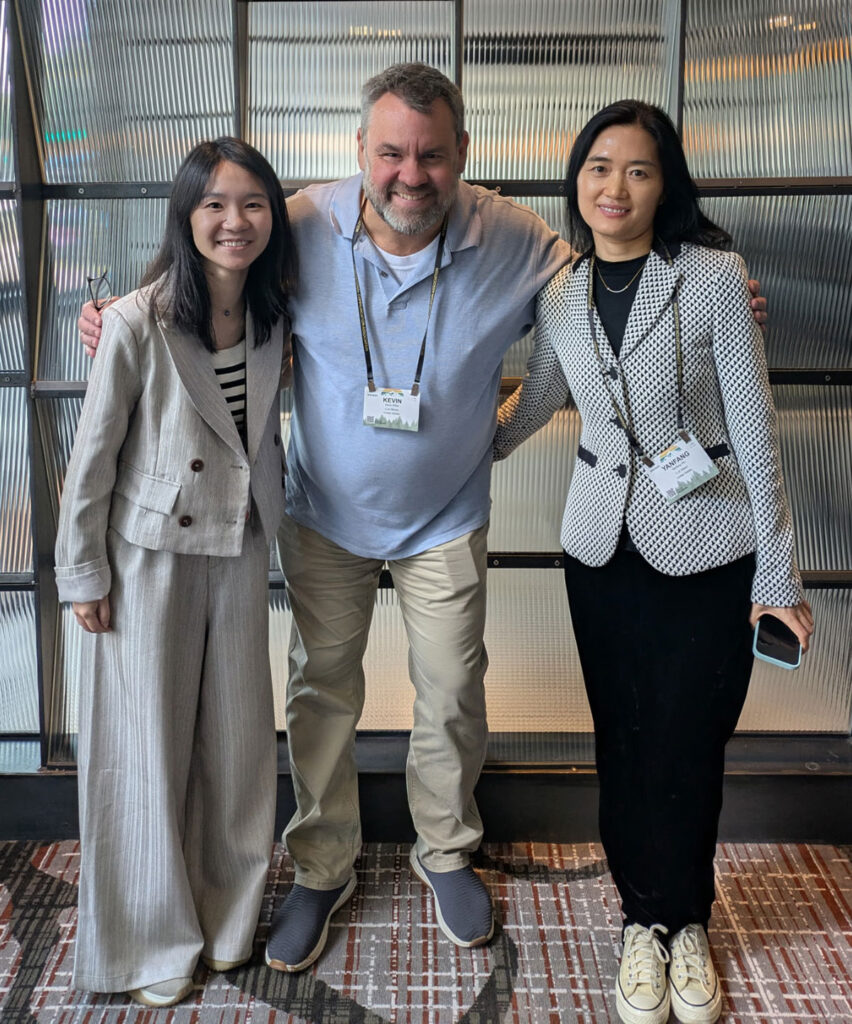
Kevin Wise (center) with Chen (Crystal) Chen at left, PhD ’23, ICR; and Yanfang Wu at right, Wise’s former student while at Missouri
Consolidating Communication Research Through Causal Inference
Shuning Lu, U of Maryland
Ewa Maslowska, Associate Professor of Advertising
Harsh Taneja, Associate Professor of New and Emerging Media, Advertising
Nathan Walter, Northwestern U
Information Processing and Health Outcomes
“Debunking COVID-19 Falsehoods: A Test of Three Cognitive Predispositions as Buffers for Partisan Influences”
Wei Wang, U of Wisconsin–Madison
Yihan Danny Jia, Boston U
Maria Grabe, Boston U
Kevin Mudavadi, Indiana U Bloomington
Gillian Paxton, ICR student
Jennifer Hwang, U of California, Los Angeles
Jimmy Ochieng, Indiana U Bloomington
MIAO-nipulating Trust: AI Dialogue, Verification, and Cross-Platform Misinformation
“Comparing Conversational Agents’ and Social Media Posts’ Roles in Correcting Health Misinformation”
Ziyang Gong, iSchool
Junqi Shao, iSchool
Nisa Rahman, ICR student
Leona Yi-Fan Su, Associate Professor of Advertising
Personalization and Privacy
“Shh… Is Algorithm Listening?” How Folk Beliefs and Knowledge Shape Our Coping Mechanisms Against Targeted Ads”
Jiyeon Chang, ICR student
Se Il Park, ICR student
Yujin Lee, ICR student
Language and Social Interaction Research Escalator Session
“The Market of Marriage: Matchmaking and the Reinforcement of Gender and Class Boundaries in China”
Anqi Peng, ICR student
Making Sense of the Machine and the Communication with it
Mike Yao, Harsh Taneja, and ICR students
“The Minds Behind the Prompts: How Mental Models Shape User Interaction with Generative AI”
Weizi Liu (MS ’19, advertising; PhD ’24, iSchool)
Mike Yao, Professor of Digital Media, Advertising; Director of the Institute of Communications Research
“From ‘Ghostly Companions’ to ‘Invisible Mechanisms’: Exploring Lay Representations and Performance Expectations of AI Across Task Contexts”
Jiyeon Chang, ICR student
Mike Yao, Professor of Digital Media, Advertising; Director of the Institute of Communications Research
Weizi Liu (MS ’19, advertising; PhD ’24, iSchool)
Popular Media and Culture Research Escalator Session
“Reclaiming Dignity or Reinforcing Misogyny? A Study of Sigma Male Meme Localization in China”
Weiting Du, ICR student
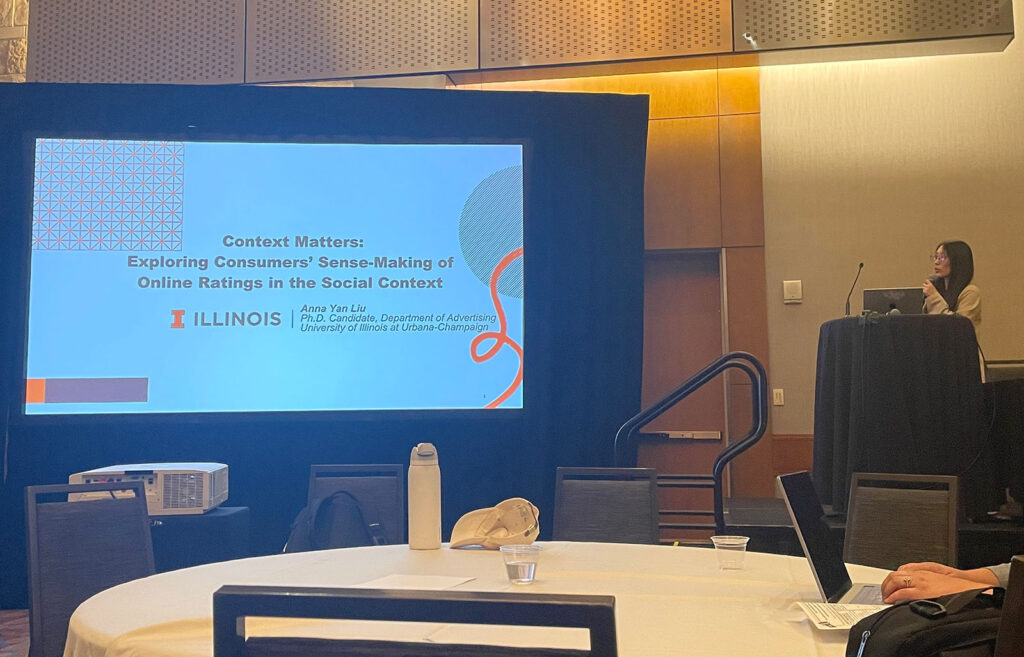
Anna Liu
Promising Student Papers
“Online Ratings in the Social Context: Exploring Consumers’ Critical Data Literacy and Sense-Making of Numeric Information”
Anna Liu, ICR student
Communicating with the Machine: Dynamics and Sophistication
“Testing the Machine-Likeness Hypothesis: How Humans Communicate Like Intelligent Agents”
Hai Liang, Chinese U of Hong Kong, HONG KONG
Longhan Wei, Chinese U of Hong Kong, HONG KONG
Maggie Zhang, ICR student
Jiyuan Qi, Chinese U of Hong Kong, HONG KONG
Anfan Chen, Hong Kong Baptist U, HONG KONG
GATO-lyzing Minds: Digital Advocacy, Social Cues, and Online Persuasion Tactics
“When Humans Anthropomorphize Non-Humans: The Influence of Language Cues and Human Motivation on Anthropomorphism and Persuasion”
WooJin Kim, U of Colorado Boulder
Chang-Dae Ham, Professor of Advertising and Associate Head of Graduate Studies
Supathida Kulpavaropas
Advertising and Consumer Behavior
“Does the Phrase ‘Limited Edition’ Embedded in Ad Matter? The Influence of an Advertising Attribute on Consumer’s Choices and Variety-Seeking Behavior”
Supathida Kulpavaropas (PhD ’17, ICR)
Sela Sar, Professor of Advertising
Xiaowei Zhang (MS ’23, advertising)
Qing Ang (MS ’24, advertising)
Virtual Social Processes
Chair: Sela Sar, Professor of Advertising
“What Makes Fake News More Viral? Emotions as Catalyst for Fake News Virality”
Sela Sar, Professor of Advertising
George Anghelcev, Northwestern U
Qing Ang (MS ’24, advertising)
Xiaowei Zhang (MS ’23, advertising)
Critical (Race) Disruptions and Transformations in Dominant Communication Paradigms
“The Tensions Between Internationalizing and Intersectionalities in the ICA”
Angharad Valdivia, Professor Emerita, Institute of Communications Research
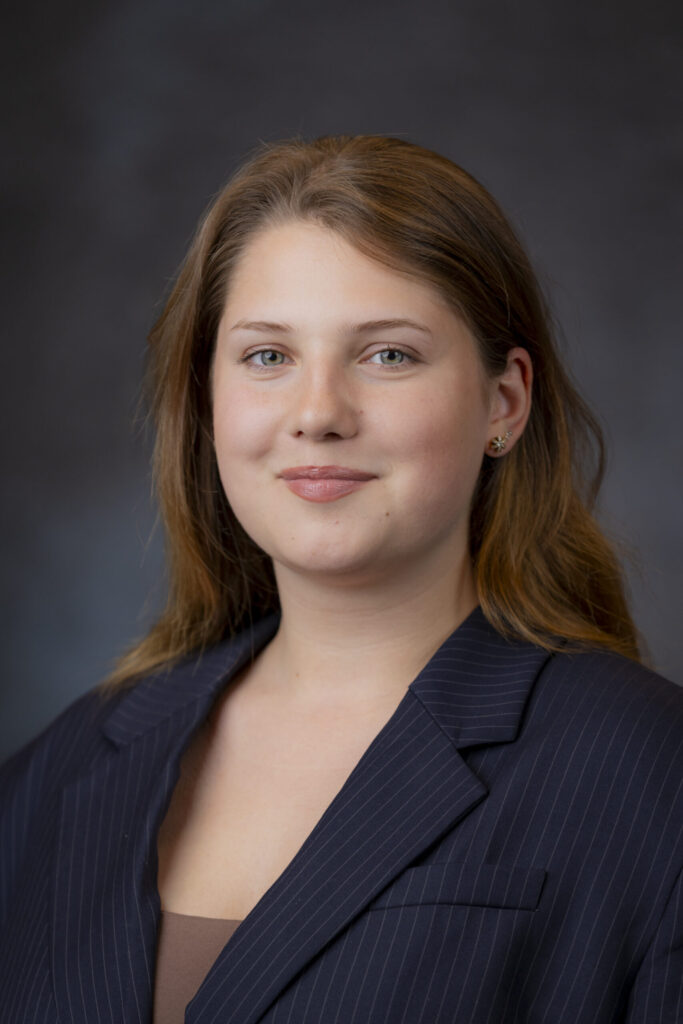
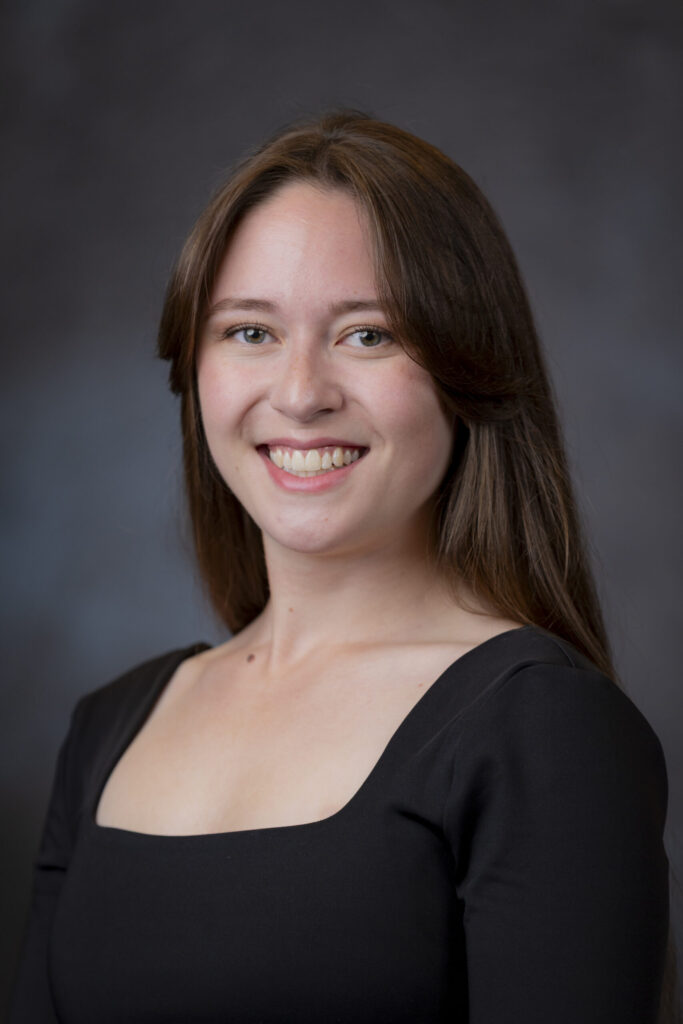
Layli Nazarova won first place and a $10,000 scholarship award in Hearst’s National Audio Championship. Madison Holcomb was named a finalist and won a $1,500 scholarship award for Hearst’s National Writing Championship.
Both Nazarova and Holcomb advanced to the Hearst Championships, the culmination of the 2024-25 Hearst Journalism Awards Program, held May 31-June 5 in San Francisco, California, to complete assignments under deadlines that were judged by media professionals.
(Photo of Madison Holcomb by Jakub Mosur.)
Nazarova’s assignment was to produce a two-minute story on the following topic: “Demonstrate how one of President Trump’s executive orders is having an impact on life in the San Francisco Bay Area. Choose from one of the following subject areas: immigration, higher education, tariffs, the economy, DEI.” Listen to her story.
Holcomb’s assignment was to write two articles: a news story from an interview with Executive Chair and Director of TPG Inc. Jim Coulter, and an article about how one of President Trump’s executive orders is affecting the Bay Area. Read her stories.
The Hearst Championships, often referred to as the “Pulitzers of College Journalism,” included 29 student journalists from across the country. The finalists were selected from 1,260 entries submitted in 14 competitions held throughout the academic year.
Journalism students Maggie Knutte, Nathan Gonzalez, Piper Pascarella, Nour Longi, and Faith Lee, and agricultural communications student Elena Cleary earned first place and a $3,000 scholarship for a documentary on period poverty titled “Tailoring Hope,” which was one of 60 entries submitted from 35 schools in the multimedia competition.
Additional credit for the documentary goes to 2024 Illinois journalism alum Stephanie Wayda and Fourah Bay College students Amadu Lamrana Bah, Stella Fredricka Bangura, Ola Deen, Nuhu Jalloh, Alpha Janneh, Aminata Kamara, Kelfala Kargbo, Rose-Lyn Koroma, and Hanna Aba Yankson.
The project is the inaugural work of the Illinois Partnership for African Women’s Health Narratives, an interdisciplinary initiative that empowers early-career African and American journalism and media students to research, produce, and disseminate the true stories of grassroots innovations to women’s health challenges in Africa—leveraging the humanizing power of first-person, character-driven storytelling to raise awareness and drive meaningful change.
“Tailoring Hope” focuses on Uman Tok, a nongovernmental organization based in Freetown, Sierra Leone, West Africa, which aims to alleviate period poverty and menstrual exclusion and educate girls and boys about sexual and reproductive health awareness. Read more about the making of the documentary.
Watch here:
Madison Holcomb, a senior in journalism, won first place in Explanatory Reporting and a $3,000 scholarship for her piece on livestock fatalities during transportation. The story was published in Investigate Midwest.
Layli Nazarova, a junior in journalism, won fourth place in Audio News and a $1,000 scholarship for her stories on campus accessibility and the designation of the Middle Eastern North African Census.
The Hearst Journalism Awards Program was founded in 1960 to provide support, encouragement, and assistance to journalism education at the college and university level.
For his outstanding career accomplishments and generous monetary support of advertising students, Murray Kalis (BS ’61) was recognized by the College of Media with the 2025 Distinguished Alumni Award.
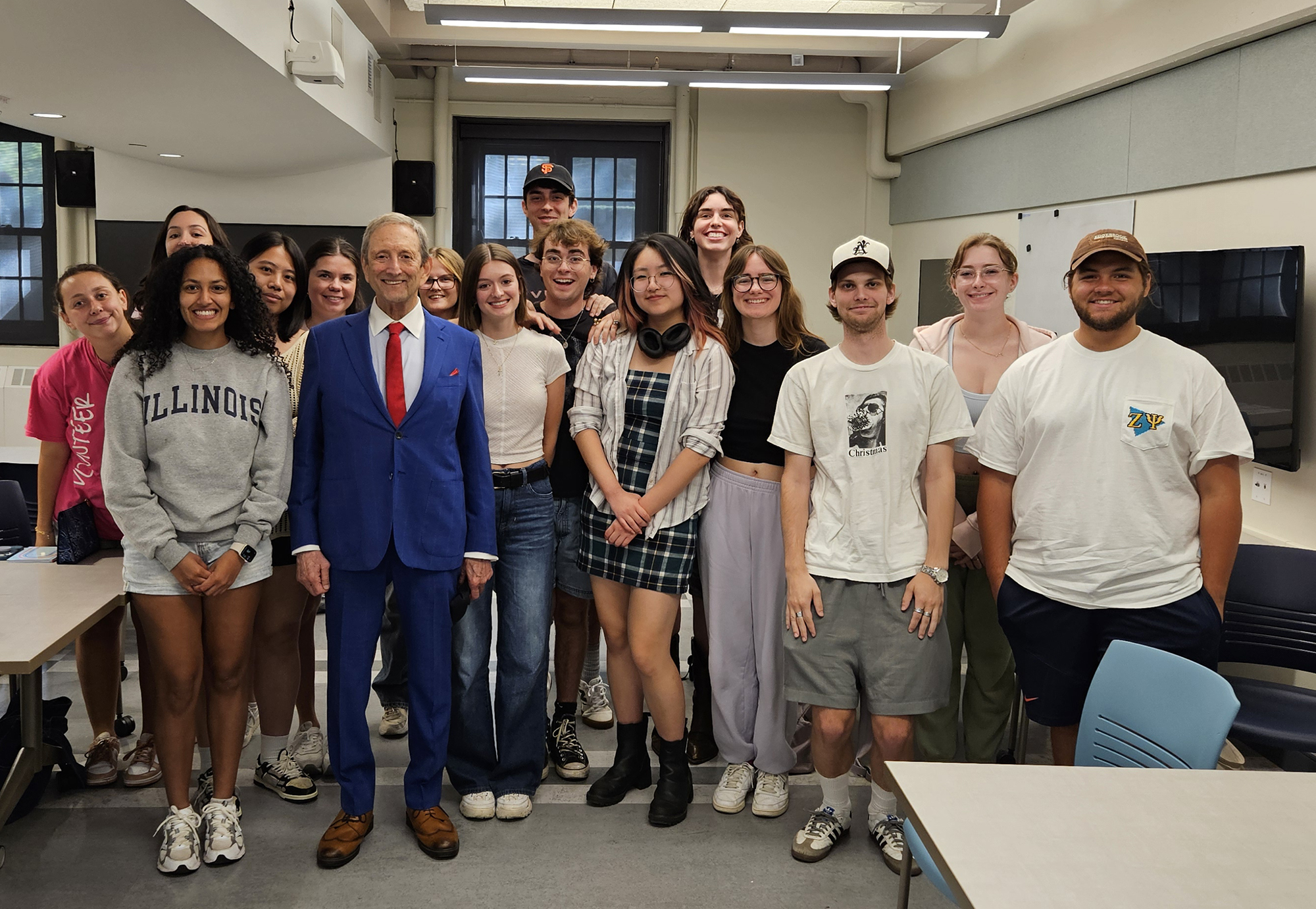
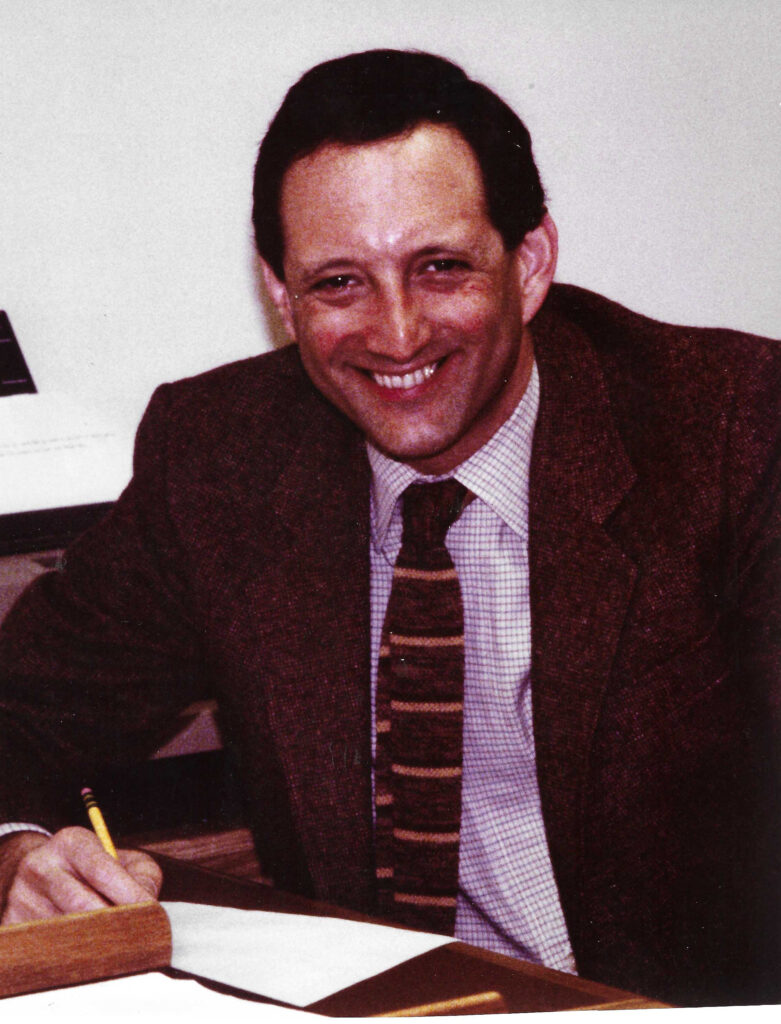
Murray Kalis with advertising students during one of his visits to the College of Media.
Kalis, whose work has taken him across the world and back, heading his own agency, and serving as chair of the largest global network of independent agencies, has experienced some remarkable moments throughout his 50 years (and counting) in advertising.
He’s helped numerous companies build their brands, including United Airlines, Nestle, KFC, Wetzel’s Pretzels, Hormel Foods, and Starbucks Coffee. Most recently, a former client brought him in as a strategic investor for Dave’s Hot Chicken, where he is creating TV and social media advertising that has helped it grow to over 300 restaurants, and just begun international expansion.
In 2020, he established the Murray Kalis Award for Creativity in Advertising to provide monetary gifts to advertising students judged for creative excellence. Students who demonstrate smart positioning, outstanding creative concepts, strong execution, and a “wow” factor receive awards for Best Single Ad, Best Campaign, and Best Portfolio.
“The response to the Award for Creativity in Advertising has been beyond what I anticipated,” Kalis said. “The students are thrilled to express creative ideas. And the questions I get when I teach are insightful, mature, and often surprising.”
“Murray Kalis has charted an exciting career in advertising and shares his wealth of experience, advice, and encouragement with our students,” said Dean Tracy Sulkin. “The College of Media appreciates the time he devotes to our classes—as well as his advocacy of creativity through the award that he established—and we are proud to honor him with the 2025 Distinguished Alumni Award.”
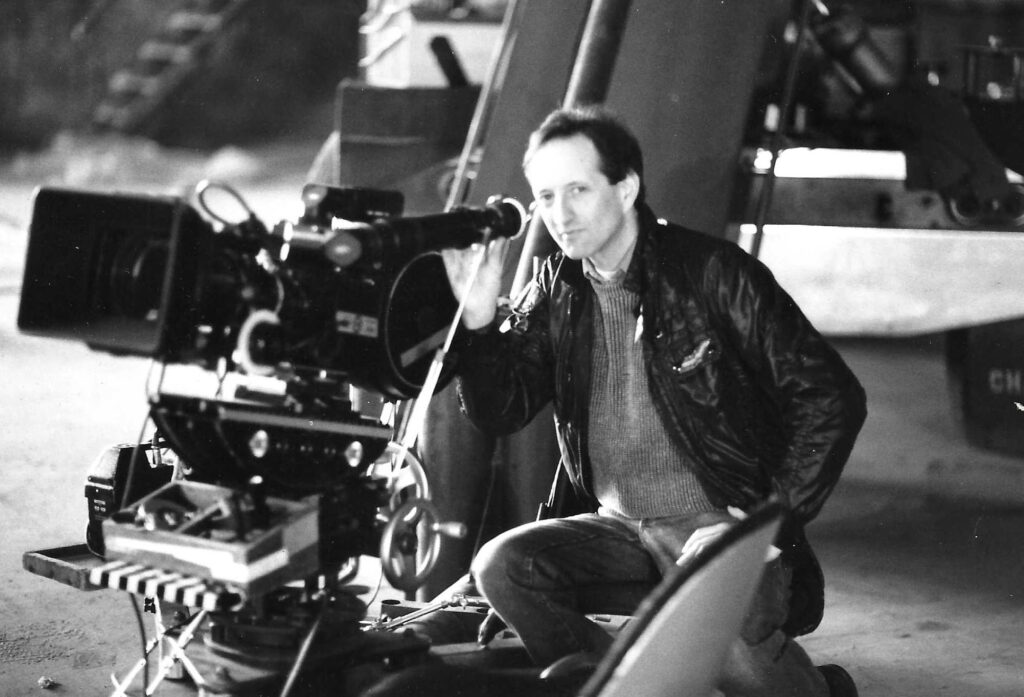
Murray Kalis early in his advertising career.
As a student at the University of Illinois, Kalis felt fortunate to be taught by the legendary “Father of Advertising Education” Professor Charles H. Sandage.
“I can picture him to this day. He made an impression on me that still guides my work,” Kalis said. “He discovered advertising could impart its own magic: That a great ad can do more than sell, it can add value to the product itself.”
Kalis said Sandage always approached advertising from a highly philosophical and intellectual way and encouraged critical thinking. “He used a kind of Socratic method [of teaching].”
If students gave an incorrect answer, Sandage had a way of guiding them to the right one.
“He would start asking you questions, and he would lead you to understand, to try to defend your position, and suddenly you realize, ‘Oh, that doesn’t make any sense,’” Kalis said.
After receiving his bachelor’s degree—and thanks to the University of Illinois Reserve Officers’ Training Corps program—Kalis was commissioned as a lieutenant in the United States Army where he put his civilian education in advertising to work in psychological operations.
“I had two years of active duty basically running an ad agency,” he said. “We found illustrators and writers among the draftees, and we would create leaflets to be dropped out of planes.”
Following his military service, a master’s degree in fine arts, and a college teaching position in Iowa, Murray joined ad agency Leo Burnett in Chicago.
There, he quickly rose up from junior copywriter to creative director in an era when the ad industry resembled the glossy, high-profile lifestyles portrayed in the television series Mad Men.
As a member of the Academy of Television Arts and Sciences and Emmys judge, Kalis met Mad Men star Jon Hamm at a reception for the cast and producers.
Kalis said they discussed the similarities of the TV show and his real-life experience in advertising, which included “making those pitches, dealing with clients, and having to work your way through three-martini lunches.”
Kalis’s creative career also introduced him to actor Tom Hanks. To prepare for a role as a Chicago advertising executive in the 1986 film Nothing in Common, Hanks followed Kalis around the office to get a feel for his daily routine.
At this point in his career, Kalis says he is mainly working in social media, which is a lot different than when he first started in the business. Then, there were just three television channels that offered an opportunity to advertise.
While media delivery options have changed over the years, Kalis said the purpose of advertising—finding solutions to consumer problems—has remained the same.
“The media changes,” he said, “but people don’t. It’s Maslow’s Hierarchy of Needs, just like when I was entering Greg Hall for the first time.”
After all these years, Kalis is still full of energy and enthusiasm for the advertising industry.
“I love the biz. I love doing this stuff,” Kalis said. “I love looking at a product and figuring out how to match it with a consumer.”
Above: Murray Kalis was creative director for this Dave’s Hot Chicken ad.
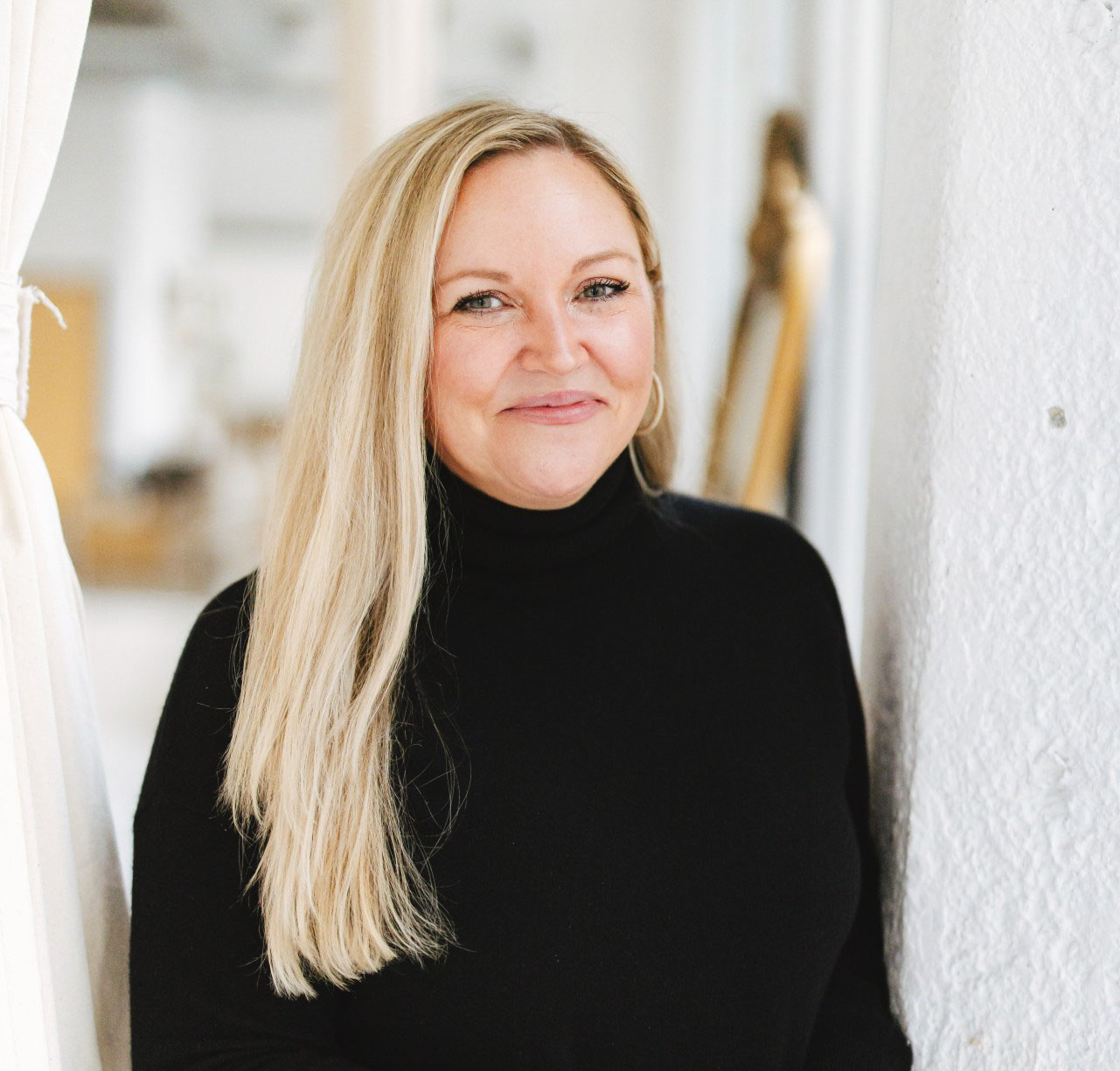
Stephanie Lulay’s (BS ’08, journalism) start-up venture, Block Club Chicago—whose mission is to deliver reliable, nonpartisan, and essential coverage of Chicago’s diverse neighborhoods—has become a news staple for readers throughout the city since its founding in 2018.
Lulay serves as executive editor and co-founder of the award-winning newsroom, which has 18,000 paid subscribers, more than 130,000 newsletter subscribers, and an average of 2.3 million pageviews a month. Over seven years, the newsroom has grown from a staff of eight reporters and editors to a staff of 39. Lulay credits her journalism education at Illinois as a key to her success.
“The [University of Illinois] gave me the problem-solving skills and the confidence I needed to succeed in this industry,” she said.
In honor of her career accomplishments and her continued engagement as an alum, Lulay was chosen as the winner of the 2025 College of Media Emerging Leader Award.
“The College of Media is pleased to award Stephanie Lulay as our 2025 Emerging Leader for her innovative and entrepreneurial path in the journalism industry, along with her enthusiasm for sharing her experiences with our students and alumni,” said Dean Tracy Sulkin. “Stephanie is an alum who exemplifies, in an ever-changing media landscape, how to enhance the lives of people in our state.”
Lulay calls Block Club Chicago a “freemium site”—very few articles are paywalled and most stories are accessible for free, including breaking news, health, election coverage, and news from underserved South Side and West Side neighborhoods. They also produce twice-weekly Block Club Chicago podcasts, hosted by fellow Illinois journalism alum Jon Hansen (BS ’06).
The [University of Illinois] gave me the problem-solving skills and the confidence I needed to succeed in this industry.
Stephanie Lulay
Executive Editor and Co-Founder of Block Club Chicago
Their reporter model is different from traditional newspapers, too. Rather than having beats, reporters are assigned to neighborhoods, tasked with covering whatever news is most important that day.
Lulay says their “big bet” is when they put reporters on the ground every day, it will lead to a more accurate portrayal of the neighborhoods in Chicago and build reader trust.
“That’s what makes me so excited about working for a local newsroom in this time. I When you know who is serving you, and you see them all the time — at your kid’s school, at a community meeting —that is key to rebuilding trust between media and people,” Lulay said.
Lulay says she took what she learned at college with her into the workforce—including the hands-on experience she gained from writing and editing for The Daily Illini and the confidence she built from working closely with Brant Houston, Knight Chair Professor in Investigative and Enterprise Reporting in the Department of Journalism.
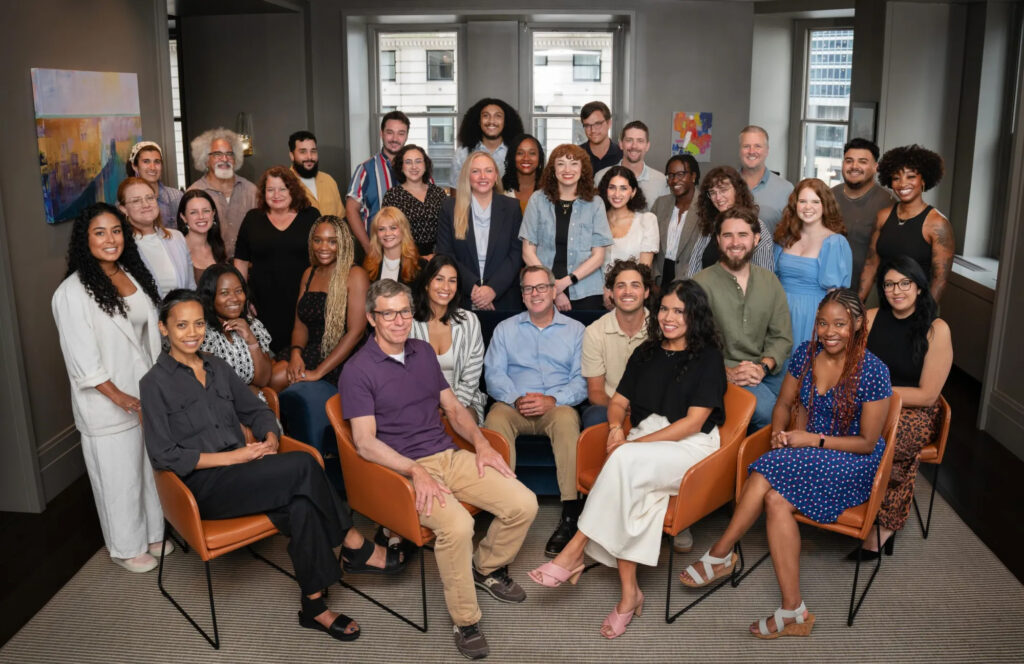
The staff of Block Club Chicago.
“Brant really encouraged me to dig into some big investigative stories and to not think of myself just as a student, but as an investigative journalist,” she said. “Because of that, I was able to get real-life professional experience.”
When Lulay and 115 reporters across the country lost their jobs after DNAinfo sites shuttered in November 2017, one of the first calls she made was to Houston.
Lulay describes Houston as “a godfather in the nonprofit news movement,” and said he gave her the right connections and insight to think through their plan at the start of Block Club Chicago.
Lulay has stayed engaged with College of Media students through educational webinars and classroom visits.
She hopes Block Club Chicago’s success might inspire others to start up similar newsrooms across the country, especially recent College of Media graduates.
“I would love to see some Illini students graduate, pop up in a news desert, and start a newsroom there,” Lulay said. “It’s hard work, but there is so much opportunity right now in nonprofit news and I’d love to see some students capitalizing on that.”
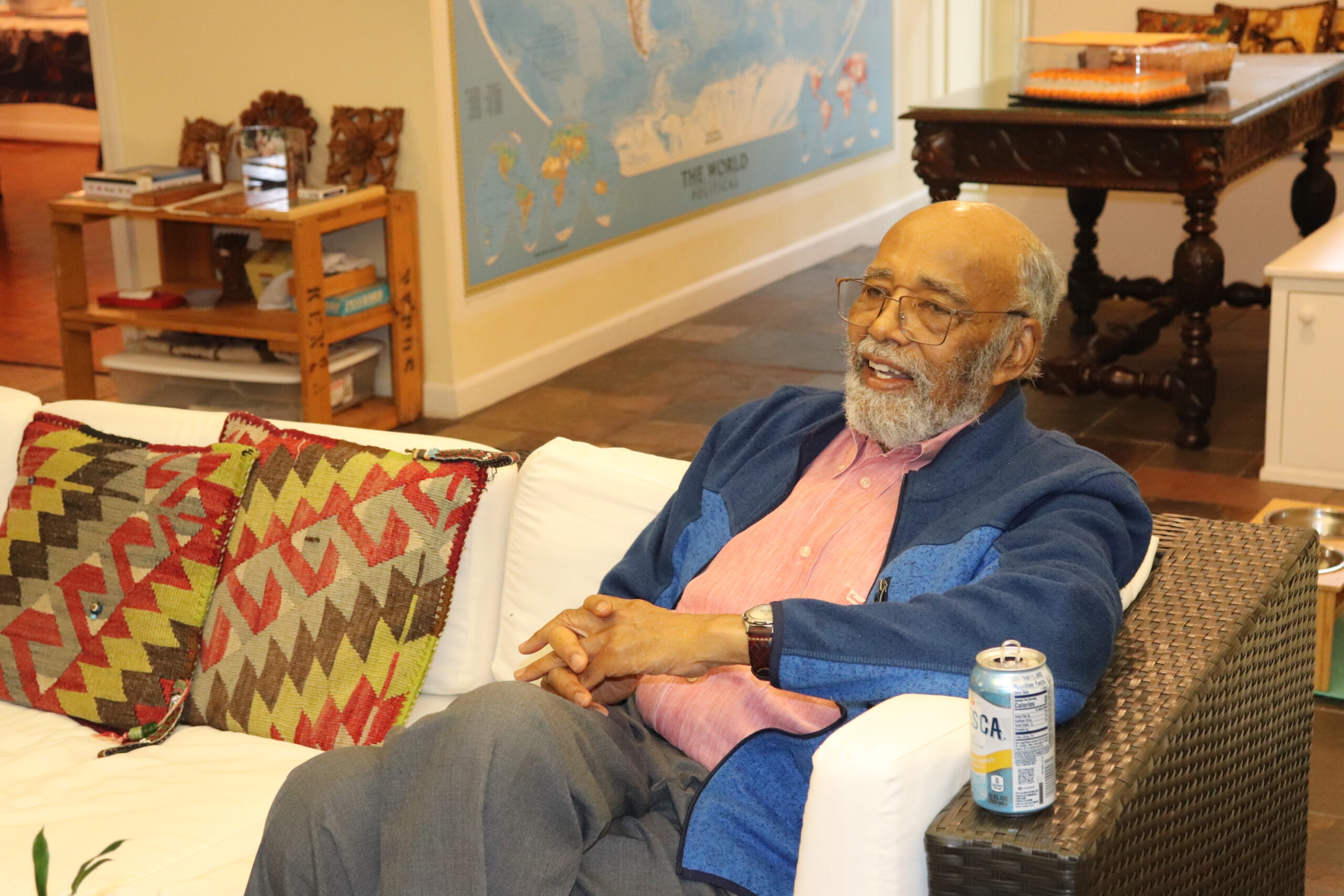
Leon Dash, winner of a Pulitzer Prize and Swanlund Chair Professor of Journalism, sat in his office chair on the third floor of Gregory Hall, appearing calm and collected on his last day of teaching at the College of Media.
Leon Dash at his retirement celebration on May 13, 2025. (Photo by Kelly Youngblood.)
With 27 years of classroom instruction soon to be behind him, and a 30-plus-year career as an investigative news reporter for The Washington Post in his rearview mirror, Dash was looking forward to his next step—retirement.
Dash has always tended to look ahead to the next step, the next chapter, the next story.
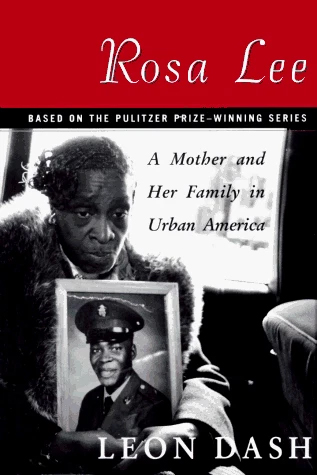
This inclination may have contributed to him becoming a Pulitzer Prize finalist in 1987 for a six-part series on teenage pregnancy, and eventually winning the Pulitzer Prize in Explanatory Journalism in 1995 for an eight-part series, “Rosa Lee’s Story,” that shed light on an impoverished, urban family trapped in intergenerational cycles of crime and addiction.
Dash followed Rosa Lee Cunningham, her children, and her grandchildren for four years, chronicling their struggles and occasional victories for TheWashington Post series, which also won the Robert F. Kennedy Journalism Award for setting “the standard for reporting about poverty.”
The piece was also named to the “Top 100 Works of Journalism of the Century” by the Arthur L. Carter Journalism Institute at New York University.
A year after winning the Pulitzer, Dash published a book based on the series, Rosa Lee: A Mother and Her Family in Urban America. Dash didn’t know it yet but that book, along with another one he wrote about teen pregnancy—When Children Want Children: The Urban Crisis of Teenage Childbearing—would become required reading for his journalism students one day.
Dash’s trailblazing efforts in immersion journalism opened many doors for him, including an opportunity to join the faculty at the College of Media. In Fall 1998, he stood in front of his first class of college students and began the next half of his journalism career—this time as an instructor.
Dash said he was intimidated at first but quickly found his footing thanks to his “self-appointed” faculty mentor and fellow professor of journalism, the late Bob Reid. With Reid’s guidance, Dash said his transition from the newsroom to classroom went very smoothly.
Throughout his extraordinary career, Dash has seen the journalism landscape undergo several changes. The most notable for him is a decline in assertive news reporting.
“So many of the publications are weak when it comes to standing up to power. That used to not be the case,” he said.
At the Post, Dash said he was expected to confront people in power, if necessary, to get answers to the tough questions.
But now more than ever, media outlets are fearful of economic and legal repercussions, he said.
“That was a big disappointment to me. It was painful to watch,” he said. “That kind of interference was unheard of in the past.”
Dash also believes social media has blurred the lines between what is considered news and what is considered opinion, which creates confusion; and people tend to look to a variety of political figures and social influencers for their news today, rather than trained journalists, which Dash views as “very dangerous.”
About 10 years ago, he ran into a former newspaper colleague who told him her job required her to produce two to three different ledes a day for the same story. Using the same facts, the reporter told Dash she had to create a new enticing hook to reel in more readers.
For Dash, who was accustomed to spending months on stories, the idea of churning out multiple ledes a day sounded like “a nightmare.”
Dash says he has no solutions for the many issues plaguing the journalism industry today but does encourage others to think for themselves.
He knows social media is here to stay and engages on a few platforms, sometimes connecting with former students.
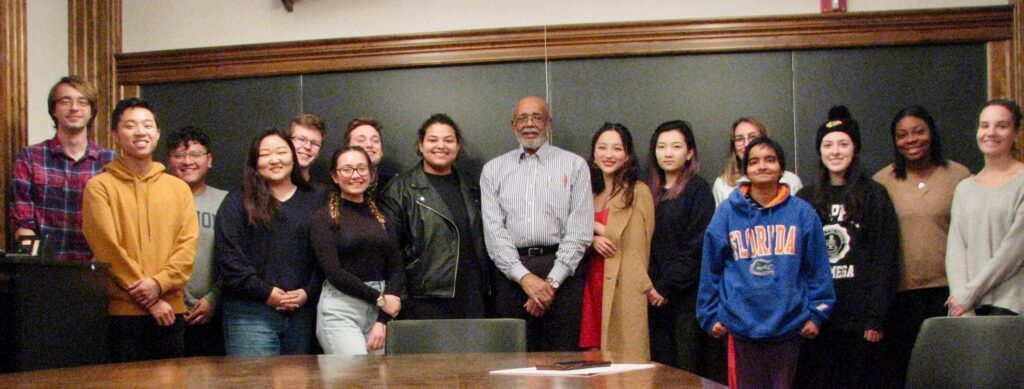
Leon Dash with students in his Great Books of Journalism course in Fall 2019.
He even joined a Facebook Group, which is now inactive, called “Dash Survivors,” created by former students to playfully discuss Dash’s more rigorous coursework.
Dash’s current news diet includes online subscriptions to The New York Times, The Washington Post, and The News-Gazette. He never thought he’d make the transition from reading print news to digital news but now he says it’s more convenient.
“I no longer have ink stains on my fingers from reading the newspaper,” he said.
Dash will miss a lot about teaching, especially working with students who have the ability and genuine interest to become a successful journalist one day.
“Those kinds of revelations are always pleasant, and I’ll miss that,” he said.
But Dash is already looking ahead to his next piece of work. Namely, he said: “A book I need to write.”
He said his forthcoming book “entails lengthy interviews with Black and white Americans focusing on what, when, and under what circumstances did they have a defining ethnic experience on the American landscape.”
The honorary degree award recognizes individuals who have shown exemplary, extraordinary, and distinguished contributions to knowledge and creativity in a specific field, or sustained activity of uncommon merit.
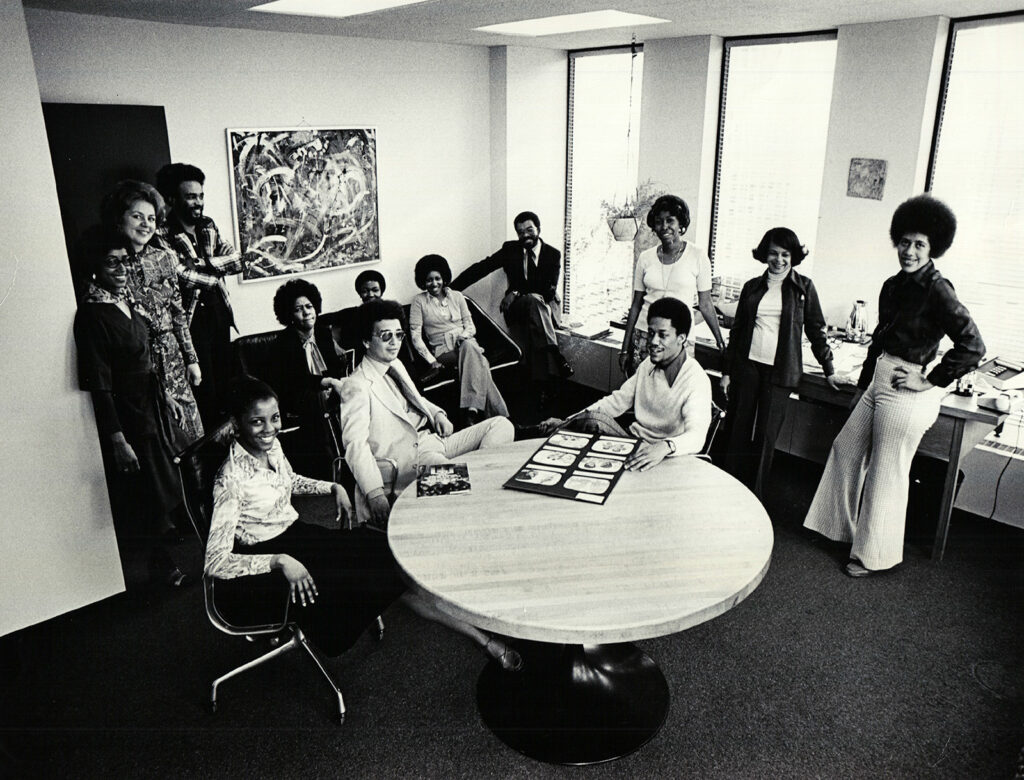
The Charles H. Sandage Department of Advertising was the key sponsor of Burrell’s honorary degree, with three additional departments supporting his nomination, including the Department of African American Studies, the Marketing Group in the Department of Business Administration, and the Department of Communication.
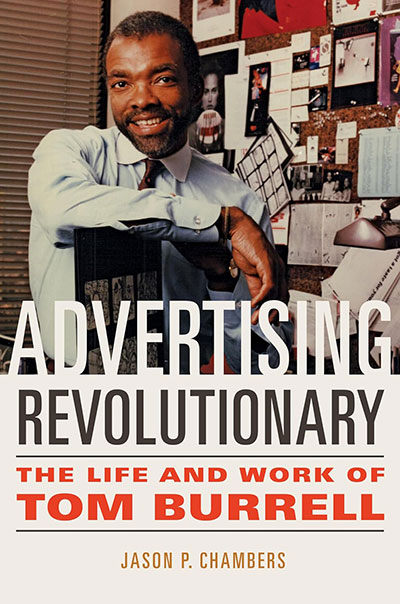
Jason P. Chambers, professor of advertising and associate dean for access and engagement at the College of Media, describes Burrell as his “favorite person in the history of the [advertising] industry.”
Tom Burrell is unquestionably a pioneer in the field of advertising. He helped to normalize the image of African Americans in advertising.
Jason P. Chambers
Advertising Professor and Author of Advertising Revolutionary: The Life and Work of Tom Burrell
“He started in advertising at a time in which the number of African Americans operating in a professional capacity could have been measured in the dozens,” Chambers said. “He is one of the people who is singularly responsible for helping to get African Americans on TV.”
Burrell’s career, first as a copywriter and then as an agency owner of the Burrell Communications Group, spans more than 40 years. He created an approach to advertising, “positive realism,” that is still utilized today in the field.
Burrell has been elected to the American Advertising Federation Hall of Fame, one of the industry’s highest honors. He also received the Albert Lasker Award for Lifetime Achievement in Advertising and the Missouri Honor Medal for Distinguished Service in Journalism. In 2017, he became the first African American creative elected to the One Club Creative Hall of Fame.
Despite the many challenges he faced throughout his career, Chambers said Burrell provided an opening into advertising for African Americans who likely otherwise would not have found one, giving them a place to learn the business, to develop as professionals, and to be themselves.
“Tom Burrell is unquestionably a pioneer in the field of advertising,” Chambers said. “He helped to normalize the image of African Americans in advertising.”
The Sandage Department of Advertising will host a luncheon for students and faculty to meet Burrell while he is on campus.
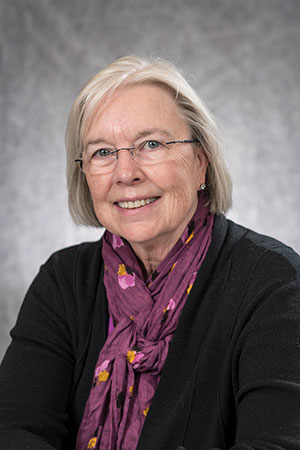
Nancy Benson, professor emerita of journalism, died on April 21, 2025. She was 72 years old.
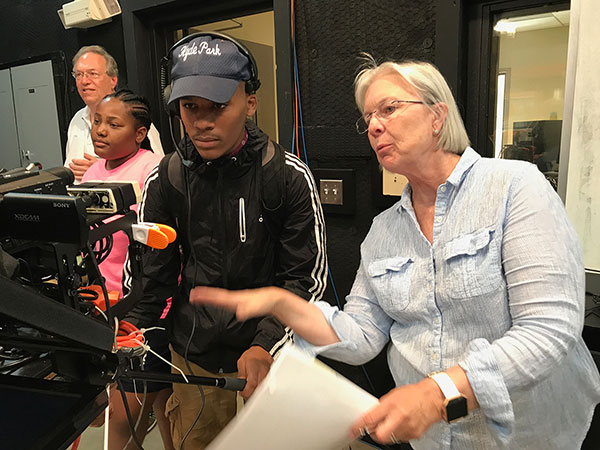
In 1996, she was hired as a visiting professor in the Department of Journalism and became an assistant professor in 1997. She was promoted to associate professor in 2003 and to full professor in 2014. Before retiring in 2019, she served as interim head of the Department of Journalism.
During her 40-year career in broadcast journalism at various television and radio stations across the Midwest, including morning drive anchor and reporter at WMAQ radio in Chicago, Benson won numerous awards for reporting.
The highlight of her teaching career was developing an international reporting course. After a term of teaching about a particular country, she traveled with her students to that country. There, they would research and produce stories about issues that otherwise had been ignored. Nancy took students to Peru, China, Romania, Italy, and Turkey.
April 14, 2025 | Ruth Kwak, Office of the Chief Information Officer, Technology Services
When the Website Management Center of Expertise collaborated with the College of Media, the College of Law and the School of Social Work to solve the challenges on each unit’s websites, the result was three new websites and a roadmap for building more.
Launched just one year ago from the grassroots efforts of the Website Implementation Guidelines Group, the Web CoE was established as part of the universitywide Operational Excellence initiative. With a mission to streamline dedicated resources and centralize expertise, the Web CoE now serves as a vital resource for helping units campuswide create and manage secure, accessible, and Illinois-branded websites.
How does it work?
At the heart of the Web CoE is its Website Management Consulting Service, designed to serve any group on campus—regardless of their levels of web experience. Groups can submit a ticket to start the consultation process, whether they’ve inherited an outdated website or are building one from scratch. The consulting team meets with the group to understand their specific goals, audience, technical capacity and needs. Based on this consultation, the team provides expert recommendations and, when appropriate, full-service migration support. Visit the Website Management Consulting Service webpage to learn more about the details of the process.
One of the biggest draws of working with the Web CoE is that it guarantees the final product will meet the university’s standards for accessibility, privacy, security and branding.
Previous Website Implementation Guidelines Group co-leader and current program director for the Website Management Center of Expertise, Cordelia Geiken shared more about why the Web CoE was identified as a part of the Operational Excellence initiative.
“People have been making websites at U of I since Mosaic in 1993, but it’s been all over the place. Our goal is to make things more streamlined, and to enable people to get the help they need in order to be accessible, secure and also branded…. Illinois branding is still pretty new. People are really excited about it and want to improve the user experience on their sites. If you’re on a University of Illinois site, you should know you’re on one.”
People have been making websites at U of I since Mosaic in 1993, but it’s been all over the place. Our goal is to make things more streamlined, and to enable people to get the help they need to be accessible, secure and branded.
Cordelia Geiken
Program Director for the Website Management Center of Expertise
Early adopters
This spring, the Web CoE completed full website implementation engagements with its first three early adopters: the College of Law, the College of Media and the School of Social Work. These projects were not only impactful for the individual units, but also valuable learning experiences for the Web CoE itself. The Web CoE engaged in a full website migration for each early adopter.
Geiken said that the early adopters each had a unique situation that the Web CoE had to work through. “All of campus will benefit from the unique situations those units faced,” Geiken said.
The College of Media
Without a web developer on staff, Holly Rushakoff, director of communications for the College of Media, was seeking assistance to update the college’s site when she was connected with Cordelia Geiken.
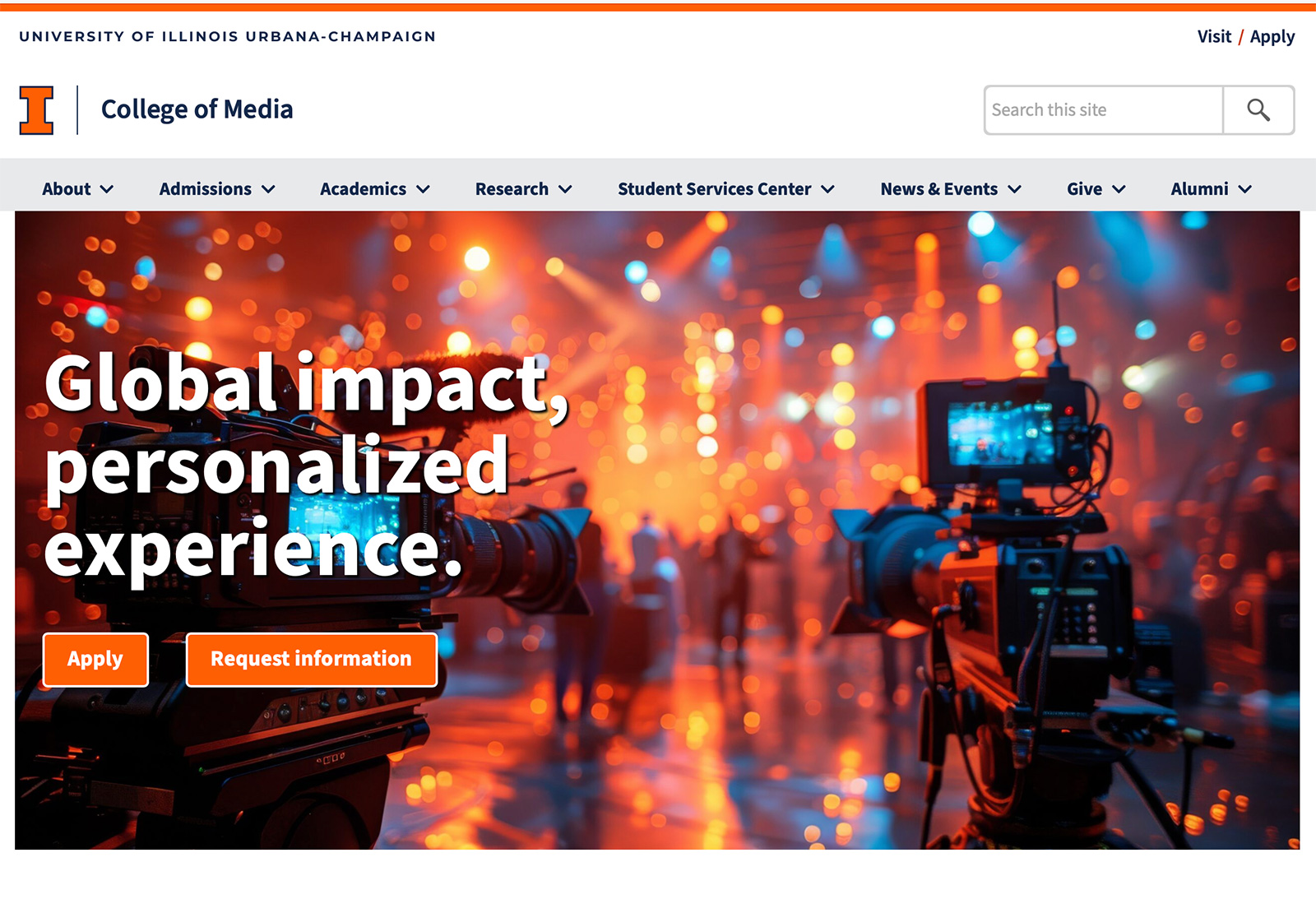
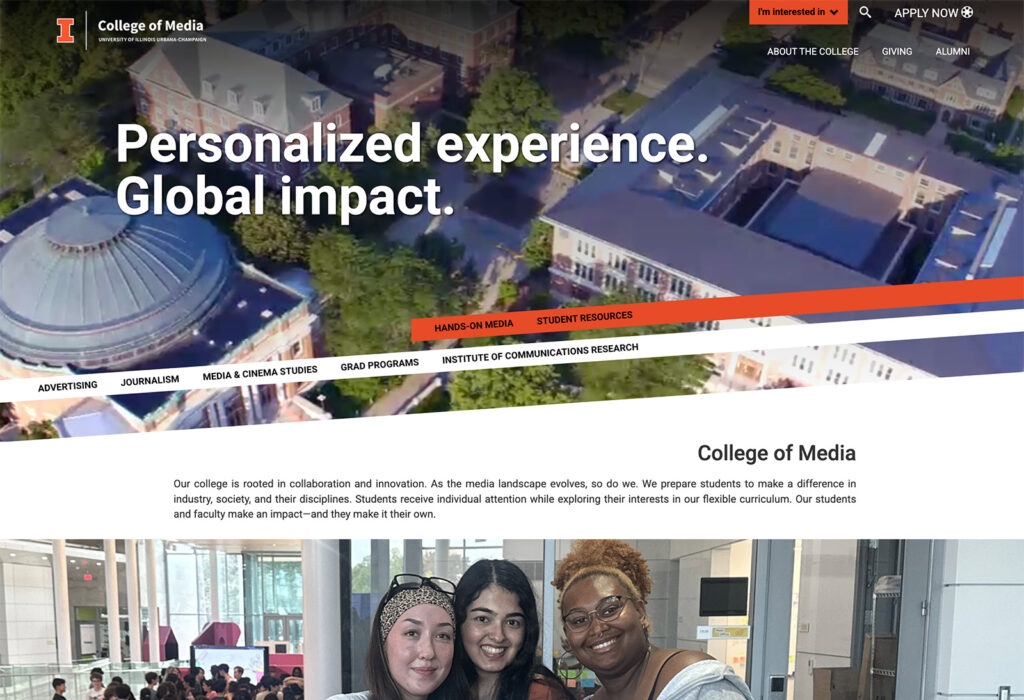
The College of Media’s previous homepage.
Media’s previous website was on Drupal and was a redesign that had been completed in 2019. According to Rushakoff, the web design of their page had impactful landing pages, but the other pages were simple with limited design and functionality options. Rushakoff also explained that the photos had to be a certain width or else it would break the flow of the page. These limitations were addressed with the Web CoE.
“The new website has accessibility enhancements and an incredible selection of design and layout options, from buttons to call-to-action blocks to clickable cards, plus photo slideshows, pull-quotes, and many header styles—and of course Illinois orange and blue templates to choose from. These design features enable us to make our stories much more visually dynamic and pull readers through the story or a landing page in a more engaging way, with multiple entry points,” Rushakoff said.
Working on the site was a year-long process, with many working meetings between Rushakoff and her Web CoE liaison, Liz Shallenberger, user experience design specialist at Technology Services.
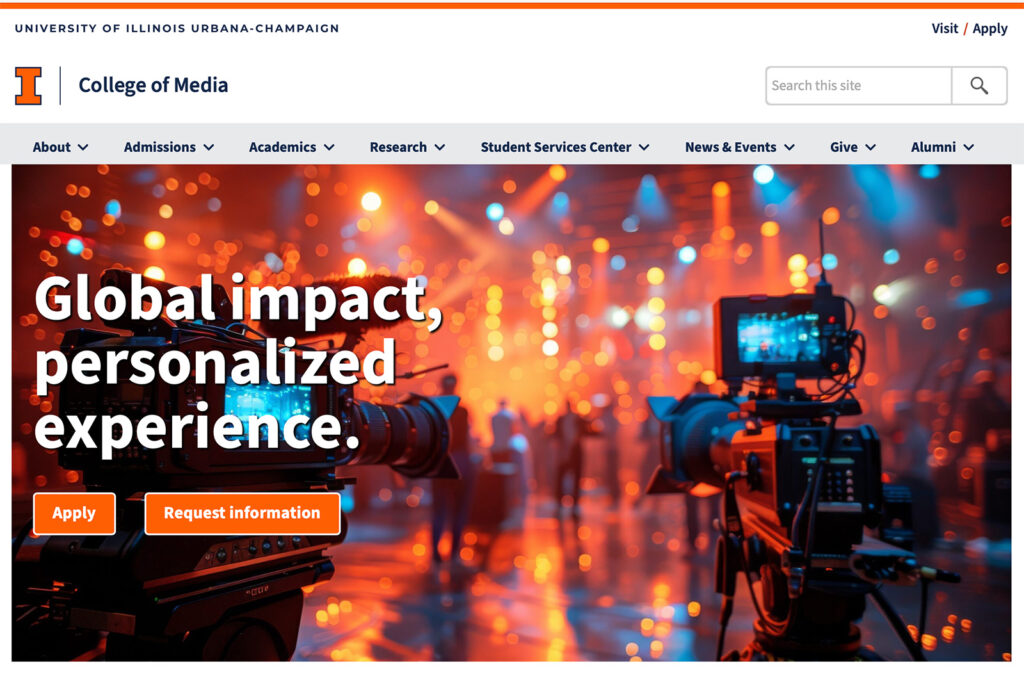
The College of Media’s new website adheres to campus brand guidelines.
“The Web CoE team offered a wide range of expertise in web, graphic and user experience design, information architecture, accessibility and more. There were no questions they couldn’t answer! It was incredibly helpful and reassuring to have guidance from the Website Management Center of Expertise team throughout the entire process,” Rushakoff said.
Throughout the engagement, the College of Media was responsible for tasks such as auditing and organizing their content, tracking accessibility reviews, redesigning past stories with the new story template, updating short URLs and testing the development site for any issues before launch.
“I had an excellent experience working with the team from the Website Management Center of Expertise! Although it was a lot of extra work, it was primarily a joyful process because we could see the exciting transformation as we worked on the development site and chipped away at our milestones,” Rushakoff said.
The final product is a new Illinois-branded, accessible and secure website hosted on the Tech Services server, with people from the College of Media ready to perform site maintenance.
Krista Gaedtke, senior director of strategic marketing and communications for the College of Law was always looking for ways to stay connected with what was happening with website design at a campus level. The College of Law had been needing a refresh for a while, and so when talks about the Website Management Center of Expertise reached Gaedtke, she immediately submitted a ticket requesting available resources.
“Our previous site was not in terrible shape – it was nicely designed, well-structured, responsive and accessible, but it was decidedly not ‘on brand.’ There were also a few features that we were using on our previous site that didn’t provide the level of customization or flexibility that we needed, so finding viable alternative solutions was also a priority for the migration,” said Gaedtke.
According to Gaedtke, WordPress had been meeting their needs sufficiently, and so they opted to migrate their old WordPress site onto another WordPress site, focusing on minor re-structuring instead of changing the host.
“The end result is a website that is now fully compliant with Illinois brand guidelines and accessibility standards and takes advantage of many of the design features and components available within the Illinois web theme,” Gaedtke said.
In addition, Gaedtke noted that they were able to complete the website migration at no cost to the College of Law.
“Having gone through the process for a full-service website redesign project within the past ten years, I am well aware of the significant cost savings we were able to achieve with this partnership,” Gaedtke said. “I think we can easily say that we saved the College of Law at least $50,000 on this project, if not more.”
Gaedtke also mentioned several other benefits to partnering with the Web CoE, including regular access to the developers who were building the tools, the ability to offer feedback at will, see adjustments being made in real-time and suggest future developments.
Geiken said that the Web CoE worked with the College of Law for a full migration, and the College of Law then opted to perform their own future regular maintenance. However, as an official user of the Illinois Web theme, the College of Law will now have first access to all new product releases on the Illinois Web theme and tech support whenever needed.
“There was a point person for the project on both the Web CoE team and on our team. Dena Strong was assigned as our Web CoE liaison for the project; her background is user experience design, but she had to wear many different hats throughout our project, and she was an absolute rockstar. We met on a bi-weekly basis,” Gaedtke said.
Dena Strong, the Web CoE liaison for the project, is a senior information design specialist at Technology Services.
Gaedtke explained that the Web CoE drove the overall management of the project, prioritized action items, migrated all the content over to a development site, worked with them to make it look how they wanted; they performed troubleshooting and also advised on how to utilize certain tools.
On the other hand, Gaedtke’s team worked on making sure all the content was accurate and up-to-date, structured as they wanted it to be, and designed consistently across pages. As the site was on the College of Law’s server, they were also responsible for ensuring that they were aligned to the College of Law’s privacy and security best practices.
“There were certainly some growing pains along the way… simply because this was the first time that either of our teams were engaged in this type of project,” said Gaedtke. “We are really pleased with the end result.”
Over the years, the School of Social Work has had many conversations with units on campus about their lack of internal web support. Without internal staff dedicated to web support, they had been working with an external vendor.
“We started with well-designed, accessible, highly customized site that was expensive to maintain. Through migration [with the Web CoE], we transitioned to a clean, fresh design with significantly improved content organization. The new site aligns with our brand, enhances user experience and will hopefully be much easier to maintain in the long run,” said Becky Ponder, director of communications for the School of Social Work.
The previous site was a vended site hosted on WordPress with extensive customization.
“We had to do custom scripting in order to export their site out from their old environment to their current one. They don’t have staff to maintain their site, so we came up with a solution to address that, working with field consultants at Tech Services. We were able to hire a part-time field consultant to do maintenance for them,” Geiken said.
According to Ponder, the Website CoE managed more of the technical aspects of the site, while the School of Social work’s team focused on content, design preferences and identifying functional needs.
Social Work partnered up with Web CoE liaison and lead consultant for the project Huaqi Zhang, user experience design specialist at Technology Services.
“It was a true partnership, with both teams working diligently to ensure the site met our goals,” Ponder said.
The result was a full migration to a fresh site with dedicated web maintenance support from Tech Services. Receiving overall website support from campus has resulted in significant cost savings for the School of Social Work.
“One of the biggest takeaways from this migration is how complex website transitions can be, even with a great support team. Every website has unique needs, and ensuring all integrations function properly takes time and patience. It was a learning experience for everyone involved! While it was a complex transition, we’re grateful to have the new site launched and are very happy with it,” Ponder said.
The Web CoE has created a list of campus web resources for anyone at the university. This list of resources will be ever-evolving, updated with resources to support groups with all web-related concerns.
“Not everybody needs someone else to set up or maintain their sites. So we wanted to provide some resources for those who do have staff who can do all this for them. This is where collaboration comes in, and this is what this resources page and what our group is all about. We are trying to create a place for people to collaborate, to use whatever resources they have to join in the efforts to unify and protect our websites. So far, it has produced a much better product across the board,” Geiken said. Following the work on the three early adopter’s websites, the Web CoE will be reflecting and refining the program processes while engaging with the College of Applied Health Sciences on a website migration. The Web CoE will be ready to work with more units in the later summer of 2025. If you’re interested in learning more or working with the Web CoE, submit a ticket to start a conversation or to get on the list.
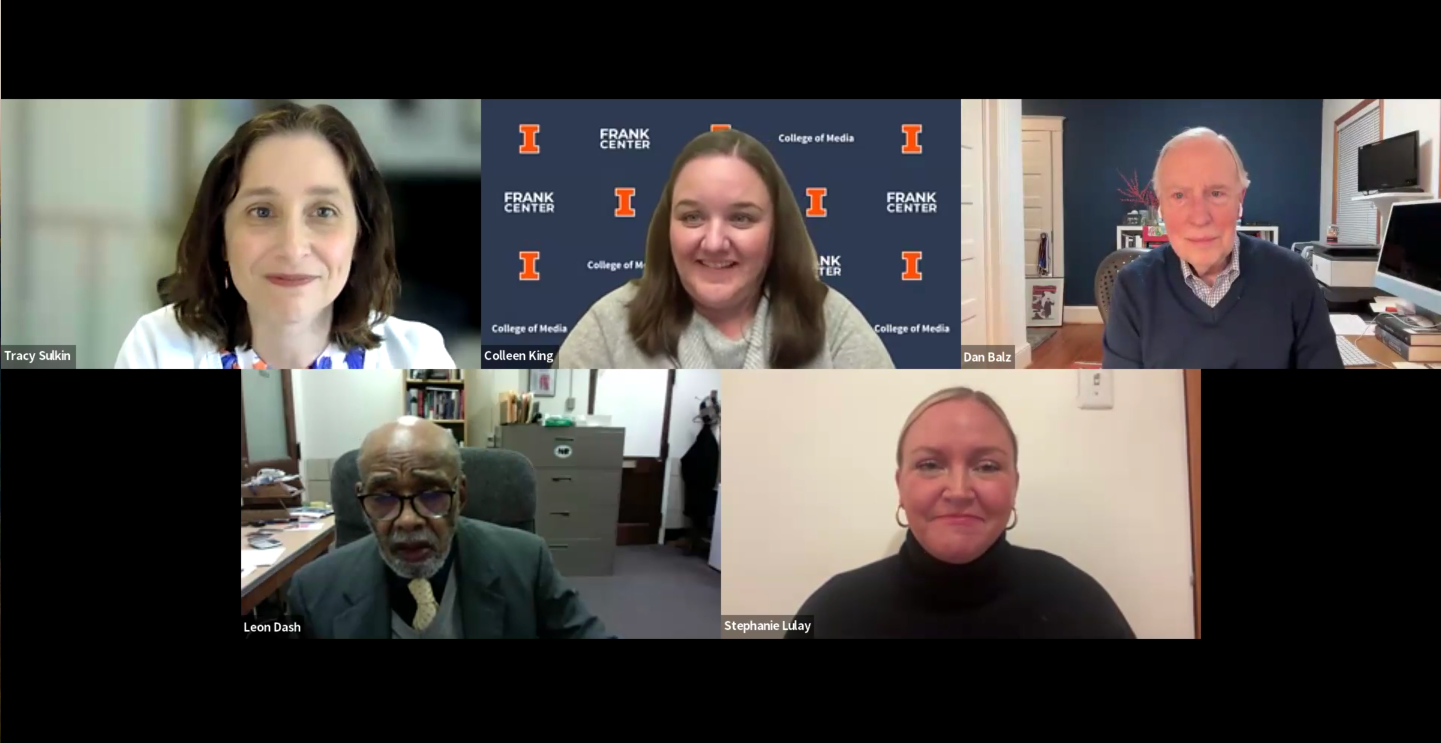
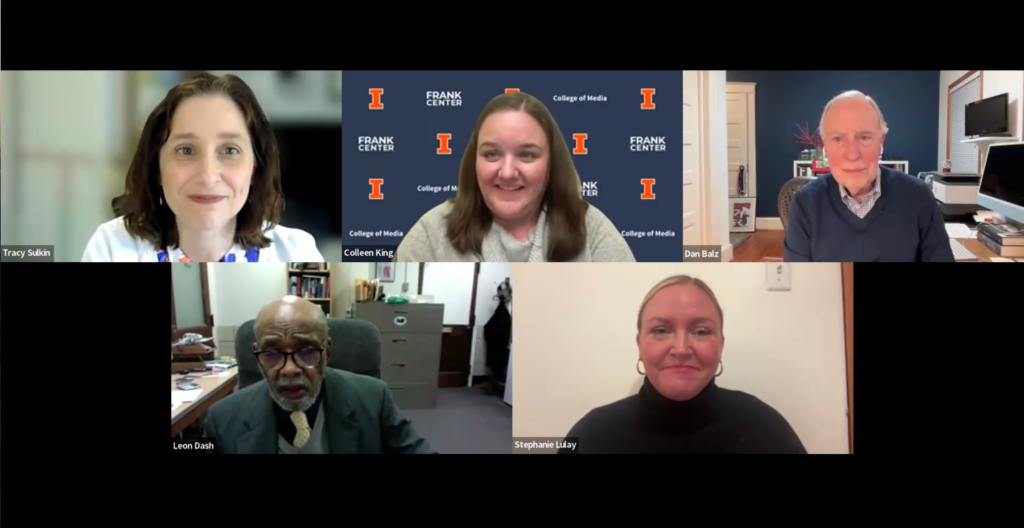
On February 25, 2025, the Suburban Illini Club hosted the College of Media for “Engaging in a Divided Society: Lessons from Journalism,” a panel discussion on how to engage with others in an age of polarization.
Leon Dash,Professor and Swanlund Chair, Department of Journalism; 1995 Pulitzer Prize Winner for Explanatory Reporting while at The Washington Post
Colleen King,Clinical Assistant Professor, Department of Journalism; Director of the Richard and Leslie Frank Center for Leadership and Innovation in Media; former Executive Producer for MSNBC’s The 11th Hour with Brian Williams
Dan Balz(BS ’68, MS ’72, journalism), Chief Correspondent at The Washington Postcovering national politics, the presidency and Congress
Stephanie Lulay(BS ’08, journalism), Executive Editor and Co-Founder, Block Club Chicago, an award-winning, reader-funded nonprofit newsroom focused on Chicago’s neighborhoods
Read excerpts from “Engaging in a Divided Society” below. Note: Answers have been condensed for length and clarity.
Sulkin: It strikes me that a threshold that we discuss a lot is the lines between news versus commentary. And many see the lines between those two as becoming increasingly blurred. I wonder what your thoughts are about the extent to which that seems a useful theoretical divide, and then what the consequences are of the blurring of those lines.
Dash: News columns are very clear that they are news columns, and I try to point that out to the students, in terms of understanding what a news column is. An opinion column is very, very different from a news column, in which you have a lot of leeway to express your opinion. I think social media has blurred the lines between what is considered news and what is considered an opinion. But I think the conventional publications have continued to distinguish between the two and keep them separated.
Lulay: I think Twitter/X and TikTok are full of opinions. We’re in a period where newsrooms are rapidly disappearing and we’re in an era that the world really needs more truth tellers. Something I’ve seen, engaging with readers for a long time, is that readers on the whole really aren’t able to distinguish between news-driven reporting and opinions on the Op-Ed page, and I think that that damages trust.
Balz: One of the things we’ve noticed is that commentary and opinion writing draws a huge audience. And we know that because of the siloed nature of how people get their news, that people seek out opinion journalism that conforms with their points of view. And in the in the digital age, particularly when you’re looking at a homepage for—whether it’s the Washington Post or the New York Times or the Wall Street Journal—the commentary pieces are right there smack next to the news pieces. In a printed paper, the opinion pages are in a separate place. They’re clearly marked. But in a sense the, the presentation has helped to blur the lines.
Sulkin: We’ve been talking about the public’s trust in the news and looking at polling about what people think about the media. There’s been a slow decline in trust in all sorts of institutions over the past several decades, with the news media being part of that. Pew reports that over three-quarters of Americans and majorities from both political parties think that news organizations tend to favor one side or the other. Yet large majorities also say that news coverage keeps politicians from doing things that they shouldn’t. So that scrutiny, that watchdog role, still holds. What are your views about what would help the public to regain trust, if we think it’s been lost, or where could we build on some of those pockets of trust?
Lulay: I’m really happy to be in a local newsroom these days. I think we can make a real impact in terms of trust. Trust is built from the ground up and there’s no better place to build relationships with readers than in a local newsroom. Rebuilding trust in our city is key to why Block Club was founded.
When we started this newsroom, there was a study that trust, particularly on the South and West sides of our city—these are under-resourced areas of our city—trust was at an all-time low with the media. And that was because of generations of the media either only reporting on crime or chaos that happened in those neighborhoods, if they ever showed up at all. At Block Club, instead of covering a traditional beat like courts and education in such a big city where there’s too much going on, our reporters are assigned to two to three contiguous neighborhoods. And when they’re covering a smaller area like that, they really are able to build close relationships with readers, which we believe ensures the news that we’re reporting not only reflects what they most care about, but also leads to a more accurate portrayal of their neighborhood.
King: I would say it’s very tricky because the skills that we teach our students to cover Chicago and maybe go work for Stephanie [Lulay] are not different than skills I would teach up-and-coming reporters to go work with Dan [Balz]. I think people are turning off the news in large part because it always seems like bad news right now. So perhaps we can be more creative in our angles, but I also think transparency is a big part of reporting. And being honest in what we know and what we don’t is a big part of it, too. You know, it is our job to hold people accountable; that’s why we do what we do. Hopefully over the course of time, people can see that our reporting holds up and is fact-based and we’re just trying to report the truth as best we know it.
Balz: Repairing the decline in trust is a very difficult job that we can’t do in and of ourselves as news organizations. What’s happened in terms of the decline of trust is a societal-wide problem. Just as the polarization of the country is a societal-wide problem. And it will take time to begin to overcome that. We have a role to play in that. There are things we can do about that. Colleen [King] is exactly right. Transparency is important. The idea of being open about what we know and what we don’t know is important. But we also have to do what we’ve always done, which is to be aggressive in our reporting and follow that wherever it leads us and live with the consequences of that. Our first obligation is to find the truth to the best that we can find it on any day or week.
Sulkin: We had Chuck Todd visit the College of Media in December right before he announced that he would be departing NBC News after a long career there. I think a narrative thread he was pulling was that local news is the cure to what ails the news ecosystem. I think part of the argument was that maybe if folks have the opportunity to engage with local news, that helps with some spillover to how they think about national news. But the growing news deserts mean a lot of folks don’t have local news.As we are preparing students and launching them out into their careers, Colleen and Leon, what are we doing to correct some of these news desert issues?
Dash: My emphasis with my students is fact-based reporting. It’s a no-no in my classes when they say, ‘I assume’ or ‘I think.’ I say you shouldn’t be ‘assuming’ and you shouldn’t be ‘thinking’ anything. You should know. If you don’t know, you should say you don’t know. And transparency is a big part of that. Being honest and upfront. I don’t even know how you overcome this divide in this society today. But in terms of conventional journalism, fact-based reporting is very, very important and transparency is also very important.
King: And I would say we’re training our student journalists to learn all kinds of skills. Our students are leaving our universityknowing how to podcast and write, do audio and video journalism, and write online or for print news outlets. So they could really drop in anywhere and cover any community they want to. While we’ve got many who want to return home to the Chicagoland area, or make it big in New York or LA or Washington, we do encourage them to think about covering smaller communities— at least getting a start there—and understanding what it’s like to cover a community where you do get to know your audience and the people you’re covering and in government as well.


 Gregory Hall lower level corridor before renovations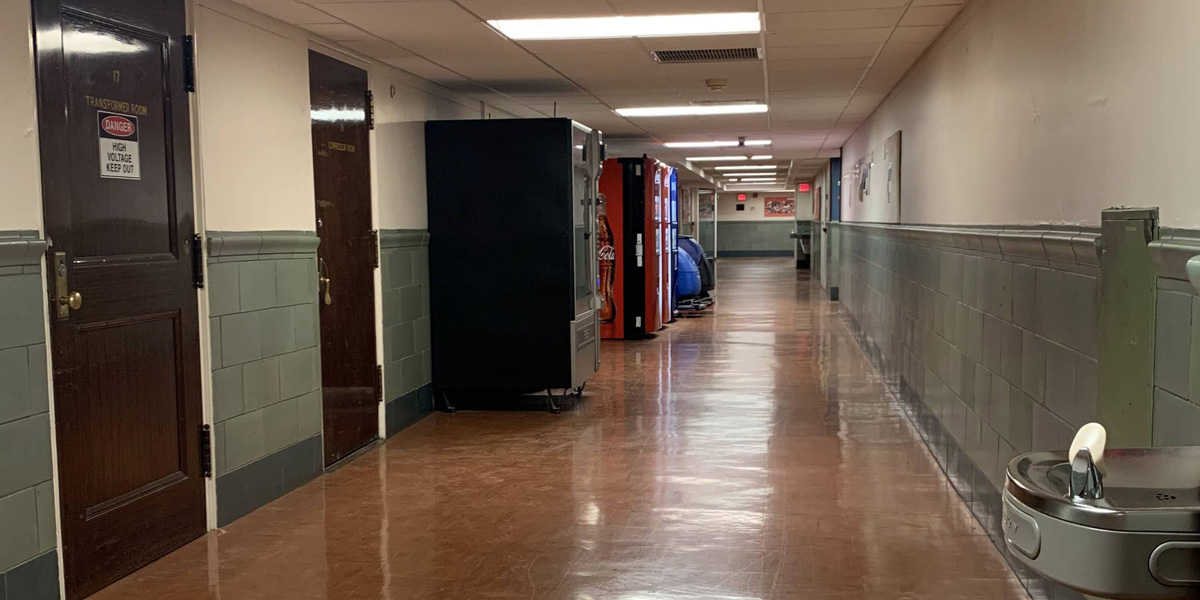
 Painting primer in the hallways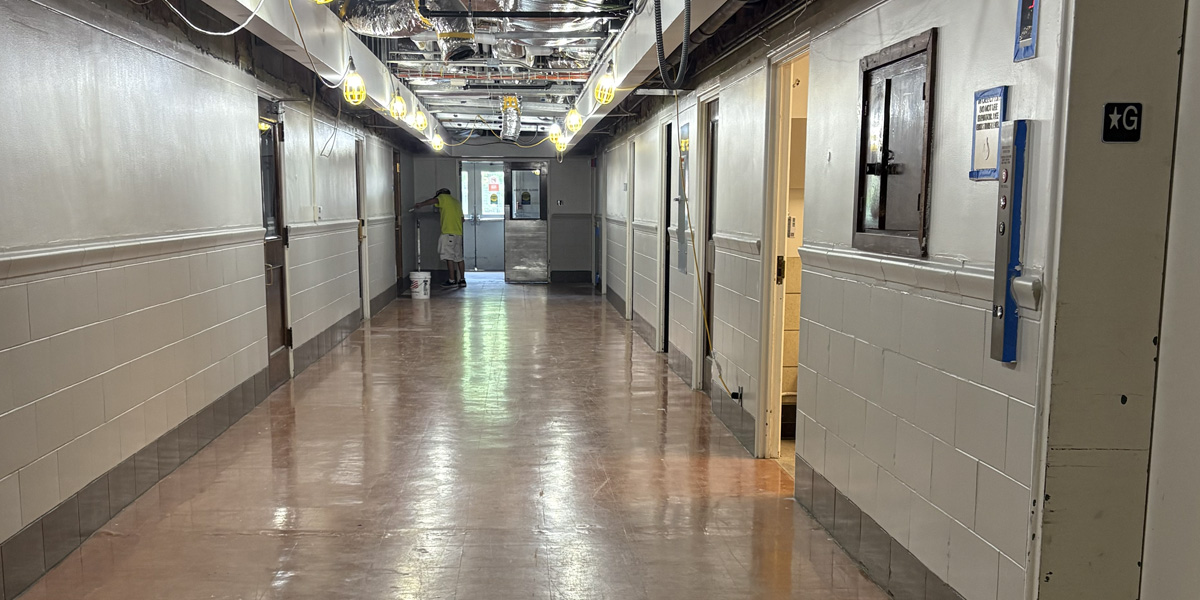
 Gregory Hall Rooms 1, 2, and 3 before renovation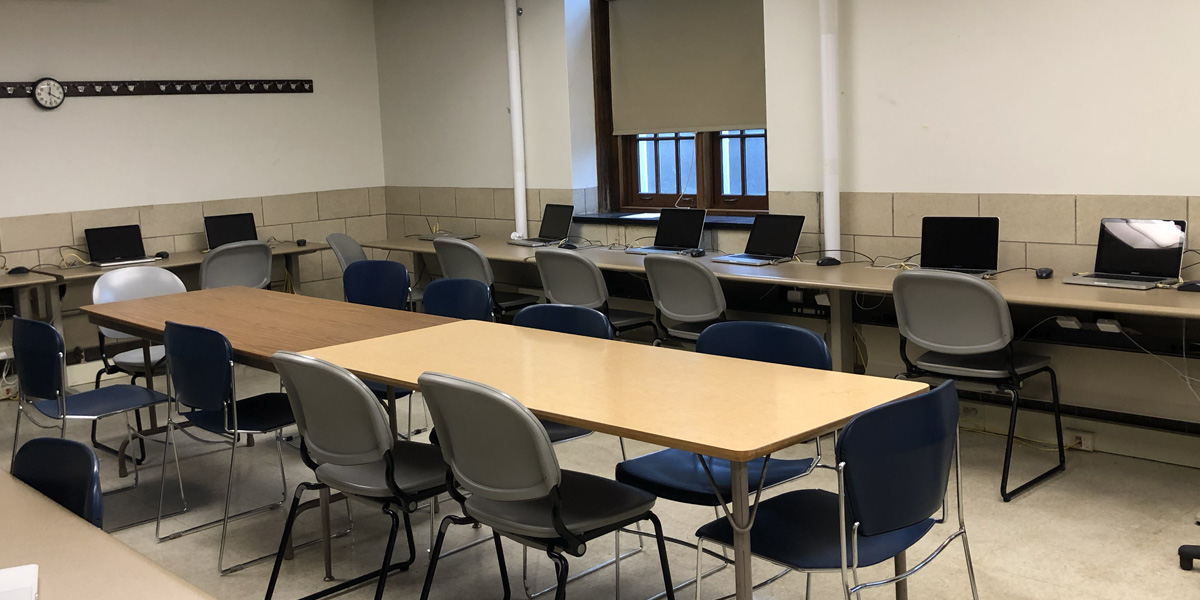
 Gregory Hall Room 1 after demo