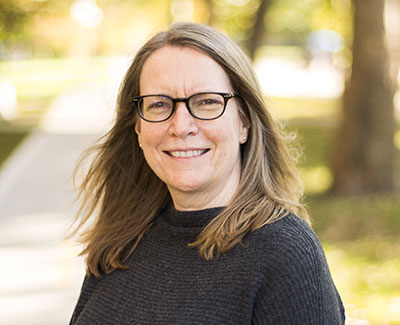
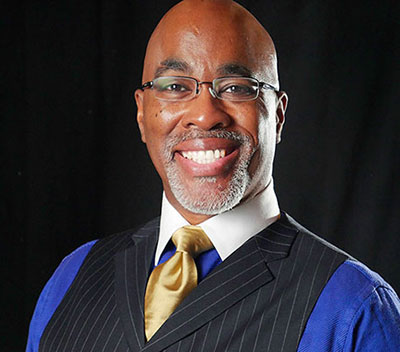
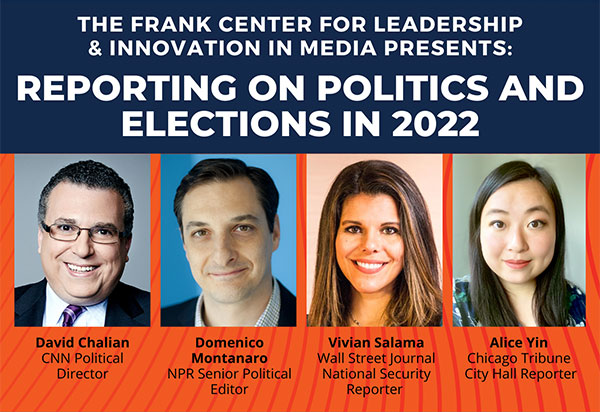
The Richard and Leslie Frank Center for Leadership and Innovation in Media at the University of Illinois Urbana-Champaign will host four of the country’s top political journalists—David Chalian from CNN, Domenico Montanaro from NPR, Vivian Salama from the Wall Street Journal, and Alice Yin from the Chicago Tribune—for a panel discussion on what it’s like to cover politics and elections in 2022.
Titled “Reporting on Politics and Elections in 2022,” the panel will be held Thursday, Oct. 13, from 6-7 p.m., in the Knight Auditorium of Spurlock Museum, 600 S. Gregory, Urbana.
Vivian Salama, Wall Street Journal National Security Reporter
Alice Yin, Chicago Tribune City Hall Reporter
Moderator: Colleen King, Frank Center for Leadership and Innovation in Media Director and Clinical Assistant Professor of Journalism
The panelists will weigh in on the upcoming midterm elections and potential national outcomes, from the fate of President Joe Biden to the control of Congress, and more. Audience questions will be welcomed toward the end of the hour or may be submitted through the Zoom registration form.
David Chalian is CNN’s vice president of political coverage and political director. In his role, Chalian oversees CNN’s daily political coverage across all platforms, the polling and decision desk operations, and helps guide the editorial content for the network’s special event political programming.
Domenico Montanaro is NPR’s senior political editor/correspondent. Based in Washington, D.C., his work appears on air and online delivering analysis of the political climate in Washington and campaigns.
Vivian Salama covers national security for the Wall Street Journal, based in Washington. She has covered U.S. foreign policy and national security issues for nearly two decades, reporting from more than 75 countries. Most recently, she has reported extensively from Ukraine.
Alice Yin is a reporter for the Chicago Tribune’s metro desk, responsible for covering the ins and outs of Cook County government and the Obama Presidential Center.
For more information, please contact Colleen King, director of the Frank Center for Leadership and Innovation in Media and clinical assistant professor of journalism, at cck@illinois.edu.
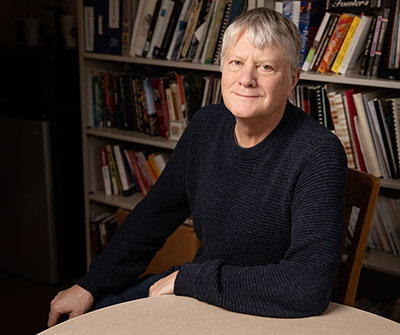
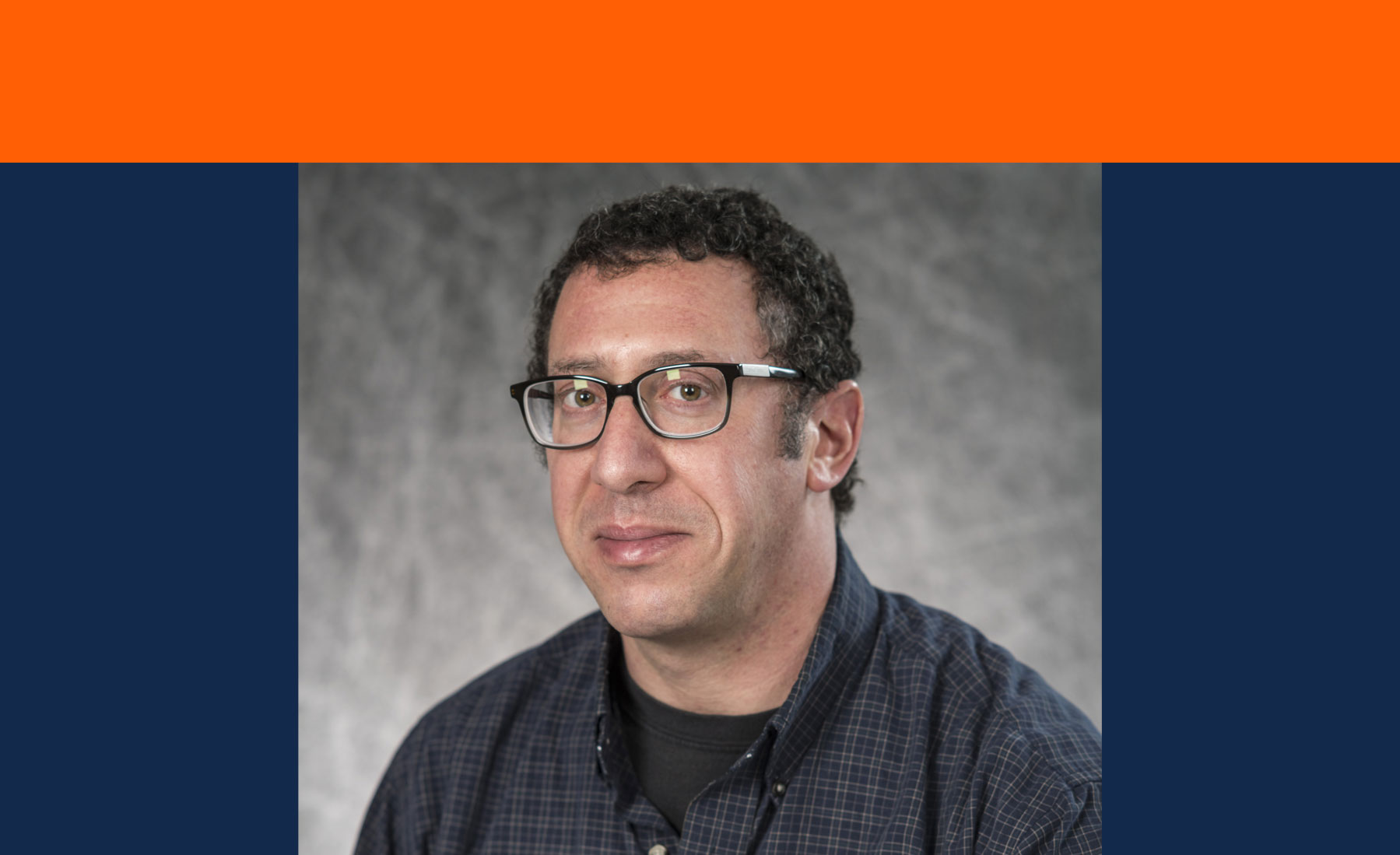
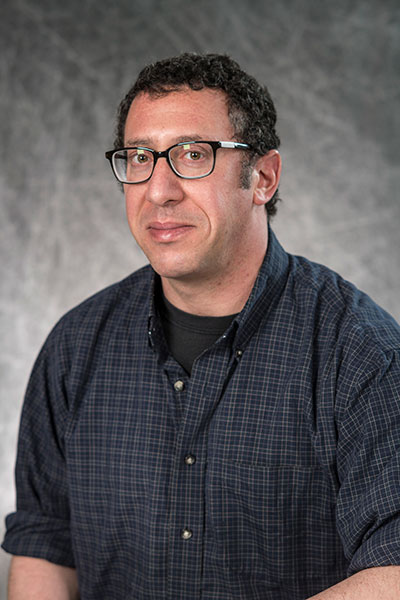
Josh Heuman, a teaching assistant professor in the Department of Media & Cinema Studies and the Department of Journalism, has been appointed by College of Media Dean Tracy Sulkin as a Dean’s Fellow for the coming academic year. Heuman will work with department and college leadership teams to facilitate activities around the college’s 2022-2023 annual theme of media literacy.
The idea for an annual theme emerged from the College of Media strategic planning process in 2020. Each year, college faculty and students brainstorm about possible themes and then vote to select among them. Last year, the inaugural theme focused on social justice.
“This is a critically important time to be examining media literacy,” said Dean Tracy Sulkin. “We’re excited to bring together perspectives from advertising, journalism, and media and cinema studies through class projects, college events, and public engagement. I’m very pleased to have Professor Heuman join our leadership team this year to support these initiatives.”
Heuman sees the theme as particularly timely. As the pandemic has increased our time spent online, there are concerns about how to be an informed citizen amidst the spread of misinformation.
“We are at a moment where the ways that we engage with media have qualitatively changed,” he said. “It’s hard not to peek out into the scary world outside and see lots of ways that [media literacy] is very relevant, whether we’re talking about the field of politics or social media, and [the effect it has on] young people.”
As part of his duties, Heuman will engage with IMEDIA, a joint collaboration between faculty in the College of Media and College of Education that is helping Illinois public school educators learn how to teach media literacy to students and hosted a media literacy workshop this summer.
“I think it’s a really exciting time to think about these questions, maybe at a more abstract level, but also to recognize and engage with the people who are putting these ideas on the ground, in schools across the state and other states, too,” he said.
Heuman’s own research explores media industries and regulation, especially in television, with an emphasis on the regulation of media work. He’s also interested in the evolution of the television writers’ room—the place where stories are first introduced.
“What kind of an environment is this, in which the stories that we see on the screen come to be formed and come to be shaped?” Heuman asked. “We have a sense of struggles and tensions and what’s at stake in the stories that we end up seeing on screen.”
As media literacy events are announced, Heuman invites faculty, students, and alumni, within the college and beyond, to engage in the conversations.
The Institute of Communications Research is excited to announce our newest cohort! Please learn more about the students’ research interests in their profiles below and join us in welcoming them to the University of Illinois College of Media community this fall.
Jiyeon Chang received her master’s degree in communication and media and bachelor’s degrees in journalism and advertising & PR at Ewha Womans University, Seoul. Jiyeon studies the psychological and societal impacts of using new media. Her newest research focuses primarily on personal traits that determine psychological well-being and improvement in work skills in the virtual work environment. As a new student in ICR, she is interested in understanding collective actions and homophily in online and social media. She also wants to examine senior citizens’ new media usage to minimize information gaps and social disparities. Before joining ICR, Jiyeon worked in a government-funded research institute in South Korea. She has contributed to policy developments in the broadcasting and media fields in line with technological developments and changes in the media environment.
Jennifer Cintron received her bachelor’s degree in English literature with a minor in film studies from North Central College. She then completed a master’s degree at Northern Illinois University, in English with a concentration in film and literature. Her research across these degrees has focused on adaption from the written to visual, emphasizing youth culture and social media. At a past conference, she has spoken on the choice of adaptation literature in youth media, as it affects ongoing conversations of cultural and historical awareness. With her new work at the ICR, she hopes to continue this path and research these ongoing changes that can be seen in the film medium.
Namita Gupta graduated from Lady Shri Ram College for Women, University of Delhi, receiving her bachelor’s in English, and she attained her master’s degree in English from Shiv Nadar University (India). Her research lies at the intersection of print and digital public sphere, where she aims to study the impact of new technologies on social and political discourse in visual and popular culture. Particularly, she is interested in examining how contesting notions of nationalism, collective memory, and belonging are interpreted in mass media texts. Before joining ICR as a PhD student, she worked as a researcher with Indian Institute of Management-Ahmedabad, participating in various projects on gender, politics of space, and trolling. She has also held several teaching assistantships and editorial positions.
Ruochong (Alice) Ji received her bachelor’s degree in psychology and economics at the University of Chicago. Her bachelor’s thesis in psychology “Ramifications of social inclusion: Does social inclusion affect people’s adoption and internalization of harm-doing group normative behavior?” examined whether profile likes by group members on social media affected subsequent learning and internalization of aggressive behaviors displayed by other group members. Prior to joining ICR, she also worked as a research assistant at the University of Chicago Booth School of Business. Her primary research interest is in media psychology. Specifically, she is interested in the reception of health messages and scientific/political communication on social media, the effects of social media in promoting policy and social change, and influencer (real or virtual) marketing.
Jiwon Oh’s research interests intersect digital culture, technology, and identity. Drawing upon both qualitative and computational methods, she would like to study how gendered and racialized boundaries are created, enforced, and protected within digital spaces, particularly regarding how Asian-American communities navigate pandemic-era identity politics online. Jiwon holds an MA in communication from Seoul National University, where she studied cringe culture, fandoms, and Korean popular culture. She has also conducted research with industry giants like Netflix and HYBE. She graduated magna cum laude from New York University, receiving a BS with honors in media, culture, and communication.
“The College of Media is eager to celebrate Roger Ebert’s legacy through this new center that will engage scholars, students, and movie fans alike in robust conversations about film,” said Dean Tracy Sulkin. “I look forward to the energy and insight that Professor Turnock will bring to the director role.”
“I’m excited to help the center bring both more awareness of cinema and cinema studies to the campus, as well as the opportunity to bring more film-centered programming,” Turnock said.
As part of her appointment, Turnock will coordinate event programming, including the Ebert Symposium, Ebert Lecture, and a screening series; Ebert research grants and travel grants for film studies; and the Ebert Fellows Program for undergraduate students.
The first event Turnock is planning is the annual Ebert Lecture for mid-fall, which will feature a scholar of film studies.
“We will invite a prominent speaker and hopefully also have a screening, both of which will be open to the public,” she said.
Turnock’s research focuses on film, with an emphasis on special/visual effects, and she coordinates the film studies curriculum.
“I never met Roger Ebert, but like many people around my age, I watched the TV program Siskel and Ebert at the Movies religiously every week,” Turnock said. “Even though most of the films they reviewed weren’t playing in my northern Indiana town, it was an exposure to a wide variety of movies that I might eventually be able to rent at the video store.”
Turnock served as acting head of the Department of Media & Cinema Studies during academic year 2019-2020. At the 2019 Chaz & Roger Ebert Symposium, she moderated a panel discussion on diversity in film. She is the author of The Empire of Effects: Industrial Light and Magic and the Rendering of Realism (University of Texas Press, 2022) and Plastic Reality: Special Effects, Technology, and the Emergence of 1970s Blockbuster Aesthetics (Columbia University Press, 2015).
The Institute of Communications Research congratulates the degree candidates for a Doctor of Philosophy Degree in communications and media! For 2021-2022, the degree candidates, their dissertations, and their advisors are:
Susmita Das
“Speaking the International Language: A Transnational History of the Indian Advertising Industry, 1955-1969” Advisor: Professor Amanda Ciafone
Xiaohan Hu
“Exploring the role of control in digital advertising effectiveness” Advisor: Professor Kevin Wise
Morten Stinus Kristensen
“Discourse, Platforms, and Racialization: Danish Muslims Navigating Hegemonic Danishness on Social Media” Advisor: Professor Angharad Valdivia
Giang Vu Hang Pham
“The Cognitive, Motivational, and Affective Cost of Flow Experiences in Media Use” Advisor: Professor Brittany Duff
Yilin Ren
“How Do Tactile Interactions and Movement Orientations Affect Information Processing of Search Engine Results Pages (SERPS) on Mobile Devices” Advisor: Professor Kevin Wise
Ann Elisabeth Strahle
“Flag Waving Doesn’t Help when the Bullets are Coming Down the Line: Dialectical Tensions of Religious Communication in the National Guard Chaplaincy” Advisor: Professor EmeritusClifford Christians
Yanyun Wang
“Effects of Augmented Reality on Risk Perception of E-cigarettes for Young Adults: From the Perspective of Construal Level Theory” Advisor: Professor Mike Yao
Kerry Bernice Wilson
“Black Moms Matter: Competing Discourses of Black Motherhood in the Age of Black Lives Matter” Advisor: Professor Isabel Molina-Guzmán
The University of Illinois Archives has acquired and is preserving the website of FairWarning.org, a nonprofit investigative news organization founded and edited by Myron Levin. Brant Houston (pictured at right), Knight Chair Professor of Investigative Reporting in the Department of Journalism, helped arrange the archiving of FairWarning’s content.
FairWarning produced and published the work of staff writers and independent journalists, and its archives are being added to a rich collection of communication materials preserved by the University of Illinois Archives.
FairWarning issued watchdog reports with an emphasis on public health, consumer, labor, and environmental issues, and related topics of government and business accountability. Over 11 years of operation (2010-2021), its stories were published on its website and were also co-published by nearly 200 online, print, and broadcast news organizations across the country.
“I am pleased that the wonderful work of FairWarning has found a home at the University Archives,” Houston said. “It will now be a valuable and preserved resource for all journalists, especially investigative reporters. We thank the staff at the archives for all the work they put into this project.”
Levin, the site’s founder, said he was happy to see the work has found a permanent home.
“When we knew that FairWarning would be closing, it was our overriding goal to ensure that our deeply reported stories would be accessible to journalists, researchers, students, and others,” he said. “For that reason, we’re thrilled to know that our watchdog journalism will be preserved in the University of Illinois Library Archives.”
Update 4/13/2022: Comedian and actorGilbert Gottfried was originally scheduled to be one of the headlining guests at Ebertfest, accompanying the documentary Gilbert.Because of Gottfried’s death on April 12, Ebertfest will be dedicating its 22nd annual event in his honor.
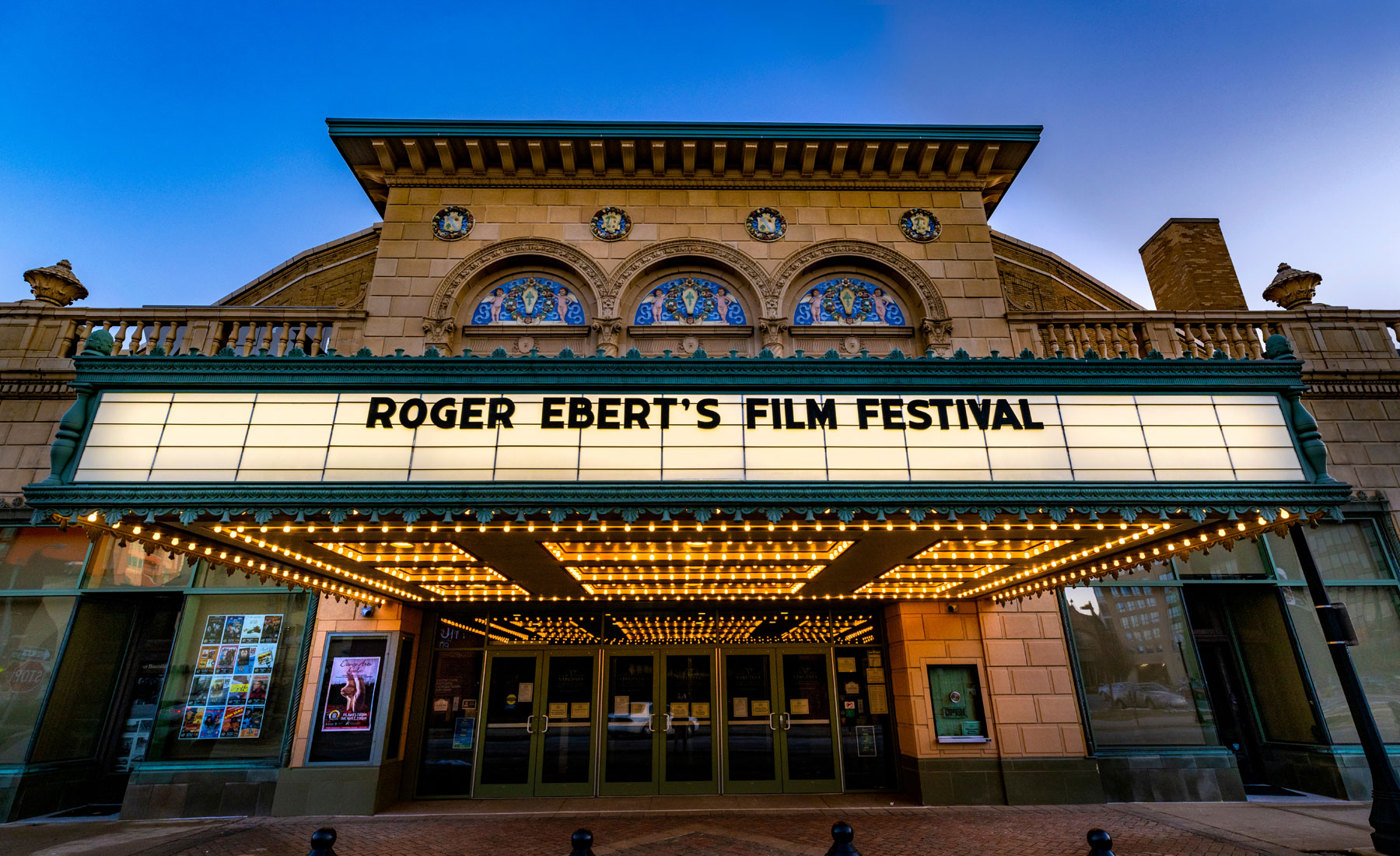
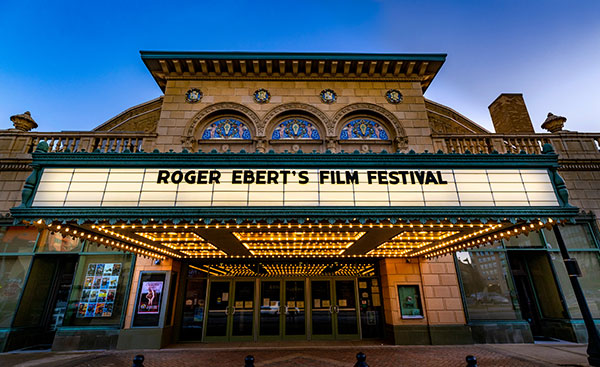
The 22nd Annual Roger Ebert’s Film Festival, co-founded and hosted by Chaz Ebert and also known as Ebertfest, announced additional actors and musicians who will appear as guests, as well as a bonus film, at this year’s festival, to be held April 20-23 at The Virginia Theatre.
Actors Thora Birch and Betsy Sodaro join a large group of filmmakers already announced for this year’s festival.
Acting since age 4, Birch’s credits include iconic roles in movies such as Ghost World, which is featured in this year’s Ebertfest; American Beauty, Now and Then, and Hocus Pocus. Birch has won SAG Awards and multiple Young Artist Awards, and has been nominated for Golden Globe, Emmy, and BAFTA awards.
Sodaro achieved stardom in the 2015 TV series Clipped and in the small screen’s Disjointed from 2017-18, among many other roles in her career. An actor in the Ebertfest film Golden Arm, Sodaro joins other guests from the movie including actor Olivia Stambouliah; writers Ann Marie Allison and Jenna Milly; and producer Brigid Brakefield.
The movie Soy Cubana will be followed by a musical performance from a band of current and former University of Illinois Urbana-Champaign Latin Jazz Combo musicians, featuring guest vocalist Stephanie Woods Machado and musical director Tito Carrillo. The band will perform rhythms inspired by the movie’s Afro-Cuban music.
An additional special guest attending Ebertfest this year is executive producer Chris Kelly. Associated with acclaimed independent films including Jiro Dreams of Sushi, Olive, and Once Upon a Time in Queens, Kelly also is a co-owner of the NBA’s Sacramento Kings. He will moderate the discussion after the screening of the movie Gilbert, about Gilbert Gottfried, which highlights the everyday life of the highly influential and incomparable comedian.
A short movie, Lifeline, and a 13th feature-length film will be included in the schedule this year, instead of panel discussions. The Phantom of the Open tells the remarkable true story of Maurice Flitcroft, a crane operator and optimistic dreamer who, with the support of his family and friends, managed to gain entry to the 1976 British Open qualifier despite never playing a round of golf before.
Passes to see all 13 films cost $200, including all processing fees. Four passes purchased together are $700. Also available are a small number of University of Illinois student passes priced at $150 each. Passes and individual movie tickets–$20 for the general public or $15 for U of I students—may be purchased through the festival website or at the Virginia Theatre box office, 203 W. Park Ave., Champaign, 217-356-9063. Updates will be posted on the festival website.
Roger Ebert’s Film Festival is a special event of Chaz Ebert and the College of Media at the University of Illinois Urbana-Champaign. For additional information, visit http://www.ebertfest.com.
Two faculty from the College of Media have been appointed by Dean Tracy Sulkin to associate dean positions starting August 16.
Announced in January, Stephanie Craft, currently professor and head of the Department of Journalism, will serve as the College of Media’s Associate Dean for Academic Affairs.
Announced in March, Jason P. Chambers, currently associate professor and associate head of the Charles H. Sandage Department of Advertising, and Dean’s Fellow for Diversity and Inclusion, will serve as the College of Media’s inaugural Associate Dean for Diversity, Equity, and Inclusion.
“I am pleased to welcome Professors Chambers and Craft to their important new roles, and I look forward to working closely with them,” Sulkin said. “Their strong administrative skills, commitment to the college and our mission, and consultative approach to decision-making make them both excellent additions to the College of Media leadership team.”
Craft, a scholar of news literacy and journalism ethics, joined the Illinois faculty in 2013. She has taught courses such as History of American Journalism, Introduction to Journalism, and Journalism Ethics & Diversity. She has served as head of the Department of Journalism from August 2018 until January 2022. Last summer, the third edition of her book Principles of American Journalism: An Introduction, coauthored with Charles N. Davis, was published.
“I have appreciated the opportunity to help my department colleagues work toward their goals but am now looking forward to the chance the associate dean role offers to take a broader view of the work we do in the college and how it connects to the rest of campus and beyond,” Craft said.
While on sabbatical this semester, Craft has continued her work to create a news literacy scale, and has been developing a summer media literacy workshop for high school teachers along with other faculty in the College of Media and the College of Education. She has also begun a new research project.
“The new project involves delving into the archives of one of the first major journalistic collaborations, called the Arizona Project,” Craft said. “I’m hoping to get a better sense of how the collaboration worked and how it set the stage (or didn’t) for future large-scale projects involving journalists from competing news organizations.
In her new position, Craft will facilitate college-level promotion and tenure processes; mentor Dean’s Fellows; liaise with campus offices on college participation in strategic initiatives; facilitate policy discussions among unit leadership; and coordinate professional development programming for junior and midcareer faculty; among other responsibilities.
“I am eager to work on the college’s professional education initiatives and think about how we can serve a variety of different kinds of students, both on campus and online,” Craft added.
Chambers joined the Sandage Department of Advertising faculty in 2001 and the Institute of Communications Research faculty in 2003. He is a scholar of advertising history, particularly the contributions of African Americans to the industry. He has taught courses including Classic Campaigns, Advertising History, and Multicultural Advertising.
In his new position, Chambers is excited about working with his colleagues “to drive change and link our faculty, staff, and students to all of the opportunities that diversity provides.”
Over the past several years, the College of Media has prioritized expanding its programming in the area of diversity, equity, and inclusion, and the projects that Chambers facilitated during his two-year term as Dean’s Fellow for Diversity and Inclusion will continue to be part of his portfolio. The Alumni Mentoring Program, which connects students with accomplished alumni to share perspectives and advice, will continue to grow. The pilot focused on Black students and Black alumni, and then expanded to Latinx students and alumni. Chambers will also continue his involvement in the New Voices Internship Program, which provides opportunities for first-generation students and those from underrepresented groups to work with College of Media faculty and staff on communications projects.
He will also work with colleagues across the college and on campus to coordinate workshops on diversity, equity, inclusion, and anti-racism that are relevant to Media faculty, students, and staff, and will seek ways to further the college’s capacity in this area.
“Leadership at the department, college, and campus levels have put real resources behind diversity initiatives,” Chambers said. “I want to ensure that the College of Media continues to take advantage of all the grants and other funding sources that the campus is making available for diversity-related topics.”
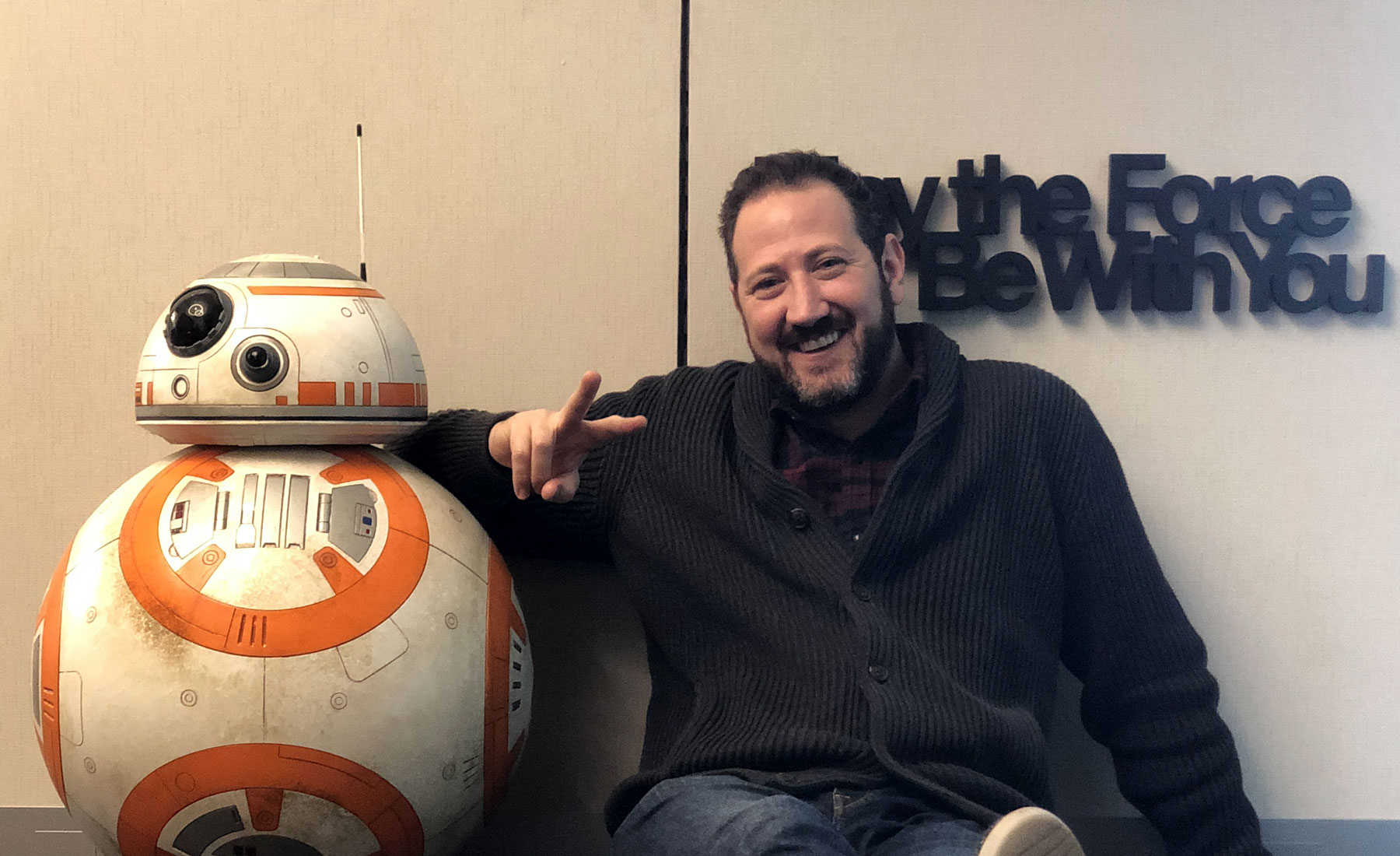
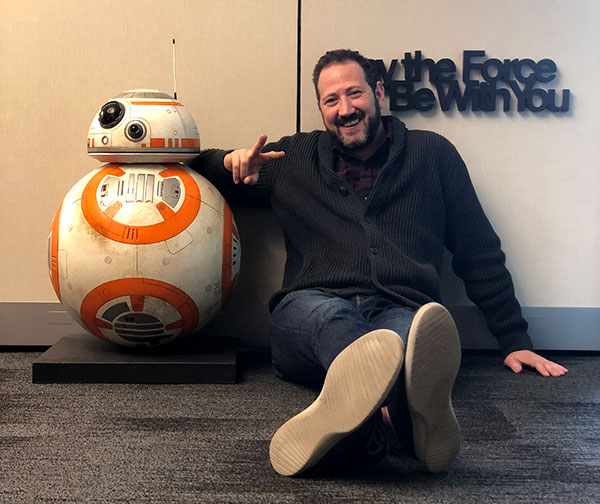
Alumnus Stephen Feder with BB-8 in the Lucasfilm Offices at the Walt Disney Studios.
Stephen Feder (BS ’02, media studies) believes that with a little persistence and dedication to the things they love to learn about, students can accomplish anything.
“I think if people can harness that, there’s no telling how far they can go,” he said.
Feder, a film and television producer at T-Street Productions, will be this year’s alumni speaker for the College of Media Convocation. Because previous ceremonies had been postponed due to the pandemic, the May 2022 convocation will honor graduates from Fall 2019 through Spring 2022.
Looking back at his time at the University of Illinois, Feder said he learned a lot about himself both personally and professionally.
“Illinois gave me such incredible opportunities, not just inside the classroom, but outside the classroom,” he said. “That helped shape me as a human and taught me a lot about what my limitations were and the things that I needed to work on.”
He is driven by the people who have helped him get to where he is, especially past professors at the College of Media.
“I think it’s really important to pay homage to how you got somewhere. Understand that it’s because of your own drive, but also because people are willing to help you,” Feder said.
Feder’s love of movies was “cultivated at [the College of Media] just by proximity to the idea of Roger Ebert.” When he was a student, Feder met Ebert, a Pulitzer Prize-winning film critic and Illinois journalism alum who created Roger Ebert’s Film Festival, known as “Ebertfest.” During Ebertfest, Feder had the chance to have lunch with Ebert.
“Our conversation and just his presence, interest, and care in us as students gave us a boost in confidence that our goals were well within our reach,” Feder said. “He probably never understood the impact he had on all of us—but his passion for movies, his intellect, and his success always was a driving force of motivation for me. I miss him.”
About a decade later, Feder’s documentary Kumaré was screened at Ebertfest 2013. Feder was executive producer for the film, featuring a man who impersonates an Indian guru and builds a following. “Kumare seems to establish that a guru can be a complete fraud and nevertheless do a certain amount of good,” Ebert wrote, “because what matters is not the sincerity of the guru but that of his followers.”
Feder said it was a full-circle moment and meant everything to him.
“The fact that he selected it to be part of Ebertfest among the last group of movies he handpicked before passing away is an honor I’ll never forget,” Feder said.
Feder at Annapurna Pictures.
It was his work on Kumaré, which received a SXSW Audience Award, that led to Feder’s time at Annapurna Studios. As senior vice president of production and development, Feder worked on films such as Everybody Wants Some!!, which was also an Ebertfest selection,as well as Where’d You Go, Bernadette, bothdirected by Richard Linklater; Spring Breakers, directed by Harmony Korine; and The Grandmaster, directed by Wong Kar-Wai.
“I had always been inclined to want to tell stories that had a broad reach,” Feder said. Growing up, he was inspired by movies like Back to the Future, Raiders of the Lost Ark, and Star Wars—movies that he shares with his kids.
Feder eventually got the chance to work on Star Wars, describing the feeling of walking onto set “a life-affirming moment.”
“It was a reminder of the power of one’s imagination—and how if you could dream it, you could make it a reality,” he said. “I never wanted to hear the word ‘cut’ and still don’t.”
He became vice president of film development at Lucasfilm in 2016, working on Solo: A Star Wars Story and other projects. He served as the Lucasfilm production executive on location/set for filming, and was a member of the Lucasfilm Story Group, which keeps track of the Star Wars canon to assist writers and directors in the development of new stories.
Feder is currently a producer at Rian Johnson and Ram Bergman’s T-Street Productions, responsible for the film Knives Out. He works with his producing partner, Kiri Hart, to help amplify artistic voices.
Feder said the professional relationships that have helped him throughout his career inspires him to pay it forward to the next generation of filmmakers. He has been a panelist at the college’s Media Career Nights to share advice on working in the entertainment industry.
“I’m only here by the grace of other people believing [in me] and I also have to be willing to do the same for others,” he said.
Above all, he recognizes that the industry and the world is forever changed because of the COVID-19 pandemic.
As streaming makes content more accessible, Feder considered the next challenge that the media industry needs to address.
“We as filmmakers have to be malleable; we can’t firmly entrench ourselves in the past,” Feder said. “We have to think about how we’re going to reach a future generation of moviegoers, and TV goers, and content consumers. It’s our responsibility to innovate ways both to tell stories and also to make them feel new.”
Feder also hopes he can provide some comfort to Media students who are feeling unsure about their futures.
“If you have been able to get through what you’ve done the last few years and come out of it, I think that there’s a lot of promise ahead,” Feder said.
Challenges can be seen as opportunities, he said.
“I understand the world is really scary at the moment and challenging, but it needs us. It needs us to make changes,” Feder said.
The 22nd annual Roger Ebert’s Film Festival, co-founded and hosted by Chaz Ebert and also known as “Ebertfest,” has announced its full slate of films for the April 20-23 event. The list announced today includes an appearance by comedian Gilbert Gottfried to discuss his film Gilbert; another movie that introduces us to women arm-wrestlers; and an appearance by a pair of filmmakers to discuss the topic of identity.
The festival also announced the itinerary for opening night.
With Oscar-winning directors, comedians, and musicians, augmented by many independent movie gems, this year’s lineup takes the festival back to the roots established by late co-founder Roger Ebert, an Urbana native and University of Illinois Urbana-Champaign journalism alumnus who gained a wide following as a film critic until his death in 2013.
“We will present films that will make you laugh, and make you cry, and some filled with so much music you will want to dance,” Chaz Ebert said. “But, most of all, we will enjoy being back together, in person, to celebrate cinema in a joyous way on the big screen as a community.”
The festival had previously announced Oscar-winning or nominated films and directors like Guillermo del Toro (Nightmare Alley in black and white), Ramin Bahrani (The White Tiger), Terry Zwigoff (Ghost World), Azazel Jacobs (French Exit), and the late Alfred Hitchcock (The 39 Steps). Ebertfest is adding other films that did not get the audiences they deserved because the theaters were closed during the pandemic.
“Some of the small theaters that showed independent and art movies, including the Art Theater in Champaign, which was one of Roger’s favorite cinemas, will never open again,” Chaz Ebert said. “So, we have carefully curated a selection of independent films, especially chosen for our Ebertfest family of movie lovers, to come to our big screen at the beautifully renovated movie palace, the Virginia Theatre.”
The “overlooked” films of this year’s Ebertfest include Gottfried’s appearance to discuss his film, which gives an intimate look behind the scenes in the life of a comedian. The festival also will welcome Krisha Fairchild to discuss her movie Krisha, which is about life, alcoholism, and recovery, but mostly about family. Golden Arm is a movie that brings a slice of life, both comic and dramatic, from a world not many know about—women arm wrestlers. The festival will award many of Golden Arms cast and crew the coveted Golden Thumb. Ebertfest will also discuss the nature of identity with Jason Delane Lee and Yvonne Huff Lee after the paired showing of their short film Lifeline and a second film that they executive-produced, the BAFTA-nominated and Spirit Awards-winning film Passing, directed by Rebecca Hall.
The opening night fare will include diverse voices starting with alt-country artist Clem Snide performing the song “Roger Ebert.” Also slated for April 20 is the Oscar-winning documentary Summer of Soul, followed by acclaimed jazz and torch singer Tammy McCann performing with Champaign’s own Aplustrodamus and Ther’Up.Y (pronounced “Therapy”). The band’s leader emphasizes the therapeutic nature music has for us, especially in these perilous times.
Other scheduled musically related films and events include Soy Cubana, by Jeremy and Robin Ungar, about the “Vocal Vidas”—Cuban singers considered national treasures.
Renee Baker and her 10-piece orchestra will be back by popular demand to accompany and interpret the silent film Siren of the Tropics. The film stars the late Josephine Baker, who in 2021 made history, 46 years after her death, by becoming the first American—and the first Black woman—inducted into the Pantheon in Paris, which is a monument reserved for French national heroes. Born in St. Louis, Baker became a French citizen in 1937. She is buried in Monaco. Previous inductees include Voltaire, Victor Hugo, and Marie Curie. Her induction ceremony was presided over by French President Emmanuel Macron.
Ebertfest has taken extra precautions, going beyond local measures to make audiences feel comfortable. The festival is introducing reserved ticketing for the first time to reduce capacity and provide ample spacing between groups. And the Virginia Theatre has installed a new state-of-the-art ventilation system.
The festival will announce additional filmmaker guests in the coming weeks.
Ebertfest will be held at the Virginia Theatre in downtown Champaign, with related talks and panel discussions at the Hyatt Place in Champaign and at the University of Illinois Urbana-Champaign.
Passes are available for $200, including all processing fees. Four passes purchased together are $700. Also available are a small number of University of Illinois student passes priced at $150 each. Individual movie tickets will be available April 1 at $20 for the general public or $15 for University of Illinois students. Passes and tickets may be purchased through the festival website or at the Virginia Theatre box office, 203 W. Park Ave., Champaign, 217-356-9063. Updates will be posted on the festival website. Depending on available seating, tickets for individual movies may be available April 1.
Roger Ebert’s Film Festival is a special event of Chaz Ebert and the College of Media at the University of Illinois Urbana-Champaign. For additional information, visit http://www.ebertfest.com.
Editor’s note: Anyone interested in supporting the event as a festival sponsor may contact Andy Hall, the festival’s project coordinator, at amhall2@illinois.edu.

 Josh Heuman,
 Jiyeon Chang received her master’s degree in communication and media and bachelor’s degrees in journalism and advertising & PR at Ewha Womans University, Seoul. Jiyeon studies the psychological and societal impacts of using new media. Her newest research focuses primarily on personal traits that determine psychological well-being and improvement in work skills in the virtual work environment. As a new student in ICR, she is interested in understanding collective actions and homophily in online and social media. She also wants to examine senior citizens’ new media usage to minimize information gaps and social disparities. Before joining ICR, Jiyeon worked in a government-funded research institute in South Korea. She has contributed to policy developments in the broadcasting and media fields in line with technological developments and changes in the media environment.
 Jennifer Cintron received her bachelor’s degree in English literature with a minor in film studies from North Central College. She then completed a master’s degree at Northern Illinois University, in English with a concentration in film and literature. Her research across these degrees has focused on adaption from the written to visual, emphasizing youth culture and social media. At a past conference, she has spoken on the choice of adaptation literature in youth media, as it affects ongoing conversations of cultural and historical awareness. With her new work at the ICR, she hopes to continue this path and research these ongoing changes that can be seen in the film medium.
  Namita Gupta graduated from Lady Shri Ram College for Women, University of Delhi, receiving her bachelor’s in English, and she attained her master’s degree in English from Shiv Nadar University (India). Her research lies at the intersection of print and digital public sphere, where she aims to study the impact of new technologies on social and political discourse in visual and popular culture. Particularly, she is interested in examining how contesting notions of nationalism, collective memory, and belonging are interpreted in mass media texts. Before joining ICR as a PhD student, she worked as a researcher with Indian Institute of Management-Ahmedabad, participating in various projects on gender, politics of space, and trolling. She has also held several teaching assistantships and editorial positions.
 Ruochong (Alice) Ji received her bachelor’s degree in psychology and economics at the University of Chicago. Her bachelor’s thesis in psychology “Ramifications of social inclusion: Does social inclusion affect people’s adoption and internalization of harm-doing group normative behavior?” examined whether profile likes by group members on social media affected subsequent learning and internalization of aggressive behaviors displayed by other group members. Prior to joining ICR, she also worked as a research assistant at the University of Chicago Booth School of Business. Her primary research interest is in media psychology. Specifically, she is interested in the reception of health messages and scientific/political communication on social media, the effects of social media in promoting policy and social change, and influencer (real or virtual) marketing.
 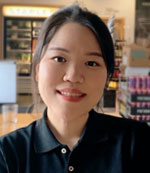 Jiwon Oh’s research interests intersect digital culture, technology, and identity. Drawing upon both qualitative and computational methods, she would like to study how gendered and racialized boundaries are created, enforced, and protected within digital spaces, particularly regarding how Asian-American communities navigate pandemic-era identity politics online. Jiwon holds an MA in communication from Seoul National University, where she studied cringe culture, fandoms, and Korean popular culture. She has also conducted research with industry giants like Netflix and HYBE. She graduated magna cum laude from New York University, receiving a BS with honors in media, culture, and communication.